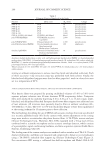
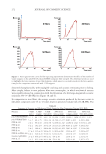
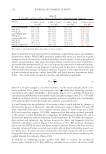
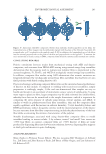
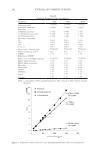
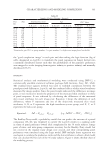
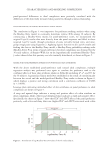
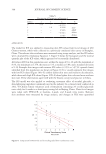
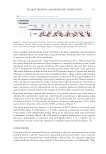
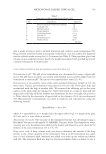
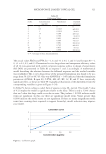
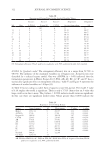
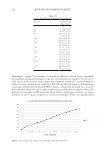
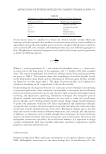
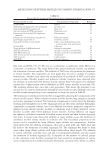
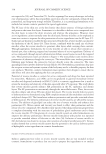
326 JOURNAL OF COSMETIC SCIENCE Furthermore, carbopol 934 develops a network by forming junction zones, responsible for providing mechanical strength to the gel. Gel viscosity was found to be less up to some extent, in the presence of the drug, which might be considered a reason behind the reduced viscosity showed by the control gel. The safe and effective improvised formulation containing benzoyl peroxide–loaded PLGA topical carbopol gel provided new ways for well-controlled and novel topical application in the treatment of acne vulgaris. Hence the developed micosponge loaded topical gel drug delivery technology may lead to a better treatment in acne vulgaris compared to conventional therapies. Thus, microsponge-based Table VII In Vitro Drug Release of Microsponge Loaded Gel Time (h) F1 (Percentage drug release) 0 0 15 5.25 ± 0.061 30 8.22 ± 0.14 45 10.11 ± 0.18 1 13.23 ± 0.39 1.30 16.49 ± 0.48 2 18.41 ± 0.24 2.30 21.24 ± 0.58 3 24.52 ± 0.16 3.30 27.19 ± 0.10 4 30.25 ± 0.75 4.30 33.19 ± 0.43 5 36.52 ± 0.84 5.30 39.72 ± 0.12 6 41.66 ± 0.66 6.30 44.40 ± 0.42 7 46.12 ± 0.48 7.30 48.66 ± 0.92 8 50.12 ± 0.75 IN VITRO DRUG RELEASE FOR MICROSPONGE LOADED GEL 60 55 50 45 40 35 30 25 F1 0 15 30 45 1 1.3 2 2.3 3 3.3 4 4.3 5 5.3 6 6.3 7 7.3 8 TIME IN HOURS Figure 6. Percentage drug release of microsponge loaded gel formulation.

327 Microsponge Loaded Topical Gel drug delivery technology is expected to become a valuable drug delivery matrix substance for various therapeutic applications in the future. REFERENCES (1) D. R. Bickers, H. W. Lim and D. Margolis, The burden of skin diseases: 2004 a joint project of the American academy of dermatology association and the Society for investigative dermatology, J. Am. Acad. Dermatol. 55, 490–500 (2006). (2) A. Bhatia, J. F. Maisonneuve and D. H. Persing, “Propioni bacterium acnes and chronic diseases,” in: The Infectious Etiology of Chronic Diseases: Defining the Relationship, Enhancing the Research, and Mitigating the Effects: Workshop Summary, S. L. Knobler, S. O’Connor, S. M. Lemon, M. Najafi. Eds. (National Academies Press, Washington, DC, 2004), pp 74–80. (3) N Sibinovska, V. Komoni and K. Ancevska-Netkovska, Novel approaches in treatment of Acne vulgaris: Patents related to micro/nanoparticulated carrier systems, Maced. Pharm. Bull. 62(2), 11–24 (2016). (4) N. Jadhav, V. Patel and S. Mungekar, Microsponge delivery system: An updated review, current status and future prospects, J. Sci. Innov. Res. 2, 1097–1110 (2013). (5) S. Deshwal and A. K. Saxena, Microsponge delivery system: An overview, International Journal of Bio- pharmaceutics 5(1), 39–46 (2014). (6) J. Bikowski and J. Q. Del Rosso, Case reports: Benzoyl peroxide microsphere cream as monotherapy and combination treatment of acne, J. Drugs. Dermatol. JDD 7(6), 590–595 (2008). (7) A. Roy, Microsponge as a novel drug carrier system: A review, World Journal of Pharmaceutical Research 4(12), 680–701 (2015). (8) M. Dutil, Benzoyl peroxide: Enhancing antibiotic efficacy in acne management, Skin Therapy Let. 15(10), 5–7 (2010). (9) U.S. Food and Drug Administration, Classification of Benzoyl Peroxide as Safe and Effective and Revision of Labeling to Drug Facts Format, 2010. Topical Acne Drug Products for Over-The- Counter Human Use Final Rule, accessed December 2022, https://www.federalregister.gov/documents/2010/03/04/2010-4424/ classification-of-benzoyl-peroxide-as-safe-and-effective-and-revision-of-labeling-to-drug-facts. (10) M. E. Acevedo, C. Bregni and V. Mourino, Solubility and stability studies of benzoyl peroxide in non- polar, non-comedogenic solvents for use in topical pharmaceutical formulation developments, Lat. Am. J. Pharm. 30(9), 1737–1743 (2011). (11) T. Edwards, L. Cardwell, N. Patel and S. R. Feldman, Benzoyl peroxide gel stains synthetic fabrics less than cotton. J. Am. Acad. Dermatol. 85, 481–482 (2018). (12) R. Wester, R. Patel, S. Natch, J. Leyden, J. Melendres and H. Maibach, Controlled release of benzoyl peroxide from a porous microsphere polymeric system can reduce topical irritancy, J. Am. Acad. Dermatol. 24, 720–726 (1991). (13) M. Simonoska-Crcarevska, A. Dimitrovska and N. Sibinovska, Implementation of quality by design principles in the development of microsponges as drug delivery carriers: Identification and optimization of critical factors using multivariate statistical analyses and design of experiments studies, Int. J. Pharm. 489, 58–72 (2015). (14) R. Ravi and S. K. Senthil, Standardization of process parameters involved erythromycin microsponges by quasi emulsion solvent diffusion method, Int. J. Pharm. Dev. Technol. 3, 28–34 (2013). (15) S. Nacht and M. Katz, “The microsponge: A novel topical programmable delivery system,” in: Topical Drug Delivery Formulations, A. Amann. Ed. (Dekker, New York, 1990), 42, pp. 229–325. (16) J. N. Bollinger, D. Lewis, and V. M. Mendez, Benzoyl peroxide stability in pharmaceutical gel preparations, J. Pharm. Sci. 66(5), 718–722 (1977). (17) M. Jelvehgari, M. R. Siahi-Shadbad, S. Azarmi, G. P. Martin and A. Nokhodchi, The microsponge delivery system of benzoyl peroxide: preparation, characterization and release studies, Int. J. Pharm. 308, 124–132 (2006).
Purchased for the exclusive use of nofirst nolast (unknown)
From: SCC Media Library & Resource Center (library.scconline.org)