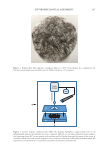
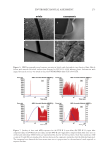
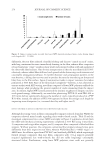
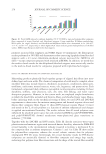
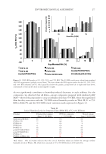
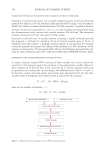
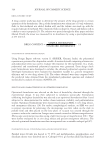
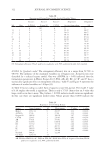
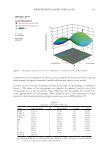
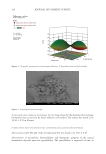
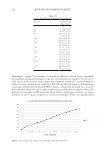
318 JOURNAL OF COSMETIC SCIENCE DRUG CONTENT STUDY A drug content study was done to determine the amount of the drug present in certain quantities of the formulation. One g of the formulation was taken into a 10 mL volumetric flask to that methanol was added, shaken well, and the volume was made up with the required amount of methanol. The volumetric flask was kept for 2 hours and shaken well in a shaker to mix it properly (23). The solution was passed through the filter paper and then filtered. Finally the mixer was measured for its absorbance by using a spectrophotometer at 235 nm (12). DRUG CONTENT SAMPLE ABSORBANCE STANDARD ABSORBANCE =×100 VALIDATION OF EXPERIMENTAL DESIGN Using Design Expert software version 11 (SRIHER, Chennai, India), the polynomial equation was generated for a dependent variable. A statistical model comprising of interactive and polynomial terms was used to evaluate the responses for the experiment. As a result, polynomial and transformed polynomial equations were generated. Extra design check point formulations were developed to validate the obtained polynomial equation model. Developed formulations were evaluated for dependent variable (i.e., percent entrapment efficiency and in vitro drug release (24)). The values obtained were then compared with the predicted value obtained from the transformed polynomial equation and evaluated statistically by analysis of variance (ANOVA 25). SELECTION AND CHARACTERIZATION OF OPTIMIZED FORMULATION Optimized formulation was selected on the basis of desirability obtained through the experimental design. It was then subjected to validation statistically. Formulation exhibiting the highest desirability was selected as an optimized formulation (Run 1) and subjected to characterization for surface characterization, stability, and preformulation studies. Optimized formulations were characterized using an SEM, in vitro drug release, and entrapment efficiency (26). For surface morphological analysis, an SEM was used to prepare specimens for polarizing the microsponge was first taken on the slide in powder form and then placed on the base plate. A vacuum was created through the system to reduce the conduction. Images were created scanned at different magnification. Microscopic examination was done using a light microscope at magnification 100×. They were further evaluated for in vitro drug release and percent entrapment efficiency. The selected optimized formulation was then incorporated into a suitable carbopol gel (27). PREPARATION OF GEL CONTAINING DRUG-LOADED MICROSPONGES Purified water (60 mL) was heated to 75–85°C and methylparaben, propylparaben, and disodium edetate were dissolved into it. Carbopol 934 (1 g) was then added and dispersed

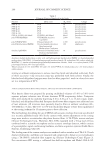
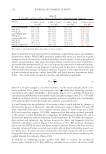
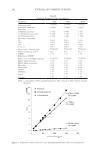
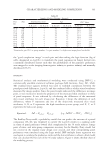
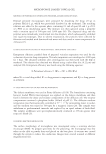
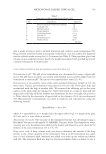
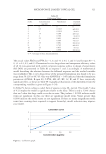
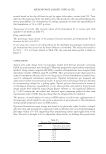
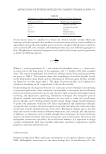
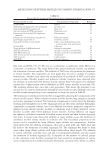
319 Microsponge Loaded Topical Gel into it under stirring to form a uniform dispersion and cooled to room temperature (28). Drug benzoyl peroxide–loaded microsponge formulation (1 g) was added and dispersed into the solution under stirring for 10–15 minutes (see Table I). Then propylene glycol and silicone oil were added and mixed finally, the weight was adjusted with purified water with continued stirring for 15 minutes (29). EVALUATION PARAMETERS FOR MICROSPONGE LOADED TOPICAL GEL Determination of pH. The pH of the formulation was determined by using a digital pH meter. The pH meter electrode was washed with distilled water and then dipped into the formulation to measure pH. This process was repeated three times (29, 30). Determination of spreadability. Glass slides with standard dimension (length of 6.0 cm) were taken. Topical gel formulation was placed on the one side of the glass slide and sandwiched with the help of another slide. We removed the adhering gel on the outer surface of the glass slides by wiping (31). Slides were fixed in a stand so that only the upper slide could slip off freely without any disturbance by force of weight (20 g) tied to it. Time taken for the movement of upper slide to the distance of 6.0 cm was measured (32). Measurement of spreadability was done in triplicate and calculated by using the following formula: Spreadability (m×l)/t, =where, S =spreadability m =weight tied to the upper slide (20 g) l =length of the glass (6.0 cm) and t =time taken in seconds. Measurement of viscosity. The viscosity of the formulated batches was determined using a Brookfield Viscometer with spindle 63 (SRIHER, Chennai, India). The formulation whose viscosity was to be determined was added to the beaker and allowed to settle down for 30 minutes at the assay temperature (25 ± 1°C 33). Drug content study. A drug content study was done to determine the amount of the drug present in the certain quantity of the formulation. One g of the formulation was taken into a 10 mL volumetric flask. Methanol was added in to make up the volume and shaken well (23). The volumetric flask was kept for 2 hours and shaken well in a shaker to mix it Table I Composition of Microsponge Loaded Topical Gel S. No. Ingredients Quantity 1. Benzoyl peroxide–loaded microsponge 1 g 2. Carbopol 934 1 g 3. Methyl paraben 0.2 g 4. Propyl paraben 0.02 g 5. Disodium edetate 0.1 g 6. Silicone oil 1 mL 7. Propylene glycol 5 mL 8. Purified water Q.S 100 mL
Purchased for the exclusive use of nofirst nolast (unknown)
From: SCC Media Library & Resource Center (library.scconline.org)