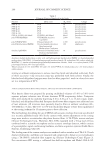
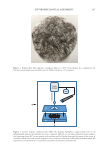
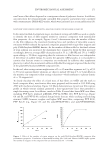
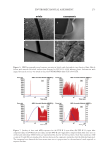
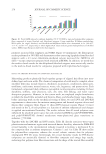
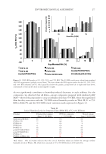
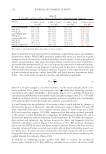
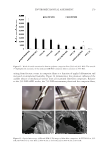
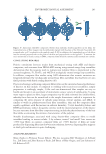
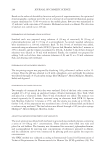
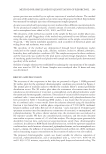
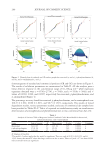
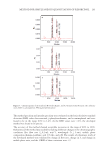
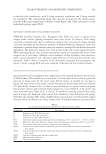
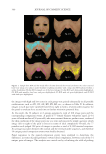
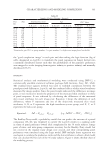
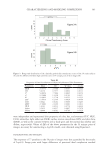
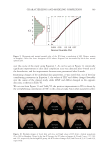
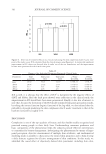
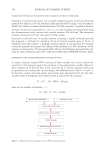
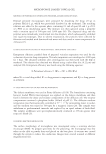
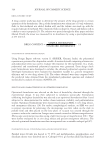
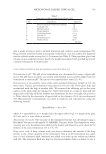
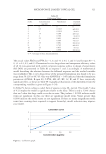
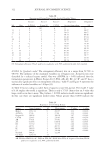
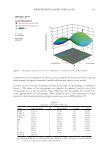
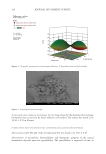
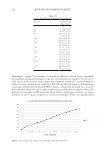
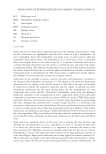
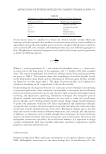
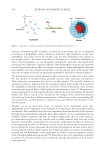
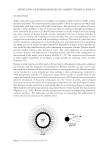
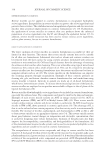
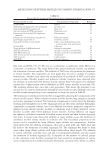
278 JOURNAL OF COSMETIC SCIENCE Fixative durability may be investigated by employing complementary linear and nonlinear deformation schemes. While DMA introduces infinitesimal stresses to materials to probe changes in linear viscoelasticity, methods including texture analysis, tensile strength, and impact testing introduce large molecular displacements to probe factors that contribute to irreversible film deformation (18,22). As a case in point, the importance of ambient humidity, E′, and tensile strength on style longevity is underscored by Equation 1, which relates the adhesive debonding energy to dissipative adhesion. Equation 1 (18) implicitly specifies that at low-to-moderate humidity—where lower MW and glassy fixatives demonstrate brittle failure—less tensile work is required to fracture and delaminate rigid welds: P lσ2 E′ =(1) where P is the peel strength l is the film thickness σ is the tensile strength, and E′ is the elastic modulus. For a given l, the dissipation ratio (σ 2 E′ )shows that debonding strengths increased for softer films with higher σ. Interestingly, Figure 12 (*)and Table IV show that only imidized p(IB/MA) had a measurable tensile strength and appreciable E′ at ≥75% RH, which are attributes related to intrinsic humidity resistance, intrafilm ionic crosslinking, and tough interfiber strings that bridge and constrain seam-weld fissures. It is well known that the probability of fracturing a film is highly affected by changes in film ductility. By way of illustration, the light microscopy images in Figure 13A and 13B show seam-weld dislocations and complete interface failure in welds composed of PVP K-60 and virgin hair snippets (30% RH), suggesting that debonding occurred primarily at the interface at lower humidity. For comparison, the SEM images in Figure 13C and D illustrate the humidity-induced dichotomy of adhesion failure. At 30% RH, the composite film cracked and splintered, but friction between the fibers and fragments held the shattered components in place (Figure 13C) however, at 90% RH moisture absorption plasticized the PVP K-60 welds and fibers, whereby adhesion between the film and fiber remained strong and failure occurred near interfacially, in which debonding ensued near the interface (i.e., the fibers remained coated with a thin layer of polymer) and led to fibers being pulled from the sticky restrictions of the flexible film as the texture analyzer probe pushed through the composite (Figure 13D). In addition to combining texture analysis with AED to evaluate the mechanical characteristics of films at 50% RH, AED was similarly used to evaluate the release of AE Table IV E′ (±25 MPa) and Tan ∂ (±0.01) Versus %RH Results for Virgin Fiber Film Composites Polymer E′ (MPa) /Tan ∂ 20% RH E′ (MPa) /Tan ∂ 35% RH E′ (MPa) /Tan ∂ 50% RH E′ (MPa) /Tan ∂ 75% RH poly(VP/DMAPMA) 490 /0.05 483 /0.05 504 /0.07 8.30a /1.02 PVP K-90 445 /0.05 448 /0.05 407 /0.07 8.40 /0.20 PVP K-120 441 /0.04 439 /0.05 409 /0.07 5.98 /0.23 poly(VP/MAPTAC) 390 /0.05 389 /0.06 328 /0.09 1.08 /0.41 PVP K-60 288 /0.06 292 /0.05 261 /0.07 6.65 /0.41 Imidized p(IB/MA) 239 /0.05 241 /0.05 235 /0.05 82.0 /0.28 PVP K-30 176 /0.04 177 /0.04 179 /0.05 3.47 /0.28 PVP K-15 68.4 /0.13 75.3 /0.10 94.4 /0.17 4.07 /0.33 PVP K-30:PEG 400 35.1 /0.02 34.8 /0.05 26.4 /0.15 3.33 /1.02 a Red values =soft and ductile films blue values =elastic response.

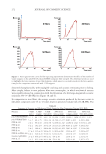
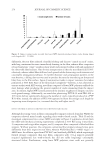
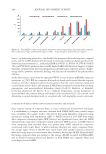
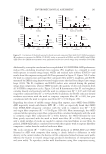
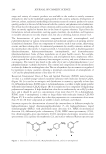
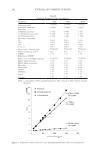
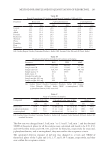
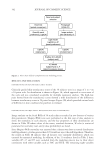
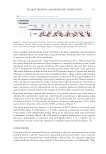
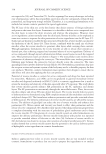
279 Enviromechanical Assessment arising from fracture events in composite films as a function of applied deformation and increased environmental humidity. Figure 14 demonstrates that moisture influenced the audible release of mechanical stresses from all examined film-fiber composites. Relative to the 35% RH #AED results, the 75% RH environment plasticized the composite films Figure 12. Work of tensile extension for fixative-polymer composite films (50% and 90% RH). The asterisk (*)highlights the resistance of the imidized p(IB/MA) composite film to extension at 90% RH. Figure 13. Optical microscopy (A,B) and SEM (C,D) images of film-fiber composites: A) PVP K-60 at 30% RH B) PVP K-60 at 30% RH C) PVP K-60 at 30% RH and D) PVP K-60 at 85% RH.
Purchased for the exclusive use of nofirst nolast (unknown)
From: SCC Media Library & Resource Center (library.scconline.org)