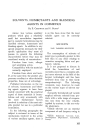
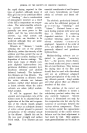
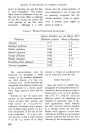
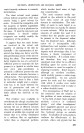
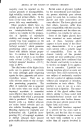
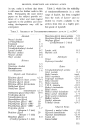
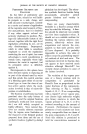
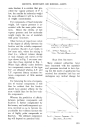
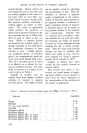
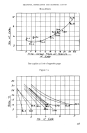
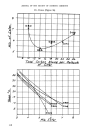
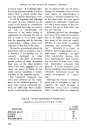
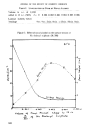
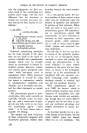
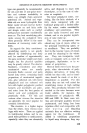
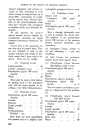
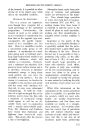
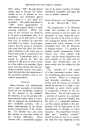
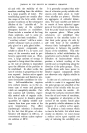
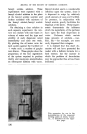
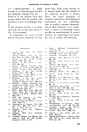
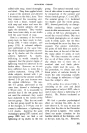
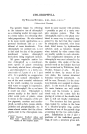
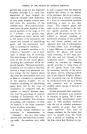
SOLVENTS, HUMECTANTS AND BLENDING AGENTS TABLE 5. BLENDING POWERS OF ESTERS (Mls. ooe ester required to produce at 10oc • hmnogeneous solution with a mixture of 10 mls. White Oil and 10 mls. Castor Oil.) Ester mls. Ethyi acetate - - 5.2 Butyl acetate 3.9 Amyl acetate 4.4 Octyl acetate 4.5 Ethyl laurate 5.9 Ethyl myristatc 6.4- Butyl lauratc 6- O Octyl octanoate 7.1 Isopropyl myristatc 7.4 _ - Ester mls. lsopropyl palmitate 7.8 Butyl stearate 10.2 Amyl stearate 11.0 Dibutyl oxalate 7.1 Diethyl sebacatc 5.3 Dibutyl sebacate 5.8 Dioctyl adipate 5.9 Dioctyl sebacate 6.6 Pentaerythritol •nono-oleate 7.0 _ _ _ BLENDING AGENTS The wide range of materials which is found in many cosmetic formula- tions and the requirement that all the components should remain for long periods in the physical state in which they are compounded implies that the prepared product must be in a stable condition. Where one or more of the components is of limited miscibility with the others it is necessary to ensure that break- down does not occur over the normal variation in temperature anticipated in the storage and use of the product. Although it is difficult to genera- lise (the following comments do not relate to emulsion systems directly) it might be expected that a blending agent for two immisciblc liquids must possess a structure intermediate between them. This is frequently found to be the case and in dealing with mixtures of hydrocarbons with glyceride oils and fats, blending agents with a suitable balance (determined by experiment) of ester groups and hydrocarbon chains would be expected to bring about homogeneous mixing of the two ma jot components. Thus butyl stearate has been employed for many years in this con- nexion but therc is little data from which to assess its efficiency in com- parison with other esters. The current interest in alternative esters, c.g. isopropyl myristate or diethyl scbacatc, raises the question of their rc'lativc efficiency as blending agents. A rapid appraisal of a range of esters has been made with reference to the system White Oil-Castor Oil and although the treatment is, by no means, comprehensive the results are of sufficient interest to merit com- ment. The data quoted in Table 5 and shown graphically in Figure 3, were obtained by adding small amounts of blending agent to a mix- ture of equal volumes oi White Oil and Castor Oil until the temperature of miscibility fell to 10øC. The amounts of various esters required to produce a homogeneous mixture 115

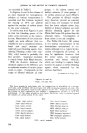
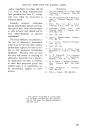
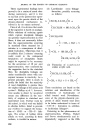
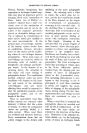
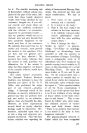
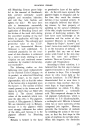
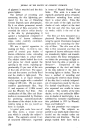
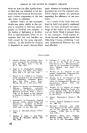
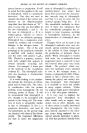
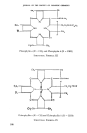
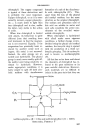
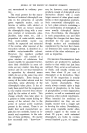
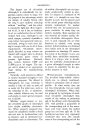
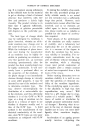
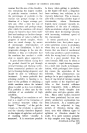
JOURNAL OF THE SOCIETY OF COSMETIC CHEMISTS are recorded in Table 5. In Figures 3A and 3•3 the volume of an ester required for homogeneous solution at various temperatures is recorded and the volumes required for mixing at 10øC are plotted against the number of carbon atoms in the ester molecule. It will be seen from Figures 3A and 3B that the blending power of the esters varies inversely as the molecu- lar size. Mono-esters of low molecular weight are most efficient (but too volatile for use in cosmetics) whereas butyl and amyl stearates are relatively poor blending agents. Con- sidering blending action with vola- tility, ethyl laurate is probably the best product. Isopropyl myristate is clearly better than butyl stearate. With the di-esters, however, the situation appears to be different, and an optimum number of carbon atoms seems to exist. Compounds in the range of dibutyl sebacate (2 ester groups + 16 carbon atoms) and diethyl sebacate (2 ester groups + 14 carbon atoms) are most efficient. The position of dibutyl oxalate may, however, present an anomaly and it may, for example, be found that the lower adipate esters (e.g. diethyl or dibutyl adipate) are more efficient blending agents for the White Oil-Castor Oil system than the sebacate esters. investigation of these esters is not yet complete. The White Oil-Castor Oil system is not strictly representative of the formulations encountered in cos- metics although it is a typical hydro- carbon oil-vegetable oil system. It may be significant, however, that the newer esters, viz. isopropyl myristate and diethyl sebacatc, which are tending to replace butyl stearate do appear as better blending agents when examined by the method described. (Continued on Page ,119) Figures 3,• and 3B (Page,s' 117 and 118) The lower graphs in each. figure plot tht, te•nperature of rnisciMlitv of a mixture of 10 mls, each of White Oil and Castor Oil with increasing amount• o• ester. The temperature of miscibility w•th no ester present was 71' 5øC. Frmn tim I o•er ographs the volume of ester required to just produce a homogeneous solt•lion al 1{) C was determined. In the upper graphs in each, figure' this latter value is plot'ted against the number of carbon atoms in the ester. A•nAc: amyl acetate AmS: amyl stearate BuA: butyl aceta•:c BuL: butyl laurate DOA: dioctyl adipatc DOS: dioctyl sebacate EtA: ethyl acetate EtL: ethyl laurate Key BuS: b•tyl stearate DBO: dibutyl oxalate DBS: dibutyl sebacatc DES: diethyl sebacate ElM: ethyl myristatc IPM: isopropyl myristate IPP: isopropyl palmirate OcA: Octyl acetate O.O.: octyl ottoate 116
Purchased for the exclusive use of nofirst nolast (unknown)
From: SCC Media Library & Resource Center (library.scconline.org)