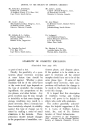
STABILITY OF COSMETIC By W•LL•AM The question of the stability of an emulsion is one of great import- ance to cosmetic chemists. To men- tion just a few cosmetic products which involve the formation of emul- sions in their manufacture is suffi- cient to emphasise this importance. Such cosmetic items include creams of many types, lotions, clouding agents, powder suspensions, "sol- uble" perfume oils, antiperspirant creams, shaving creams, hair dress- ings, vitamin and hormone prepara- tions, and other products. One of the most important features of the development of a new cos- inetic is the matter of its stability and shelf life. Not only must it show the performance •[nd have the attractive appearance and scent necessary for its success, but it must retain these properties until pur- chased by the consumer. In the case of cosmetics it is usual that stability is required over a period of months and often years. There are several ways in which an emulsion may be unstable, and one or more of the changes under- gone by emulsions may be of im- portance in any particular product. The object of this paper is to de- scribe some of these types of in- stability, and to suggest ways of * Colburn Laboratories, Inc., Chicago• EMULSIONS COLmJRN* testing the stability of emulsified products in the laboratory. There is no generally accepted definition of the term "stability" as applied to emulsions. It is obvious that an emulsion sufficiently stable for an agricultural spray, which may be used within a few hours after its formation, would require an entirely different order of stability from that expected of a cosmetic emulsion, which generally must remain unchanged over many months. In fact, the easy separation of the oil phase of an emulsion may be highly desirable, as for example in the formation of a continuous oil film in a thin layer of water-emul- sion paint. Cosmetic emulsions generally con- sist of an oil or wax emulsified with art aqueous solution. If the oil phase is dispersed in the aqueous phase, the emulsion is referred to as the oil- in-water type. An example of this type of emulsion is a "milky" permanent waving lotion. Where water droplets are dispersed in a continuous oily phase, as in a cleansing cream, the emulsion is of the water-in-oil type. The two phases of the emulsion are often referred to as the "dispersed" or "internal" phase on the one hand, and as the "continuous" or "external" phase on the other. There is no defi•fte 93

JOUI•NAI. OF THE SOCIETY particle size range for the disper•d droplets, although it is usual that dispersions of large droplets are relatively unstable while dispersions of very small• droplets assume 'more' and more the properties of the colloidal state. Most practical emul- sions have the great majority of dis- persed particles in the range of 0.5 to 5 microns- the particle sizes will depend on many factors such as the nature of the substances, the nature and amount of emulsifying agent, and the mechanical work done in forming the emulsion. When a cosmetic emulsion is de- scribed as "tinstable ", one or more types of change may be occurring. One such change is the actual separ- ation of the oil and water phases, involving the coalescence of the dis- persed droplets. Thermodynamically, emulsions are not stable in that they involve a larger free interfacial sur- face energy for the disperse phase than does the unemulsified state, and so there is a tendency to coalescence of the disperse droplets. In an emulsion containing an emulsifying agent there will be few cases of coalescence as compared with the number of contacts between drop- lets, and the percentage of contacts resulting in coalescence will be a measure of instability. The closeness of packing and frequency of drop- let contacts is the other important factor in phase separation. A second change undergone by emulsions is sedimentation or "creaming", this last term being derived from the behaviour of ordin- ary: milk• An emulsion may settle OF COSMETIC CHEMISTS in such a manner that the dispersed droplets fall slowly to the bottom of the container, but do not coalesce, thus producing a mixture consisting of a layer of concentrated emulsion underlying a more or less clear serum. This disperse phase will settle or rise, according to the rela- tive specific gravities of the two phases, and the process may be de- scribed as upward creaming or downward creaming. If the particles are not closely packed, and are spherical, their rate of sedimentation will obey Stokes' Law. Accordingly, a large difference in specific gravity between the phases will favour rapid creaming, as will large par- ticle sizes and low viscosity of the continuous phase. Creaming can usually be retarded by changing specific gravities to bring those of the two phases nearer each other, by increasing viscosity of the exter- nal phase, and by reducing particle size of the disperse droplets. Reduc- tion of particle size can be attained by mechanical work and may be the only practical way to increase stability where change in formula is tindesirable. A third unwanted effect sometimes observed in emulsions is an increase in viscosity on ageing. This is more common with concentrated emul- sions, or with products thickened with the aid of colloidal substances like starches or gums, than with dilute emulsions. This kind of change accounts for the lotion that can't be poured from the bottle after a period of standing, or for th e. •thin cream that thickens o n age- 144
Purchased for the exclusive use of nofirst nolast (unknown)
From: SCC Media Library & Resource Center (library.scconline.org)