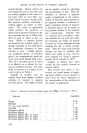
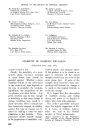
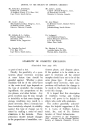
STABILITY OF COSMETIC EMUI,SIONS ing. It is common among substances ir• the colloidal state for the material to gel or develop a kind of internal structure that interferes with free flow and produces a falsely high viscosity. The product returns to its fluid state if agitated sufficiently. The degree of gelation permissible will depend on the particular pro- duct. The final type of change which may be undergone by emulsions is phase inversion, wherein an oil-in- water emulsion may change over to the water-in-oil type, or vice ver.•a. While the technique of phase inver- sion used during the manufacture of an emulsion may be highly de- sirable in producing an emulsion of very fine particle size, an inversion occurring spontaneously after the product has been manufactured may be highly undesirable. It will com- monly have a p•'ofound effect on the properties of the emulsion. If the phase change is not immediately obvious through change in viscosity or some other property, it may be detected by one of the methods used to determine emulsion type. One may observe microscopically the distribution of a water-soluble dye in the emulsion, and thus determine whether it is of the O/W or W/O type or a drop of emulsion can be placed in a volume of water to see whether it disperses readily and is thus of the O/W type. A third method is the measurement of the electrical conductivity of the emul- sion, since W/O types are very poor conductors as compared with O/W emulsions. In testing the stability of an emul- sion the only procedure giving per- fect]y reliable results is an actual use test extended over a sufficiently longe time period. However, most manufacturers cannot afford the time involved, and so we chemists are called upon to devise accelerated te.•ts whose results are as reliable as possible for the degree of accelera- tion required. Some phases of the per[ormance of the emulsion are really matters o[ stability, and a laboratory test duplicating the use of the product also is a measure of the degree to which the emulsion has the neces- sary stability or instability. For ex- ample, •concentrates must be cap- able of dilution without breaking of the emulsion, while a cleansing cream must permit coalescence of oil droplets after a certain amount of water has evaporated from a thin layer of the cream. Before starting laboratory tests on emulsion stability it is well to con- sider the question o[ chemical sta- bility of the emulsion ingredients. If the emulsifying agent is an ester, is the alkalinity so high that slow saponification may occur ? Will there be a pH change due to evap- oration of a volatile amine ? Will traces of metals or irradiation by sunlight promote undesirable chemi- cal changes ? Knowing what to ex- pect in the way of chemical change enables one to carry out more intel- ligently other, sometimes lengthy, tests. Acceleration of an ageing process usually involves subjecting • the 195

JOURNAL OF THE SOCIETY sample to conditions more rigorous than those it will ever meet in the field. If the product remains un- affected for a time by these drastic tests, it is fairly certain that it will be stable for a longer time under the milder conditions of actual use. But when the mixture under test shows evidence of instability, might it not be a case of breakdown under severe conditions where under ordinary cir- cumstances the product would be- perfectly stable ? If several different kinds of accelerated tests show several types of instability in the product, it is probably justifiable to reject the formulation. But if the degree of breakdown is slight, and there is a possible doubt about the conclusion based on speeded-up tests, it is usually worth while to re- peat the test under conditions less drastic and more nearly approach- ing actual use, even though such a test will necessarily be of longer duration. Generally, the milder test of longer duration is the more re- liable. A commonly applied laboratory test is the centrifugation of the sample. This procedure accelerates creaming changes, and in some cases will also speed up coalescence of the dispersed phase. Creaming can also be accelerated by dilution of the emulsion so as to reduce the vis- cosity of the external' phase. Separation of the two phases of the emulsion occurs where dispersed droplets coalesce unduly, frequently upon contact. In any case only a small percentage of collisions result in coalescence, or the emulsion could OF COSMETIC CHEMISTS not have been formed at all. Study- ing the stability of an emulsion with regard to this type of breakdown involves increasing the frequency and force of meetings between drop- lets. This can be accomplished to some extent by centrifuging, which may cause a closer packing of drop- lets and thus result in more frequent contacts, although it should be em- phasised that centrifuging is usually of small value in predicting phase separation (its main use being the acceleration of creaming). Raising the temperature of the emulsion causes an increase in the general thermal agitation, and also produces a lower viscosity in the external phase. Both these effects tend to increase the rate of droplet contacts and also their force, so that any in- stability due to droplet coalescence will be magnified. Accordingly, storage of samples at elevated tem- peratures, in the range of say 110 ø to 160øF., is essential in judging product .stability. Breakdown by phase separation can occasionally be directly observed microscopically. If during the course of a few minutes' examination, several instances of droplet coal- escence are seen, the emulsion will no doubt separate relatively quickly. More valuable information is ob- tainable by microscopic examination if one makes a particle size distribu- tion count. About 1,000 to 2,000 particles are measured and classified into particle size groups, say 0 to 1 micron, 1 to 2 microns, and so forth. It is generally found that this distri• bution changes wi•t.h time in such a 196
Purchased for the exclusive use of nofirst nolast (unknown)
From: SCC Media Library & Resource Center (library.scconline.org)