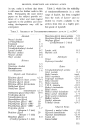
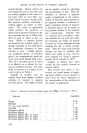
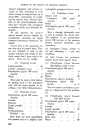
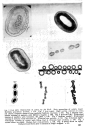
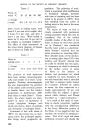
EMUL$ION,q AND TIlE COSMETIC CHEMIST place for the soap containing type. How many creams have been improved by the addition of cetyl alcohol put in for quite another reason ? A microscopical examina- tion of a typical vanishing cream of the caustic potash-stearic acid type, with and without cetyl alcohol, emphasises this point. Furthermore, self-emulsifying gly- ceryl mono stearates which will stabilise o/w emulsions of low pH are also available. These are usually mixtures of glyceryl mono stearate and long chain alcohol sulphates, sapamine phosphate or other surface active agents. ' The writer has made a study of the effect of many types of surface active agents in both cetyl alcohol and glyceryl mono stearate. In each case (Cetyl alcohol or GM.S•) t0ø/o of the surface active agent was added to produce a base. The experiments covered a wide range of soaps-- varying both fatty acid and alkali, and a wide range of anionic, cationic and non-ionic agents. Each base wa.q used to make creams of the types shown in the table below. Cream 1 Base Water 2 Base Water 3 Base Water 4 Base Water 5 Base Water 6 Base Water 7 Base Water 8 Base Water 9 Base Water 10 Base Water 11 Base Water 12 Base Water Constituents -- Glycerin Citric Acid Glycerin Hydrochloric Acid Glycerin Aluminium Chloride Glycerin -- Mineral Oil Citric Acid Mineral Oil Hydrochloric Acid Mineral Oil Aluminium Chloride Mineral Oil -- Waxes Citric Acid Waxes Hydrochloric Acid Waxes Aluminium Chloride Waxes The purpose of the experiments was to determine the efficiency of each base when used as an emulsi- fier in creams of different types and under varying conditions of pH. The results were both valuable and instructive, and although not avail- able for general publication, illustrated the value of certain non- ionic agents as auxiliary emulsifiers under conditions of low pH. How- ever, the use of a water soluble non- ionic agent would not fulfil one requirement of the complex forma- tion theory as this specifies the presence of an ionisable water- soluble substance. In fact, the water-soluble non-ionic agents are poor substitutes for the soaps and alcohol sulphates when used in con- junction with cholesterol, cetyl alcohol, etc. It must be remembered 149

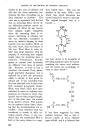
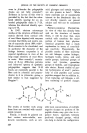
JOURNAL OF THE SOCIETY that the production of a thin emul- sion calls for much more stringent conditions than a cream where the favourable condition of high viscosity is obtained. The fact that a comprehensive range of non-ionic oil and water soluble agents is now available opens up a huge field of experimentation. One is, however, tempted to wonder whether some of the complex bodies now being offered will not defeat their own object. Dr. A. E. Alex- ander suggests that a complex hydrocarbon ring system with two polar heads in close proximity would give a condensed fihn at the inter- face, but if the polar groups are widely separated the molecule tends to lie flat on the surface, giving a gaseous or expanded fihn. This would point to a mono glyceride as a satisfacto•3z film forming substance, but would cast considerable doubt upon the efficiency of some of the recently developed emulsifiers, where the hydroxyl groups are widely separated. Before leaving o/w emulsifiers, some mention of the widely used triethanolamine soap should be made. The fatty acid soaps of triethanolamine are very efficacious in producing emulsions of low vis- cosity. They are usually regarded as forming an addition compound with stearic acid, although de Navarre suggests that, in the presence of water, triethanolamine forms a hydrate, and that the stearic acid reacts with the hydroxyl group with the elimination of water. Triethanolamino stearate, when dis- OF COSMETIC CHEMISTS solved in alcohol may be titrated with either acid or alkali. Using brom phenol blue as indicator, all the triethanolamine may be titrated with standard acid solution. With phenol phthalein, all the stearic acid may be titrated in spirit solution with standard alkali. On heating to fairly high temperatures, stearic acid reacts with one of the chain hydroxyl groups, in triethanolamine. This ester shows only a small amount of free stearic acid when titrated to phenol phthalein in alcohol. The di and tri esters can also be prepared. The mono ester offers possibilitie• a cationic emulsifier. An interesting example of the application of some of the theories so far described is the production of a hair-reconditioning cream. Such a preparation aims at the correction of the pH of the hair, subsequent to permanent waving, shampooing, etc. Even more important is the problem of redistributing a fine film of oil (let ns say synthetic sebum) to the hair in fact, it is the degreasing problem of the wool industry in reverse. The efficient, but not excessive, lubrication of the hair calls for an o/w emulsion. By a careful study of the adhesive properties of certain substances, the nature of the emulsifying agent and conditions of pH, it is possible to formulate a very effective recondi- tioner. In this way, an enmlsion may be produced which, when applied to the hair and then thoroughly rinsed •vith water, will leave all the oil originally contained in the emulsion, on the hair. By a suitable variation 150
Purchased for the exclusive use of nofirst nolast (unknown)
From: SCC Media Library & Resource Center (library.scconline.org)