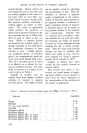
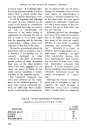
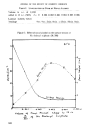
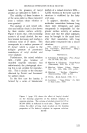
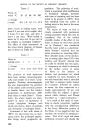
PROPERTIES OF KER•ITIN FIBRES of the polypeptide chains. The re- activity of these various groups will vary with conditions of temperature and pH, as well as with the nature and concentration of the reagent acting on the fibre. 1. Dry Heat The use of heat in the setting and drying of hair makes it desirable to understand the influence of dry heat on keratin fibres. Wet fibres are much les•,l resistant to heal than are dry fibres, a factor which should always be considered in the permanent waving and drying of hair. Experiments have shown that wet wool heated in dry air at 105øC. loses water and the fibre becomes harsh and loses strength. If the heat- ing is not prolonged, the effect is more or less reversible and in moist air the wool takes up water and re- covers its softness and strength. Heating at temperatures above 105 ø C. for any appreciable time causes decomposition of the wool which turns yellow and gives off ammonia and hydrogen sulphide. At temper- atures above 150øC. dry wool grad- ually decomposes until at 210øC. the fibre isl black and brittle. Argin- ine, proline, threonine and cystine appear to be the amino acids most affected by heat, therma] decom- position ,of the fibres resulting •in diminished basic properties and water absorption, but increased alkali solubility 2. From a practical standpoint it is useful to note that the steady tem- perature of air from the normal electric hair dyer is of the order shown in Table I: Distance from orifice (cms.) 2.5 Temperature øC. 147 2. Water 5.0 126 T^BnE 1. 7.5 113 Extraction of hair with cold water (20øC.) or repeated washing at 35øC. removes non-keratinous constituents such as uric acid, xan- thine, urea, ammonia, creatine, gly- cogen, citric and lactic acids, to- gether with mineral constituents-- calcium, sodium, potassium, phos- phorus and chloride--and enzymes, such as pho.sphatase, xanthine oxi- dase and dopase. Many of these constituents are derived from nucleic acid present in the epidermal nuclei 10.0 12.5 15.0 17.5 22.5 25.0 -i•2- 90 78 73 63 57 which disappear during the keratin- isa•tion process. When hair is treated with water at 50øC. protein hydrolysis sets in, as shown by the evolution of hydrogen sulphide TM. The amorphous regions of the fibre appear to be involved first, and it is only after treatment for 1 hour at temperatures greater than 60øC. that significant changes occur in the stress/strain diagrams of hair. Table II shows the percentage change in work required to stretch a fibre 30 per cent before and after treat- ment: 165

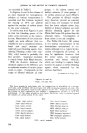
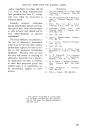
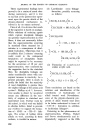
JOURNAL OF TIlE SOCIETY OF COSMETIC CHEMISTS Temp. of water øC. % change in work TABLE 2. 20 35 60 80 100 0.0 1.0 1.0 -7.3 -17.9 After 1 hour in boiling water, wool loses 0.2 per cent of its weight after 2 hours 0.3 per cent, and after 8 hour• 1 per cent. Wool boiled in water for 14 days lost 36 per cent of its sulphur as hydrogen sulphide 22. The effect of these treatments on the stress/strain diagram of human hair is shown in Table III: TABLE 3. Hours in boiling water 1 2 4 8 % change in work -14.4 -14.6 -18.0 -25.0 The products of wool hydrolysis have been studied chromatographi- cally and consist of at least 3 poly- peptides. Partition chromatography has also demonstrated the presence of the amino acids normally present in keratin fibres, but the relative proportions in hydrolysates differ from those in whole fibres 2ø. Chem- ically, the above results are inter- preted in terms of hydrolysis of cystinc disulphide linkages, acid amide side chains, fission of peptides and disruption of hydrogen bonds. Treatment of hair with steam at 100øC. for short times has no dam- aging action, but prolonged applica- tion brings about progressive de- gradation. The yellowing of 'wool, which is associated with' modification of disulphide linkages, increases with time of steaming and has been stated to be greater at 100øC. than that resulting from the action of boiling water or dry heat at the same temperature. The action of water on hair is closely .connected with permanent waving processes which will now be considered. One of the earliest scientific studies of the effect of hot water or steam on wool was can'ied out by Harrison •a who considered that the water acted as a plasticiser, while Shorter •4 believed that the steam exercised an annealing effect. More detailed study of the mechan- ism of setting dates from 1933 when Astbury and Woods •* showed that set could be divided into two types, i.e. temporary set which is destroyed by the further action of steam on fibres in the absence of tension, and permanent set, which is unaltered by such treatment. It was also found that when a stretched wool fibre is steamed under tension for 2 minutes, followed by release in steam, the fibre contracted to a length approximately 30 per cent smaller than the original, a pheno- menon which Astbury and Woods described as "super-contraction" As a result of this study of varia- tions in elastic properties, together with the accompanying differences in the X-ray diffraction pattern of the fibres, it was suggested that two reactions• are involved in setting pro- cesses. First of all, rapid side chain hydrolysis occurred and should the 166
Purchased for the exclusive use of nofirst nolast (unknown)
From: SCC Media Library & Resource Center (library.scconline.org)