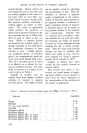
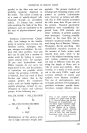
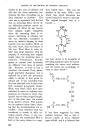
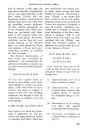
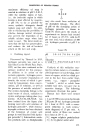
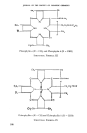
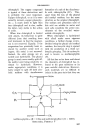
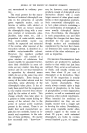
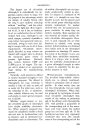
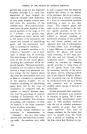
IaROPERTIE• OF fibre be released •t this stage, the long chain molecules (polypeptides) coil up and supercontraction of the fibre results. Parallel with this breakdown reaction, re-formation of linkages takes place and when link- age rebuilding exceed::• hydrolysis the fibre remains permanently set in the elongated state. When wool fibres are pre-treated with dilute alkali or with reagents which com- bine with amino groups, the second, rebuilding, reaction does not occur during steaming of the stretched fibres, e.g. when steamed at 50 per cent extension a 50 per cent super- contraction occurred on releasing the fibre in steam. The chemical interpretation of these events was commenced by Speakman•% who assumed that the preliminary breakdown reaction was associated with the cystine disulphide linkages: R.S.S.R--R.SH + R.SOH KERATIN FIBRES been deaminated with nitrous acid, or whose amino groups had been blocked by reaction with benzoqui- none. Finally, it was shown that fibres cannot be set in acid media. Optimum setting occurs at about pH 9 when the duration of treatment is some 30 minutes. Speakman con- cluded that in solutions of this pH value hydrolysis of the fibre disul- phides is adequate, while in acid solutionsl basic side chains are fully combined with acid. Phillips 27 sug- gested that secondary reactions of sulphenic acid groups could give rise to new linkages as folo•vs: R.CHa.SOH--R.CHO + H•S R.CHO + R.NH•-- R.CH=N.R+H:O. From what has been said so far it will be seen that in this work on permanent setting we have the fol- lowing facts: The fact that reagents which arc known to cause fission of the disul- phide linkages of cystine, e.g. bisul- phires, cause wool fibres to super- contract, was given a•-4 evidence in support of this view. The rebuilding mechanism was thought to occur by condensation of sulphenic acid and amino groups: R. SOH + R. N H•--R. S. NH. R + H•O Here again it was found that attain- ment of permanent set was pre- vented and supercontraction follows on steaming wool fibres which had (i) (2) (3) (4) Supercontraction and t•et of fibres stretched in steam. Supercontraction o f stretched fibres treated with reagents known to rupture the disulphide linkage in cys- fine. Prevention of set by treating wool fibres with reagents combining with amino groups. Occurrence of maximum set in fibres boiled in solutions of pH 9.2. 167

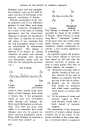
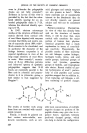
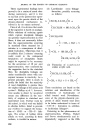
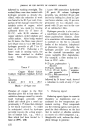
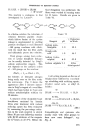
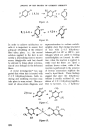
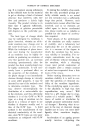
JOURNAL OF THE SOCIETY OF COSMETIC CHE•ilSTS These experimental findings have proved to be a centre, of much stim- ulating controversy, and it is true to say that at the present time agree- ment upon the precise details of the physico-chemical mechanisms in- volved is by no means universal. First of all, it is obvious that much of the argument is based on analogy. While solutions of reducing agents which rupture disulphide linkages can produce supercontraction in wool fibres, it does not necessarily follow tha, t the supercontraction occurring in stretched fibres steamed for 2 minutes is a consequence of disul- phide hydrolysis. Objections that it is unlikely that 2 minutes' steaming could result in the widespread breakdown of disulphides which might be expected to be necessary for the occurrence of 30 per cent supercontraction, were countered by the suggestion that in the stretched fibre, the disulphide linkages are under considerable stress with con- sequent increase in reactivity. As a general principle, there is much to justify the belief that the reactivity of wool dimlphides is greater than the sulphur linkage of the amino. acid cystine •8. Phillips et al. •9, however, were unable to detect by analytical means any difference in the reac- tivity of sulphur in stretched and unstretched wool. Further work by this school, in which wool was boiled in alkaline buffers, failed to provide any evidence to support. the forma- tion of - SNH - or - CH=N - link- ages. The action of boiling dilute alkalis on wool, according to these workers, is twofold in nature: Lanthionine cross • linkage formation, possibly occurring as follows' \ ,/ CH.CH2.S.S.CH.•,.CH -- CH.CH..,SH + HO.S.CH..,.CH b. \ CH.CHo. S.OH \ -- C=CH2+H.•O+S C=CH2 + SH.CH2.CH-- / \ / CH.CH2.S.CH2.CH ,/ (2) Formation of combined amino acrylic acid. x, ,•' CH.CH•.S.S.CH2.CH -- \ C=CH.., + H..,S + S + CH2=C / These conclusions are based on the isolation and identification of the constituents of hydrolysates of alkali treated wool. Nevertheless, some of the physico-chemical pro- perties of alkali treated wool seem to be better understood in terms• of -- CH-- N-- formation in addition to lanthionine linkages •ø. Returning to the phenomenon of supercontraction, Phillips, Rudall and Stoves simultaneously and in- dependently suggested at the 1946 168
Purchased for the exclusive use of nofirst nolast (unknown)
From: SCC Media Library & Resource Center (library.scconline.org)