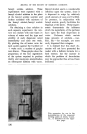
INFLUENCE OF ALIPHATIC CHEMISTRY DEVELOPMENTS lamine oleate itself, for example, darkens from light yellow to deep brown quite rapidly, and is much darker than sodium oleate. With tdethanolamine stearate the, purer the grade of stearic acid the better the colour, but stearic acid is never entirely free from unsaturation. When I was in America I had with me a specimen of practically pure white triethanolamine stearate, pre- pared in London by the most careful technique with the best ingredients. I was gratified to find that my specimen won appreciative comment from all concerned, until after a week or m in Pittsburgh, June, at around 88øF. every day, it all at once developed brown streaks of superficial but alarmingly unattrac- tive appearance, and I abruptly withdrew my prizewinner from cir- culation. The same superficial dark- ening occurs to a greater degree with cationic nitrogen derivatives from stearic acid, and again very hot weather will accelerate the effect. In the high degree of dilution and dispersion in ordinary creams these d•sco.lorations are of course much less evident. Specimens of liquid shampoo made from triethanolamine and mixed isopropanolamine respec- tively, with otherwise e!xactly the same ingredients and proportions: palm kernel fatty acid, industrial spirit, polyethylene glycols and water, do show paler colour with mixed isopropanolamine. Palm ker- nel fatty acid contains a subsidiary proportion of unsaturated acid: about 16 per cent oleic and 1 per cent linoleic, with lauric, myristic, palmitic, etc. On the other hand, specimens of vanishing cream (without perfume) made from the best stearic acid and cetyl alcohol only, show very small differences over a period of many weeks. The most noticeable darken- ing occurs when the colour of the amine itself is very yellow--alkan- olamines darken slowly with age or with overheating, and I have the advantage of a truly vintage trieth- anolamine which is almost mahog- any in colour. It may be noted that it contains no appreciable iron or other metals. Cream made with this very old specimen is among the ex- hibits (shown during the rending this paper.--Editor). The inclusion of 0.5 per cent sodium sulphite appears to be bene- ficial, again indicating that amines activate the oxidising tendency of unsaturated compounds, which may be restrained by reducing agents. The same test compositions main- tained at 30øC. for several weeks, to simulate tropical conditions, all showed a very faint discoloration, the isopropanolamine specimens be- ing no whiter but more pearly. One or two more remarks about triethanolamine in general may be acceptable it is well to keep it in a• warm place in winter, as it freezes fairly readily, and having a lot of hydroxyl groups it has a high speci- fic heat and takes a lot of melting. At about 50øC. it loses its high glycerin-like viscosity and runs easily. If a little water is added it will not freeze at all readily and it 135

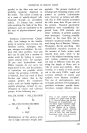
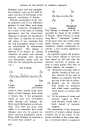
JOURNAL OF THE SOCIETY OF COSMETIC CHEMISTS is perfectly feasible to keep it as a standard aqueous solution, say exactly 10 lbs. to 10 gallons, so that if you want to use 1 lb. of triethano- lamine for 1 cwt. of a cream or lotion, all that is necessary is to measure an exact gallon of stock solution. Many aliphatic hydroxy- lamines are hygroscopic and absorb carbonic acid, so should not be freely exposed in the pure state. If it is desired to make triethano- lamine stearate separately, it should be made as near the melting point of the stearic acid as possible say 55øC. for the stearic acid and 40øC. for the triethanolamine: if the mix- ture becomes too hot its colour will deteriorate. In making creams, the components should be stirred ener- getically only at the very start, then much more slowly. If stirred vigorously in the cold, the cream generally becomes thin. On the other hand fluid lotions may be homogen- ised, the best proportion of amine to fatty acid being carefully deter- mined. In the manufacture of special soaps, triethanolaminct soaps have very low alkalinity, and the oleate, ricinoleate, linseed oil soaps and so on are soluble in many oils and sol- vents and are used in dry-cleaning. As a guide to oil solubility, the triethanolamine soaps are more oil soluble than the monoethanolamine soaps, and the isopropanolamine soaps are more soluble than the cor- responding ethanolamine soaps. If we keep the amine tertiary and knock out hydroxyl groups, the soaps become progressively more oil soluble. It is possible to substitute larger hydrocarbon substituents as in diethylhexyl ethanolamine, be- longing to a class .of substances val- uable as corrosion inhibitors in oils. CONCERNING THE POLYGLYCOLS. Returning from our excursion among the nitrogen compounds, I would like to conclude this Dutch auction of the synthetic aliphatics in descending order of complexity with a brief survey of the compounds with two carbon atom chains. Apart from acetic acid and the vinyl poly- mers, these generally start, as al- ready indicated, with ethylene oxide, and a very numerous class of compounds is built up with these linkages. The simple glycols and glycol ethers are humectants, per- fumery, colour and lacquer solvents, and blending solvents for colours, oils and waxes, usually of mild odour. In recent years the process has been carried very much further. Ethylene and propylene oxides can be converted into polyalkylene gly- cols which can contain any number from three to seventy ethylene oxide linkages. In the polypropylene glycol series, hal/ the CH2 groups are substituted by CH.CHa, pro- bably with two secondary terminal alcohol groups (--CHOH 1 CH•). Now as we progress along such a series, several interesting and sometimes very useful changes be- come apparent. The prototype, diethylene glycol, is a liquid of low 136
Purchased for the exclusive use of nofirst nolast (unknown)
From: SCC Media Library & Resource Center (library.scconline.org)