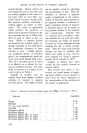
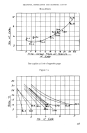
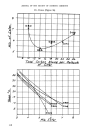
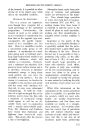
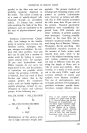
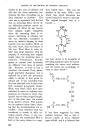
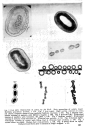
PROPERTIES OF KERATIN FIBRES Fibrous Proteins Symposdum that separation of hydrogen bonded pep- tides may play an important part in bringing about axial contraction of fibres. Later, two of Phillips' co- workers a• claimed that a more con- sistent view of the mechanism of supercontraction and set can be ob- tained if the emphasis previously placed on disulphide linkage reacti- vity is replaced by consideration of other factors which give stability to the wool macromolecule. In the present state of knowledge, stability of the keratin system results from an equilibrium between attractive forces of side chains and the stabilis- ing action of cross-linkages between polypeptides. Three main types of cross-linkage are involved, which in decreasing order of stability are, disulphides, salt linkages and hydro- gen bonds. In the absence of re- straining forces, the attraction of side chains, will cause folding of polypeptide chains. The equilibrium position achieved under any given conditions will depend on the num- ber and nature of the stabilising cross-linkages, and any factor affecting these would be expected to alter the equilibrium position of the polypeptide system and so the length o.f the fibre. Since an unstretched wool fibre neither extends nor contracts when steamed, it follows that the a-form of keratin, in which the polypeptide chains are partially folded, is a stable system. When wool fibres are stretched and steamed, however, X-ray examination shows that the a-form changes to the /•-form with unfolding of the main polypeptide chains. On releasing such a fibre in steam, the a-form does not re- turn, and the final equilibrium length of the fibres depends on the degree of re-orientation of polypeptides occurring in the extended state. If the stretched fibre is steamed for a short time, little re-orientation of the uncoiled polypeptides occurs and re- lease in steam permits folding of chair•s with consequent contraction in fibre length. Steaming of the stretched fibre for greater lengths of time, however, allows the main poly- peptides• to achieve new equilibrium positions in the extetnded state. Blackburn and Lindley have correl- ated the X-ray findings for wool with the work of Bunn and Garner ,•-ø on polyamides. The lat,ter investigators found that spreading of certain spots in the X-ray diffraction pattern resulted from the slipping past one another of layers of polypeptide chains in the /•-(extended) form. This spreading phenomenon is ana- 1ogou•,t to that occurring in the fi- photogaph of wool fibres stretched in steam, and suggests the possi- bility of slippage of the polypeptide chains during setting. On this view, supercontraction and setting of wool fibres are considered to arise as follow:•: When a wool fibre is stretched the polypeptide chains are uncoiled and take up the •-configuration. At the same time, the main chains are oriented in the direction of the fibre axis. Reduction of the adhesion be- tween chains, e.g., by the hydrating action of steam on hydrogen bonds 169

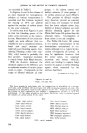
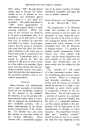
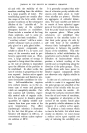
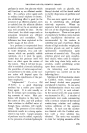
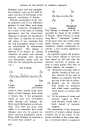
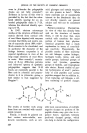
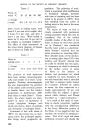
JOURNAL OF THE SOCIETY OF COSMETIC CHEMISTS and the polar groups of side chains, permits the polypeptide chains to slip past one another. After fibres have been steamed under tension for only a short time, the polypeptide• are not in the new equilibrium posi- tion and consequently on releasing such fibres in steam, polypeptides fold up under the action of the inter- nal energy, and axial contraction of the fibre occurs. If steaming under tension is prolonged, however, move- ment of the chains past one another continues until a new equilibrium position is reached, in which the main chain adhesion is sufficient to prevent folding of chains when the fibres are slackened in steam, i.e., a permanent set has been achieved. On this view reagents such as bisul- phites or alkalis which cause fission of the disulphide bonds, would be expected to facilitate setting of stretched fibres by increasing the amount of polypeptide chain slip- page. 3. Alkaliz A study of the effect of Time, Temperature, Concentration and pH on the action of alkalis upon human hair led to the conclusion that hydrolysis of the cystine linkage is followed by secondary reactions which give rise to the formation of new linkages of the type --C--S--C-- and --CH--N-- be- I tween the peptide chains •. The final result obtained on treating kera- tin fibres with alkalis is determined by the extent to which reactions of the type shown in the equations have taken place: R.CH2.S.S.CH•.R + H_•O-- R,CH2SH + R,CH2S.OH CH. CH2. SOH -- x, C----CH.o + HSOH--- H20 + S / 'x C = CH2 -I- HS.CH2.CH-• / 'x CH.CH2S,CH2.CH R.SOH -- R.CHO + H•S R.CHO + R.CH2.NH2 --- R.CH = N.CH2R + H20 Analysis of hydrolysates of alkali- treated wool has confirmed the pre- sence of lanthionine linkages, but no compound containing the --CH=N-- linkage has so far been isolated% In view of the potential danger attached to the use of alkali in hair treatments it is important that all s oaps, emulsions, permanent waving asssitants and dye solutions should be free from appreciable amounts of caustic alkalis. Weaker alkaline salts such as ammonium carbonate and borax are not so destructive in their action and when used at room tem- peratures are not regarded as delete- rious. Even so, great care should be taken to give the hair a most thor- ough washing in order to remove the last trace of alkali. Further, since the t70
Purchased for the exclusive use of nofirst nolast (unknown)
From: SCC Media Library & Resource Center (library.scconline.org)