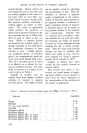
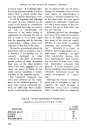
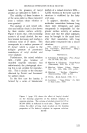
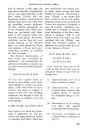
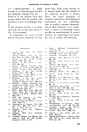
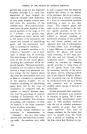
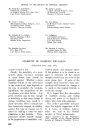
$OLYENT$, HUMECTANT$ AND BLENDING AGENTS solvent balance, since this depends on the number and type of solvents employed and final adjustment is best made by practical tests. The constants of some of the common solvents in use are given in Table 1, in order of decreasing evaporation rates. '[ABLE 1. CONSTANTS 07[: •OME COMMON SOLVENTS Solvent Vapour Evaporation Pressure Flash B.P. Rate ram. Hg Point øC Ether = I 20øC øF Acetone 56 2.1 Methyl acetate 80•/, 54 2.2 Ethyl acetate 77 2.9 lsopropyl acetate 89 4.2 Toluene 111 6.1 Methyl cthyl ketonc 80 6.3 __ Ethanol 78 8.3 Butyl acetate 126 11.8 A•nyl acetate 139 23 lsopropanol 81 21 Butanol 118 33 Methyl glycol 124 34.5 Ethyl glycol 135 43 Ethyl lactate 154 80 Diacetone alcohol 170 147 Butyl glycol 171 163 180 0 ~70 .... 73 23 •22 45 22 40 71 19 45 57 18 74 16 108 33 64 5 95 _ 10 97 _ __ 8 104 - 118 10 125 O.6 140 The final class of solvent to be considered is the non-volatile plas- ticiser. The function of this com- ponent is to improve the elasticity and toughness of the deposited film so that the danger of brittle fracture is eliminated. The materials used for this purpose must be substanti- ally non-volatile, a feature which is widely acknowledged, and they •nust also be water-resistant, a fac- tor which has apparently been little stressed. Since, during the normal life of a lacquer film, frequent immersion in warm water is encountered, the plasticiser is sub- 107

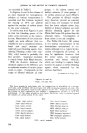
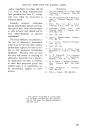
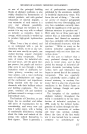
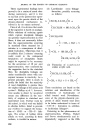
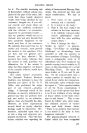
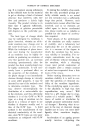
JOURNAL OF THE SOCIETY OF COSMETIC CHEMISTS j ected to leaching out and the film to water absorption. The former effect leads to brittleness of the dry film and the latter effect to softening of the film during the period the water persists in the film after immersion. Although it is well- known that the water-solubility of most plasticisers is low, it may not be generally recognised that the inverse solubility (water in plasti- ciser) is usually much higher as shown in Table 2. TABLE 2. WATER/PLASTICISER SOLUBILITIES Plasticiser Approx. Solubility. gm. per 100 gm. 20øC Plasticiser in Water Water in Plasticis•r Triacetin 6.7 5.3 Dimethyl phthalate 0.31 1.5 Diethyl phthalate 0.06 0.6 Dibutyl phthalate 0.04 0.4 Diamyl phthalate 0.03 0.4 Dioctyl phthalate 0.01 0.15 Di-methoxyethyl phthalate 0.30 ...... -•. 4 _ Tricresyl phosphate 0.01 - -0- 3 The water-resistance may be improved by. including a small amount of an auxiliary plasticiser, e.g. butyl stearate or a wax, e.g. carnauba wkx. As the products are compatible with cellulose nitrate only in the presence of a solvent plasti- ciser, large amounts must not be used. Solvents are also the main com- ponents of nail varnish removers. Active solvents like acetone and butyl acetate are frequently employed, sometimes with a propor- tion of high-boiling solvent, to pre- vent redeposition of the film by sol- vent evaporation. It is also com- mon practice to add a small amount of an oil, e.g. castor oil or butyl stearate to reduce or ameliorate the loss of natural fat from the nail. EOSIN SOLVENTS Since the advent of soluble dyes, principally tetrabromofluorescein (al- ternatively known loosely as eosin or bromo-acid or by its U.S. designa- tion of D. & C. Red No. 21) as an effective means of imparting an indelible or permanent stain in lip- stick applications, much research has been directed towards selection of a suitable solvent for this dye. Earlier work app. ears to have been restricted to the field of conventional cosmetic materials .but this has' been followed by the development of sol- 108
Purchased for the exclusive use of nofirst nolast (unknown)
From: SCC Media Library & Resource Center (library.scconline.org)