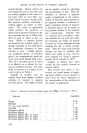
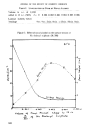
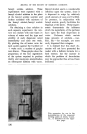
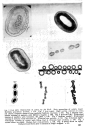
BLEACHING CREAMS lnilled toilet soap, rinsed thoroughly and dried. They then applied about 1 gram of the ointment and allowed it to remain on the skin • hotlr. Then they' removed the remaining oint- ment with a tissue, washed again with soap and water and were dis- missed. Control subject• did not apply the ointment. They washed their faces twice daily in our studio with the salne brand of soap. Here is a summary of the various group tests wc have made to date. Group 1785, 9 white subjects, and group 1749, 6 coloured subjects, were performed at the sarnc time. The white subjects lightened an aver- age of 5{ shades and the coloured subjects lightened 8• shades, indicating, as would naturally bc supposed, that the greater degree of lightening would be observed in the darker skins. }towever, wc do not have sufficient data to •nake this a positive statement. Group 1891, 9 white subjects, treated with 1 per cent ointment in the smnmer months, showed 2.54 per cent increase over the original reflectance. The non- t•t C-1 group, perforlned at the same time, showed a darkening of 3.30 per cent. It is reasonable to presume that if the test group had not used the ointment, they would have darkened to the extent o[ the uon-test group. Thus the net result to. the test group would be the sum of the changes, or 5.84 per cent in- crease in reflectance, a lightening of 3-3/4 shades. Applying the same reasoning to group 2071 control, and group 2081 test, we find a net lightening of 4:} shades in the test group. The natural seasonal varia- tion of skin colour is made apparent by comparison of the summer and winter control groups, C-I and 2071. The summer group, C-i, darkened two shades and the winter group, 2071, showed practically no change. While conducting these experi- ments in skin measurement, we made a series of full face photographs to record the over-all effects. Our start and finish photographs are of course made 6 weeks apart, but the films are developed the same day they are exposed. For greater uniformity, the prints of both films are made at the sanhe time, at the end of the test. We make about 15 prints of each film. We then measure tile control disc on all of these prints, and usu- ally obtain two or three sets of matched start and tinish photo- graphs, which read the same. By this procedure, we obtain start and finish prints of uniform density in which the only remaining variable is the change in reflectance of light from the subject's. skin. (The autho.r hcrc show'cd Slide 7, consisting of the 3'tart and l•nish photographs o! subject 2089, who is said to have shown a lightening of 8 shades). Mr. Nealon continued as follows: We find a peculiar psychological effect on viewing this slide. As we now observe it, we •nay or may not notice that the skin in the December 17th picture is lighter. Our minds direct our major attention to the familiar details of the features, such as the eye, nose, lip, etc. However, 181

JOURNAL OF THE SOCIETY when we turn the slide upside down, we find that our attention is not dis- tracted by the beauty of the features, and a better comparison of the two skin areas is obtained. Another result of this treatment which was quite visible to the eye, and is recorded in full face photo- graphs of freckled test subjects, is the fading or lightening of freckles. This is understandable when we re- member that tan and freckles are both caused by the same pigment, melanin. In the freckle the melanin is deposited in small circumscribed OF COSMETIC CHEMISTS spots, whereas in tanning it is evenly deposited all over the exposed area. These reports answer our questions regarding the efficiency of our pro- ducts. As a result of the work here out- lined in brief and greatly condensed form, we have increased our know- ledge of the action of our products and are better fitted to present them to. our customers. These reports in- dicate beyond reasonable doubt that Bleaching Creams containing 5 per cent Ammoniated Mercury are safe and effective. BIBLIOGRAPHY 1. Gibson, Parker, and Ulmus: Oint- ments prepared by Emulsification. Jour. Am. Phar. Assn. -- Sci. Ed. 30, 7, 196, 1941. 2. Zopf, L. C.: Hydrophilic Ointment Base, Jour. Am. Phar, Assn. Pract. Phcy, Ed. 6, 12, 365, Dec. 1946. 3. Bhatia. V. N. & Zopf, L. C.: Emulsi- fiable mixtures for the preparation of Hydrophilic Ointment Bases. Jour. Am, Phar. Assn. Pract. Pharm. Ed. 10, 7, 410, July 1949. 4. Report of Studies on Ammoniated Mercury Ointment.s, privately printed by the Ex, ternal Products Research Institute, Vols. 1 and 2, 1940, to be found in the libraries of Medical Colleges in the U.S.A. U.S.A. 5. Absorption of Externally Applied Mercury. Gibbs, Shank, Pond and Honsmann. Archives of Derma- tology and Syphilogy, November 1941, Vol. 44, pp. 862-872. 6. Stock, A.: Biochem. Ztschr. 304:73, 1940. 7. Bodnar, J., Odon, S., and Wesz- premy, B.: Blochem. Ztschr. 302: '384, 1939. 182 8. Sollman, T., Cole, H. N. Schrie- ber, N. E. De Wolf, H. F. and Van Cleave, J. U.: Mercurial Inunc- tions in the treatment of Syphilis, Arch, Dermat. and Syph. 27:1 (Jan.) 1933. 9. Nealon, D. F.: Analysis of Con- sumers' Complaints, Drug and Cos- inetic Industry-- Jan. 1945. 10. Nealon, D. F.: An Estim. ate of the current medical opinion of the value of Ammoniated Mercury by Quantitative Means. 1947. Pri- vately printed. 11. Nealon, D. F.: Report of Studies on Nadinola Bleaching Cream. Pri- vately printed 1946. To be found in the libraries of Medical Colleges in the U.S.A. 12. 13. 14. 15. Raper, Biochemical Journal, 20, 735. Arnow, Journal Biological Chemis- try, 118, 531.' Newh.all, Nicherson and ]udd: Final Report on the OSA Commit- tee on the spacing of Munsell Colours. JOSA Vol. 33 P. 385, July 1943. Munsell, Sloan and ' Godlove: Neutra Value Scales I. JOSA, Vol. 23, P. 394, November, 1933.
Purchased for the exclusive use of nofirst nolast (unknown)
From: SCC Media Library & Resource Center (library.scconline.org)