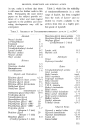
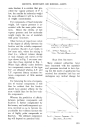
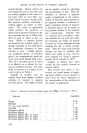
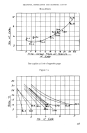
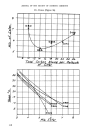
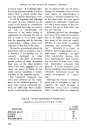
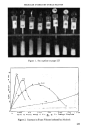
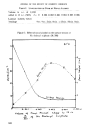
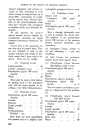
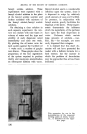
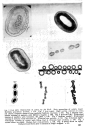
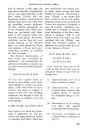
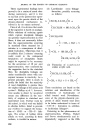
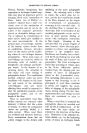
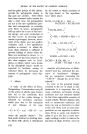
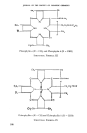
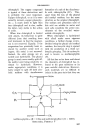
MOLECULAR INTERACTION IN BULK SOLUTION tained in the presence of nonyl alcohol are indicated in Table 1. The stability of these laminae is of the same order as those measured •from a sodium oleate solution or even greater 4. The analogy of such mixed solu- tions and sodium oleate is also, shown by their similar surface activity. Figure 3 sho,ws that, with increasing amoup*s of nonyl alcohol, the sur- face tension decreases and reaches a minimum value of 27 dynes. This corresponds to a surface pressure of 45 dynes 4 which is equal to the collapse pressure of penetrated monolayers of cetyl alcohol and cetyl sulphate. Furthermore, the mixed solution SDS--C.•OH give laminae of stratified step-like structure, but unfortunately the photograph show- ing this is not suitable for reproduc- tion. This is similar to the structure obtained by Perrin '• and Lawrence' for sodium oleate. In the first case the lamina is formed by a series of bimolecular leaflets of a mixed structure $DS- C9OH, whereas in the latter case the structure is stabilised by the fatty acid map. It appears, therefore, that the molecular association between long chain ionic detergents and polar compounds is responsible for the greater surface activity of sodium oleate and that the alkyl sulphates may be brought to the same level after their association with long chain polar compounds into a mixed structure. (The author's present address -is: The Chemistry Department, Kirtg' s College, London.) ]•EFE RENC E S (1) Schulman & Stenhagen. Proc. Royal Soc. B 1938, 126, 356. (2) Matalon & Schulman. Trans-Farad (Discussion), 1949, No. 6, 29. (3) Matalon, Salton, Cohen. Nature, Vol. 167. Feb. 10th, 1951, p.241. (4) Matalon. "Surface Chemistry" (Butterworths), 1949, p.195. (5) Perrim Kolli Zetsch. 1938, 51 3. (6) Lawrence. "Soap Films" (G. Bell & Sons Ltd.), 1929. Figure 1 (page 123) shows the effec• of heptyl alcohol on the foaming properties of Na dodecyl sulphate in aqueous solution. The volume of alcohol present in 120 cc M/300 (SDS) is indicated in each tube. Figure 2 demon- strates •he effect of long chain alcoh,ols on the foaming properties of Na dodecyl sulphate in aqueous solution, M/300. 125

DEVELOPMENTS IN ALIPHATIC CHEMISTRY AND THEIR INFLUENCE ON THE COSMETIC INDUSTRY By W. H. DmI•F.N, M.SC., ^.R.•.C.* I keenly appreciate the distinction of being invited to address this meeting of cosmetic chemists, and if you will allow me an outrageous platitude right at the start, I do feel some degree of diffidence in accept- ing the honour for, as you may know, I am not, either by definition or in fact, a cosmetic chemist. If, however, 'you imagine the scientific industries and commerce of the country as a highly complex system of geared mechanisms, then your industry and mine have engaged at various points for a good many year.4 or to change the metaphor, the cosmetic and synthetic organic chemical industries have built up together, like the foundation, brick- work, decoration and furnishings of a house. The house could not exist without the construction, and no one would or could buy a house without the decoration and furnishing. No metaphor is perfect, and this house is like a skyscraper that presumably never will be finished. The build- ing and its appointment will develop and improve all the time . . . When I say the synthetic organic chemical industry, I infer particu- larly the aliphatic side of the busi- Chief Chemist, General Metallurgical and Chemical Ltd., London. ness. This is sometimes called petroleum chemistry, and it is per- fectly true that the profound devel- opment of the internal combustion engine, the invention of the auto- mobile and the flying machine, and the incidence of two catastrophic world wars, brought about a new industry of incredible dimensions and ramifications. Natural petroleum can be distilled, separated into frac- tions by solvents, and broken down and reassembled just as if its mole- cule were an elaborate jig-saw puzzle the bits can be reduced, oxidised, nitrated and so on to make a bewildering supply of fuels, lubri- cants and chemicals. Petroleum, however, is not the only source of the newer organic chemicals in fact, it is not at all an inexhaustible one. There are natural gases, consisting of simple olefinic and paraffin hydrocarbons and coal, the world deposits of which are expected to survive those of petroleum by thousands of years. Olefinic gases can be obtained by hydrogenating the by-products of coal, or from coke oven gases, and we can start from carbon itself and water to produce hydrocarbons, al- cohols and other substances by the Fischer-Tropsch synthesis. Alcohol, 126
Purchased for the exclusive use of nofirst nolast (unknown)
From: SCC Media Library & Resource Center (library.scconline.org)