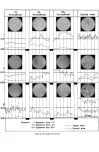
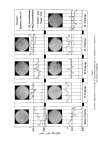
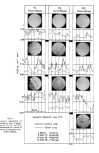
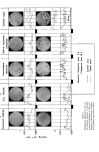
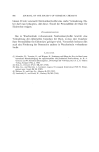
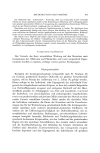
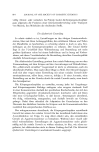
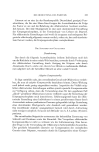
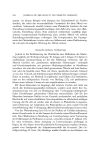
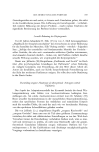
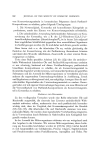
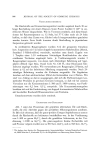
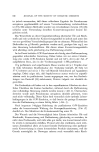
784 JOURNAL OF THE SOCIETY OF COSMETIC CHEMISTS A B C D E F Figure 5 Magnified detail of contact perspiration prints in area of application: A) Formaldehyde 1%/1 hour-- B) Aluminium chloride 15 %/3 hours--C) Formaldehyde 5 %/3 hours after 25strippings--D)Dis- tilled water/1 hour--E) Distilled water/3 hours--F) Distilled water/10 hours. (Fortsetzung der Legende auf gegeniiberliegender Seite)

COMPARISON OF THE EFFECTIVENESS 785 of an unmoistened area. On the perspiration prints, one can also see an in- crease of the large polymorphal spots which are formed by the inhibition of expelled sweat in a periporal relief which is altered by water moistening lasting for varying times. DISCUSSION From the above results it follows that, amongst the tested materials, formaldehyde is the most effective anhidrotic even at low concentrations and after short exposure periods. By denaturing the proteins of the horny layer it causes mechanical constriction or even closure of the terminal portion of the eccrine sweat duct (so-called high level blockage) (19) (20). Such microstructural contractive changes of the epidermal surfaces of the palm and the forearm have been verified with the aid of silicone rubber prints by the method of Sarkany and Caron (28) (29). The intensity and depth of denaturation of the epidermal surface are proportional to the concentration of and the exposure time to formaldehyde (3). This is also confirmed by the gradual regeneration of sweating with successive stripping. Denaturation causes modification of the physico-chemical properties of the horny layer and is the cause of varying adhesivity to the stripping tape as a result, no mechanical failure of the barrier takes place even after a large number of strippings. Mechanical occlusion of the eccrine sweat duct with simultaneously unreduced activity of the sweat gland effects changes in the water circulation in the skin and leads to dilatation of the eccrine sweat ducts in their epidermal sections (30) (31) (32). The period, during which sweating is stopped or reduced, depends on the rate of epidermal regeneration as a result of its uninterrupted renewal (horny layer--approximately 6 days, whole epidermis--26 to 30 days) (2). Explications to A) Construction to impermeability of most eccrine sweat ducts. Longitudinal elongation of dark spots demonstrates the constriction of eccrine sweat ducts to B) Changes after aluminium chloride treatment are the same as those for formaldehyde (longi- tudinal constriction to closure of a large number of eccrine sweat ducts) to C) The contours of most detected eccrine sweat ducts are round and wide open which corres- ponds to their morphological structure in the deeper portions of the horny layer. There is no pronounced imbibition of sweat into the periporal relief to D) Polymorphous, mostly isolated minute black spots with marked small dendritical spines to E) Larger, polymorphous spots with interconnected spines in the periporal relief to F) Intensely black, polymorphous spots, the maiority of which is interconnected with the surrounding spots into large merged groups.
Purchased for the exclusive use of nofirst nolast (unknown)
From: SCC Media Library & Resource Center (library.scconline.org)