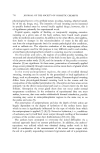
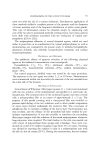
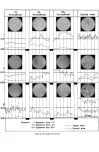
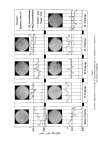
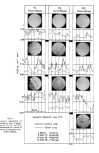
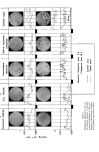
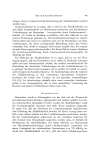
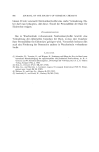
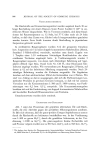
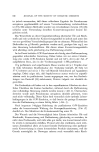
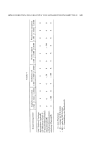
778 JOURNAL OF THE SOCIETY OF COSMETIC CHEMISTS were lying in a supine position on a soft polyurethane foam sponge (moli- tane ©) mat. The dynamics of sweat output were recorded by a resistance hygrometer with a short response time ( 0.5 sec.) (26). Contact indicator sweat tests, according to Rovensk• and Toman (27) were simultaneously conducted and are based on the color reaction between pyrogallol and ferric hydroxide in the presence of water from the sweat. Microstructural changes in the tested areas on the epidermal surfaces were investigated with the aid of the print method conducted according to Sarkany and Caron (28), and these results have already been published in a separate paper (29). Successive stripping of the horny layer was carried out with the aid of cellophane adhesive tape. RESULTS Forma/deh•yde Fig. ! shows the changes of sweat activity rs. the concentration and exposure time to formaldehyde. By comparing the hygrometric recording of sweat output and the print tests, one clearly notes a growing reduction of sweating in the tested area vs. a simultaneous increase of sweating in the control area as a function of increasing thermal stress. The decrease of sweat- ing is already pronounced in the case of 1 ø/o formaldehyde after one hour. This decrease becomes more pronounced with increasing concentrations of formaldehyde and duration of action. Almost complete anhidrosis occurs after the action of 5 % formaldehyde for 3 hours, and complete anhidrosis is observed in the case of 5% and 10% formaldehyde after 10 hours of interaction. The indicator perspiration prints show a decrease of the number and a reduction of the size of the dark spots by comparison to the control area to which only distilled water had been applied. This is a consequence of a constriction and ultimate closure of the eccrine sweat duct caused by formal- dehyde denaturation and contraction of the surfacy horny layer. A detail of a perspiration print at a large magnification is shown in Fig. 5•1. The hygrometric recordings and perspiration prints in Fig. 2 and 3 show increasing sweating as a function of the number of adhesive tape strippings at places where formaldehyde had caused either hypo- or even anhidrosis. Both the number and the size of the dark spots on the sweat print are in- Figure ! Simultaneous recording of sweating with resistance hygrometer and contact indicator perspiration prints of areas of application of 1%, 5 %, and 10 % formaldehyde for a period of 1, 3, and 10 hours. Distilled water used as control.

Formaldehyde Formaldehyde Formaldehyde Distilled water ,. ...... ....•. ...... . ..•: •.• ::..•.:. m: -• •.'•' * •...•(.•:•.•.•:•" •:. •:.•.• ............................ i ...... • ................................. Forearm: I • Exposure time • h I1: Exposure time 3 h Tested area III: Exposure time 10 h ........... Control area Legende siehe gegenfiberstehend
Purchased for the exclusive use of nofirst nolast (unknown)
From: SCC Media Library & Resource Center (library.scconline.org)