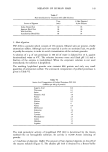
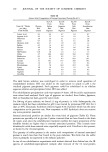
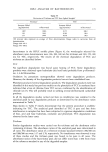
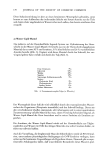
MELANIN OF HUMAN HAIR 141 hydrochloric acid. Furthermore, a pigment isolated with such a method, has a relatively high sulfur content. We proved the introduction of sulfur and phenol, when we heated melanin models (from dopa or dopamine for 24 h under reflux with the phenol-thioglycolic acid mixture (see Table I). B. ENZYMATIC DIGESTION 1. Pre- sensitization of hair. The enzymatic digestion of keratins has been studied by many authors. It has been shown that some keratin derivatives (23,24) or some natural keratins, like feather keratin (25,26) where cystine content is not as high as in the human hair, may be partially digested by usual proteolytic enzymes. However, such enzymes have virtually no action on intact wool or human hair. The enzymatic mixture described by some authors (27) requires a pre-treatment of wool or human hair, (reduction, acylation, carboxy-methylation or oxidation) which can be damaging to the melanin pigments, because of the reasons we have already alluded to (interference with reagents or with degradative products of cystine). The keratinolytic enzyme secreted by a strain of streptomyces Fradiae, described by Nickerson and Noval (28), called keratinase solubilizes about one-third of the weight of virgin wool and one-tenth of unaltered human hair. The new enzymatic digestion procedure, that we have developed is based on the action of Proteinase PSF 2019 on a pre-sensitized hair. Our aim was to avoid treatments of pre-sensitization such as reduction, oxidation and lanthionisation, and instead to find a procedure which enhances the enzyme's penetrability into the human keratin, with minimum risk for the cystine content. A formic acid treatment (29), that removes part of the cuticle was studied. But with such descaled hair fibers, only 20% of keratin was enzymatically digested. Organic solvents at reflux, during 12 hours, mostly removed lipidic materials from human hair. In most cases, such defatted hairs were only slightly digested by the enzyme (Table II). Table II Hair Sensitization by Treatment with Different Solvents Solvent Boiling % Hair Digested (Reflux 12 Hours) Point by the Enzyme Choloroform 61 ø 4 Methyl Aclohol 65 ø 16 Ethylene Glycol Monomethyl Ether 124 ø 7 Diethylene Glycol Dimethyl Ether 162 ø 10 a) DMF treatment. The action of dimethylformamide (DMF) on hair, differs accord- ing to temperature, time and concentration. When human hair is treated at reflux with aqueous solutions of DMF, a part of cystine is quickly transformed into lanthionine. There is, thus, an incompatibility between such treatments and our objective.

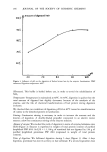
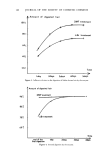
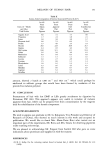
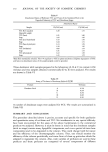
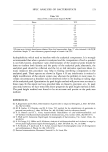
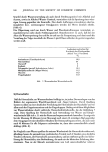
142 JOURNAL OF THE SOCIETY OF COSMETIC CHEMISTS But when human hair is heated in pure DMF between 100øC and 160øC, only small quantities of lanthionine are formed (less than 0.015 mole per 100 g of hair). DMF-treated hair, at 100øC, is not sensitized enough to be sufficiently digested by the enzyme even after 16 h treatment. At 160øC (reflux), pure DMF sufficiently sensitized the hair, even with a short 2-h treatment, but for some species of very thin and soft human hairs, the risk of cystine degradation exists. So, we prefer pure DMF-sensitization at 120øC, for 3 to 4 h.(Table III). Table III Hair Sensitization by Treatment with DMF at 120 ø % % Time Solubilized Hair Hair Digested Source of Pigment (h) During Treatment by the Enzyme Italian Brown Hair 4 4 91 Japanese Black Hair 5 3.5 92 Irish Red Hair 3 5 95 Scandinavian Blond Hair 3 5.5 93 b) LiBr treatment. An alternative sensitization procedure is the treatment with lithium bromide. Alkalibromide solutions, and specially lithium bromide solutions, are known to modify the crystalline structure of keratin (30). We studied the interaction of concentrated LiBr solutions on human hairs. We refluxed (125øC) human hair in a 10 M/I aqueous solution of LiBr for 1 to 8 h (Table IV). Hair treated with LiBr after 1 or 2 h is sensitized enough to be digested by the enzyme. Table IV Influence of Time on Hair Sensitization by a 10 M/1 Solution of LiBr at Reflux % Time Hair Solubilized % (h) During Treatment Cystine Degraded 1 2 9 2 4 14 4 19 42 8 28 44 When the time of treatment exceeded 2 h, we observed chemical transformations of peptide and disulfide bonds most of the degraded cystine was transformed to lanthionine. We showed that if such treatments occur with 7 M/I LiBr solutions or at 100øC, sensitizations of hairs are insufficient. Table V shows some of our results, when human hair is refluxed with a 10 M/I aqueous solution of LiBr. With Japanese black hair fibers, we needed to follow the LiBr sensitization, with a DMF treatment during 30 minutes at 120øC. We checked that cystine was not destroyed. Without this complement of sensitization, the amount of digested hair with the enzyme was only 70%.
Purchased for the exclusive use of nofirst nolast (unknown)
From: SCC Media Library & Resource Center (library.scconline.org)