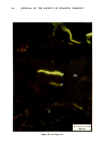
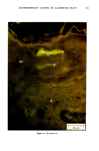
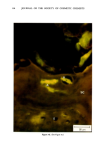
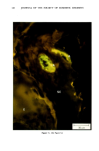
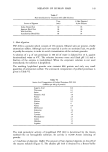
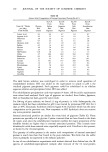
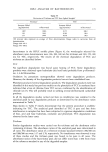
MELANIN OF HUMAN HAIR 151 Table X Amino Acids Composition of Internal Associated Protein (In.A.P.). Units: 10 -2 Moles per 100 g Total Protein In.A.P. In.A.P. In.A.P. In.A.P. From From From From Italian Japanese Irish Scandinavian Hair Hair Hair Hair Pigment Pigment Pigment Pigment Aspartic Acid 8.0 7.2 7.3 9.0 Threonine 1.7 2.3 1.8 2.1 Serine 3.8 3.9 3.8 3.7 Glutamic Acid 6.0 7.5 6.9 7.1 Proline 3.7 4.0 3.5 3.5 Glycine 26.0 22.8 28.8 23.7 Alanine 4.4 4.5 4.4 5.0 Half cystine 10.8 12.1 12.2 11.8 Valine 3.6 3.8 3.8 4.3 Methionine 0.3 0.4 0.5 0.3 Isoleucine 1.3 1.5 1.1 1.6 Leucine 3.0 2.7 2.8 2.4 Tyrosine 1.5 0.9 1.2 1.4 Phenylalanine 1.8 1.6 1.3 1.3 Lysine 5.3 5.6 4.5 4.7 Histidine 0.9 0.9 0.7 0.7 Arginine 3.6 3.3 3.3 3.1 Citrulline 1.4 1.3 1.1 1.3 amount, showed 2 bands at 1200 cm -• and 1025 cm -• which could perhaps be attributed to sulfonic groups that would have been formed by oxidation of the protein-free melanin polymer. IV. CONCLUSION Pretreatment of hair with hot DMF or LiBr greatly accelerates its digestion by Proteinase PSF 2019. This approach appears very useful in isolation of melanin pigment from hair, which can be prepared free from contamination by the reagents used for solubilization of the keratin component. ACKNOWLEDGEMENTS We wish to express our gratitude to Mr. G. Kalopissis, Vice-President and Director of Research of L'Oreal, who showed so much interest in this work and accepted its publication. We would like to thank Mrs. Marie-Claire Ritui who carried out an important part of the experiments, Mr. Riera and Mrs. Gracia for observing pigments under scanning microscopy. We are pleased to acknowledge Mr. Forgeot from Soci&• Oril who gave us some indications about proteinase and supplied us with the enzyme. REFERENCES (1) H. C. Sorby, On the colouring matters found in human hair, J. Anthr. Inst. Gr. Britain, 8, 1-14 0878).

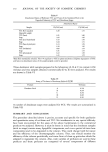
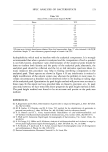
152 JOURNAL OF THE SOCIETY OF COSMETIC CHEMISTS (2) (3) (4) (5) (6) (7) (8) (9) (10) (11) (12) (13) (14) (15) (16) (17) (18) (19) (20) (21) (22) (23) (24) (25) (26) (27) (28) (29) (30) (31) (32) R. A. Nicolaus, M.P. Piatelli, and E. Fattorusso, The structure of melanins, Tetrahedron, 20, 1163-1172 (1964). E. Fattorusso, M. Piatelli, and R. A. Nicolaus, Some natural melanins, Rend. Acc. Sci. Fis. Mat. Napoli, 32,200 (1965). L.J. Wolfram, K. Hall, and I. Hui, The mechanism of hair bleaching, J. Soc. Cosmet. Chem., 21, 875-900 (1970). O. Sakamoto, Y. Fujinuma, T. Ozawa, and H. Katsura, A study of isolation and solubization of human hair melanin. J. Soc. Cosmet. Chem. (Japan), 12 (1), 39-45 (1978). G. Funatsu and M. Funatsu, Isolation of melanin granules from dark hair of humans, Agr. BioL Chem. (Japan), 26 (6), 367-370 (1962). j. A. Serra, Constitution of hair melanins, Nature, 157,771 (1946). M. S. Blois, A. B. Zahlan, andJ. E. Maling, Electron spin resonance studies on melanin, Biophy. J., 4, 471-490 (1964). J. K. Roy and B.C. Roy, Isolation of some acid soluble protein pigment from dark coloured human hair, J. Proc. Inst. Chem., 37 (6), 257-259, (1965). A. G. Bolt, Isolation and purification of human melanoprotein from hair and melanoma tissue, in Life Science, Vol. 6, p. 1277-1283. Pergamon Press Ltd. F. Gjesdal, Investigations on the melanin granules with special consideration of the hair pigment, Acta Path. Microbiol Suppl. 133, 1-112 (1959). G. Laxer, C. S. Whewell, J. Sikorski, and H. S. Woods, The electron microscopy of melanin granules isolated from pigmented mammalian fibres, Bioch. Bioph. Acta. 15,174-185 (1954). K. Hall and L.J. Wolfram, Isolation and identification of the protein component of hair melanin,J. Soc. Cosmet. Chem., 26, 247-254 (1975). Waksman, The Actinomycetes, (Tindall and Cox, London, 1961, Vol. 2). E. Lubnow, Formation of products of melanin in character by hydrolysis of keratin, Naturwiss. 47, 323 (1960). M. L. C. Maillard, Synth&se des mati&res humiques par action des acides amin•s sur les sucres r•ducteurs, Ann. de Chimie, 5 (9), 258-317 (1916). B. L. Hanna, Production of pigment similar to those from hair from aminoacid and keratin interaction, Proc. Soc. Exp. Biol. Med., 80, 285 (1952). J. E. Hodge, Browning reactions in model systems,J. Agric. Food Chem., 1,928 (1953). H. S. Burton and D.J. McWeeny, Fluorescent compounds and non-enzymatic browning Nature, 196, 948-950 (1962). A.M. Duizabo, Aspects mol•culaires de la coagulation du lait, Th}se de Doctorat d'Etat, Universit• Paris VII (1974). H. S. Mason, D.J.E. Ingram, and B. Allen, Free radical property of melanins, Arch. Bioch. Biophy., 86, 225-230 (1960). N. Goetz,J. C. Arnaud, and P. Bore, About the structure of human hair pigment, presented at 1st Int. Congr. of Hair Research, Hamburg (1979). D. R. Goddard and L. Michaelis, Keratin,J. Biol. Chem., 106, 605-614 (1934). P. H. Pringell, Proteolysis of wool and its carboxymethyl derivatives by pronase and other proteases, Aust. J. Biol. Sci., 16 (3), 725-735 (1963). M. Miyauchi, Y. Tasaka, Feather keratin,J. Japanese Soc. Food Nuttit., 5, 93 (1952). Y. Nagai and T. Nishikawa, Enzymic digestion of feather keratin and its derivates, Agr. Biol. Chem., 35 (7), 1039-1043 (1971). B. Milligan, L. A. Holt, and J. B. Caldwell, Enzymic hydrolysis of wool for amino acid analysis, App. Polym. Sympos., 18, 113-125 (1971). W.J. Nickerson, J. j. Noval, and R. S. Robinson, Keratinase, Blochem. Biophy. Acta, 77, 73-86 (1963). J. H. Bradbury and D. E. Peters, Method for the complete removal of cuticule from wool, Text. Res. J., 42 (4), 248-250 (1972). L. Mandelkern, J. C. Halpin, A. F. Diorio, and A. S. Pasner, Dimensional changes in fibrous macromols--system keratin LiBr,J. Amer. Chem. Soc., 84, 138-139 (1962). M. L. Anson, The estimation of pepsin, trypsin and cathepsin with hemoglobin,J. Gen. Physiol., 22, 79 (1939). R. M. Nicolaus, Melanins, (Hermann, Paris, 1968).
Purchased for the exclusive use of nofirst nolast (unknown)
From: SCC Media Library & Resource Center (library.scconline.org)