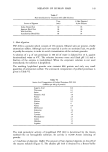
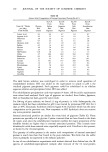
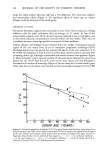
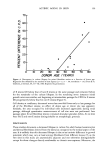
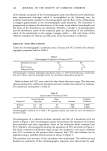
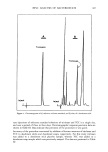
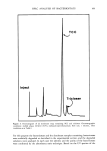
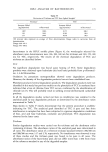
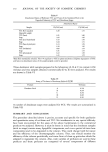
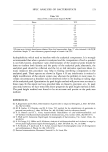
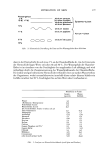
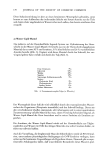
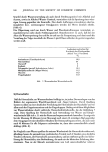
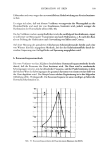
HPLC ANALYSIS OF BACTERIOSTATS 173 Table VII Assay of TCC in Deodorant Soaps (% W/W) 1 Name TCC A 1.6 B 0.6 C 0.5 D 1.4 E 0.5 F 1.03 G 0.47 H 1.04 I 0.39 J 0.16 tall soaps were common brand names obtained from local supermarkets. Soap "C" also contained 0.14% W/W of triclosan. Sample "F" was a laboratory prepared sample to contain 1.0% TCC. hydrophobicity which tend to interfere with the analytical components. It is strongly recommended that when a product is analyzed and the composition of such a product is not fully known, absorbance ratio determination of the analytical peak should be done to confirm both identity and the purity of the analytical peak alternately, the analytical peak should be collected and the 1st or 2nd derivative spectrum taken. In many instances this procedure may help in finding interfering components in the analytical peak. These spectra are shown in Figure 4. If any interference is noticed a slight modification of the solvent system may alleviate the problem in most cases. In certain circumstances a shoulder may be observed either in the leading or tailing edge of the analytical peak. Quantitation by peak height method will prove more accurate in these cases. In this report we have provided data on linearity, precision, etc., by peak area only however, we have tested the above properties by peak height method as well. The peak height method was found to be as accurate and precise as the peak area method. REFERENCES (1) E. Jungermann and E. Beck, Determination of germicides in soaps and detergents,J. Amer. Oil Chem. Soc., 38, 513 (1961). (2) M. B. Graber, I. I. Domsky, and M. E. Ginn, TLC method for the identification of germicides in personal care products,J. Amer. Oil Chem. Soc., 46, 529 (1969), (and the references therein). (3) F. X. Demers and R. L. Yates, Antimicrobials: Identification of 3,4,4'-trichlorocarbanilide and 4,4'-dichloro-3-(trifluoromethyl) carbanilide in deodorant bars,J. Soc. Cosmet. Chem., 28, 659 (1977). (4) T. Wolf and D. Semionow, Rapid liquid chromatography of bacteriostats, J. Soc. Cosmet. Chem., 24, 363 (1973). (5) E. D. George, E.J. Hillier and S. Krishnan, Analysis of trichlorocarbanilide and triclosan in soaps by reverse phase high pressure liquid chromatography,J. Amer. Oil Chem. $oc., 57, 131 (1980). (6) T. R. Koziol, J. T. Jacob and R. G. Achari, Ion-pair liquid chromatographic assay of decongestants and antihistamines,J. Pharm. Sci., 68, 1135 (1979). (7) Personal communication, Monsanto Chemical Co., St. Louis, Mo.

j. Soc. Cosmet. Chem., 32,175-192 (May/June 1981) DER HYDRATATIONSZUSTAND DER HAUT von H. Tronnier* Synopsis As an introduction, the clinical significance of skin hydration is reviewed and the importance of the water/ lipid mantle for the hydration of the stratum corneum and of the corium are described. Factors which reduce hydration include use of water and of detergents, pH adjustment, and use of lipid solvents. Hydration, especially in the stratum corneum, can be increased by occlusion, emulsification, i.e., formation of an artificial water/lipid mantle, and through the use of specific ingredients. Resistance measurements, resonance frequency measurements, and the condensation method, for determining the hydration status of the skin are suitable. These can be complemented by techniques in which the water release from the skin and the behavior of emulsions on the skin surface can be determined since variations in these measurements depend primarily on water loss. EINLEITUNG Die Bedeutung einer ausreichenden Hydratisierung der Hornschicht ist jedem praktisch tiitigen Derrnatologen von der Klinik pathologischer St/Srungen der Hydratation her ge- liiufig. Einmal k/3nnen es endogene Ursachen sein, die bei der Ichthyosis oder der atopi- schen Dermatitis zu St/Srungen unter dem Bilde einer schuppigen, trockenen, aufge- rauhten Haut fiihren, zum anderen aber auch exogene Faktoren, wie etwa die h•iufige Anwendung von Wasch- oder L/Ssungsmitteln, die besonders am Handr•icken ent- sprechende Zust•inde bewirken, fiir die der treffende Ausdruck ,,Abn[itzungsderrnato- se" gepriigt wurde. Es handelt sich dabei um noch nicht entz[indliche Ver•inderungen, die als Folgen der Entfettung und Dehydratisierung der Hornschicht anzusehen sind. * StSdtische Hautklinik Dortmund, Direktor: Prof. Dr. med. H. Tronnier Vortrag gehalten anlSglich des Kongresses der Deutschen Gesellschaft der Kosmetik-Chemiker vom 25. bis 26.4.1980 in Baden-Baden 175
Purchased for the exclusive use of nofirst nolast (unknown)
From: SCC Media Library & Resource Center (library.scconline.org)