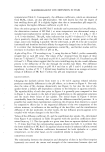
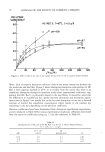
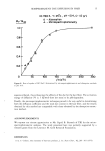
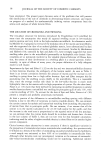
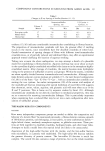
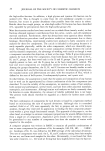
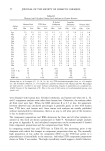
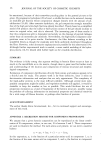
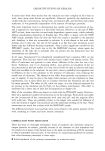
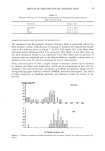
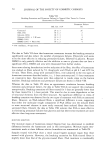
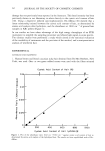
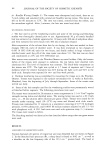
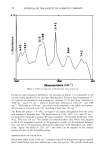
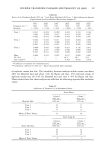
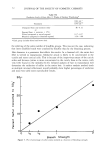
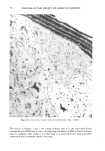
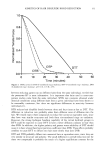
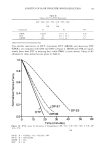
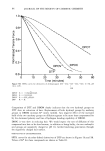
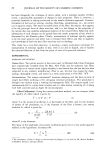
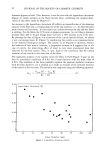
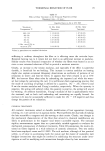
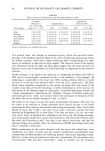
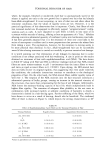
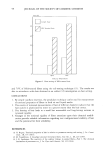
10 JOURNAL OF THE SOCIETY OF COSMETIC CHEMISTS DYE UPTAKE I,/.z•.=•g Hai.r) 4.0 3.0 2.0 {.0 HC RED 3, T:42"C, C:t.O g/•, _ pH =•0.8 pH =4.7 pH=9.0 , I I I I • • •, • 0 40 80 120 160 200 ?_.40 280 5?_0 iV2 (SV2) Figure 4. Effect of pH on the rate of dye uptake by hair from 50 vol. % aqueous ethanol dyebath. fibers. Lack of sorption hysteresis indicates a lack of any major interaction between the dye molecules and the fiber. Figure 5 shows absorption-desorption relationships for HC Red 3 from aqueous dyebath at 25øC. It is evident from the curves that there is no significant absorption-desorption hysteresis under these experimental conditions, sug- gesting that HC Red 3 is physically bound in the hair fibers. It should be noted that the differences in equilibrium dye uptake between absorption and desorprion experi- ments seen in Figure 5 are mainly due to the fact that desorption occurs into a dyestuff solution of limited but significant concentration which results in the residual dye remaining in the hair depending on the partition coefficient. Partition coefficients have been determined from desorption equilibrium experiments, and are tabulated in Table III for various experimental conditions. Affinities determined from the partition coefficients using eq. 12 are also tabulated in Table III. Table II pH Dependence of M,: and D for HC Red 3 in 50 vol. % Water-Ethanol Mixture (T = 42øC, C = 1.0g/l) D X 101ø M• pH (cm2/s) (Ixmol/g hair) 10.8 5.0 4.3 0.85 9.0 6.5 2.7 0.53 4.7 3.0 2.9 0.57

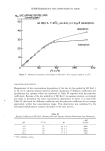
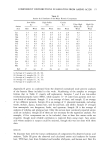
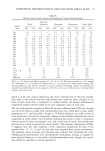
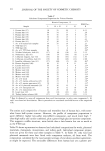
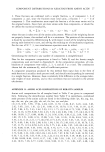
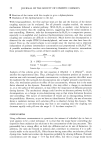
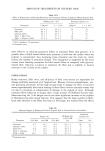
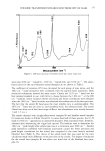
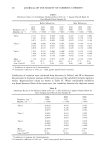
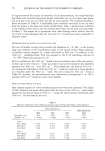
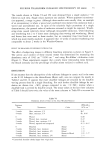
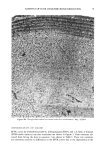
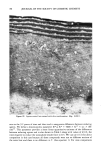
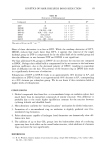
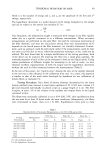
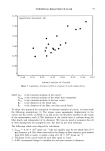
SEMIPERMANENT DYE DIFFUSION IN HAIR 11 Mr, DYE UPTAKE OR DYE LOSS ( ,u. real/g hair ) 50 40 30 2O HC RED 5, T=25øC, pH=6.0, C=t.O g/,• (absorption) Absorption Desorption 8O 160 240 t4/2 ( s I/2 ) I 320 Figure 5. Absorption-desorption relationship for HC Red 3 from aqueous dyebath at 25øC. CONCENTRATION EFFECTS Measurement of the concentration dependence of the rate of dye uptake for HC Red 3 in 50 vol.% aqueous ethanol solution allowed calculation of diffusion coefficients and equilibrium dye uptakes which are tabulated in Table IV together with the partition coefficients. Because of the low solubility of HC Red 3 in aqueous solution, no attempt was made to determine the same concentration dependence in water. It is clear from Table IV that both the diffusion coefficient and the partition coefficient do not change appreciably within this concentration range. This observation was confirmed by the microspectrophotometric analysis discussed in the next section. Table III Partition Coefficient of HC Red 3 Between Hair and Aqueous Solution Determined from Desorption - Apt ø pH T (øC) K* (J/mol) 6.0 25 49 +- 6 9600 6.0 42 44 +- 7 9900 6.0 60 32 +- 2 9600 10.4 42 17 -+ 2 7400 95% confidence limits.
Purchased for the exclusive use of nofirst nolast (unknown)
From: SCC Media Library & Resource Center (library.scconline.org)