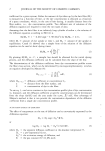
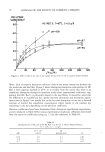
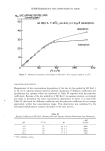
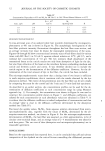
2 JOURNAL OF THE SOCIETY OF COSMETIC CHEMISTS coefficient for a given system. Either the amount of dye taken up by the hair fiber (Mr) is measured as a function of time, or the dye concentration is obtained as a function of a space coordinate, which, in the case of hair dyeing, is usually distance from the fiber surface, i.e., dye concentration profile. Two different sets of solutions of the diffusion equation are required to treat the two types of data. Assuming that the hair fiber is an infinitely long cylinder of radius r, the solution of the diffusion equation according to Hill (2) is Mr/Moo • 1 - 0.692 exp[-5.785 Dt/r 2] for Mr/Moo 0.31, (1) where M• = amount of dye uptake at time t, and M• = amount of dye uptake at equilibrium. Crank (3) showed that a simple form of the solution of the diffusion equation can be used at short dyeing times: M•/Mo• •5-r2 j . (2) By plotting M•/M• vs. t¾2, a straight line should be obtained for the initial dyeing process, and the diffusion coefficient can be calculated from the slope of the line. The determination of the diffusion coefficient from dye concentration profiles across the fiber cross section, which can be determined by microspectrophotometry, involves an equation developed by Matano (4): 1 dx •c• D(c=c•) - 2t dC xdC, (3) where D c=c•) = diffusion coefficient at concentration C•, x = distance from the fiber surface, and C = concentration of dye in the fiber. To use eq. 3, one has to construct a dye concentration profile (plot of dye concentration vs. distance), and the diffusion coefficient at specific concentrations can be determined from the slope (dx/dC) and the area under the curve, j'0 % xdC. One advantage of Matano's method is that it can provide the concentration dependence of the diffusion coefficient from a single dye concentration profile. ACTIVATION ENERGY OF DIFFUSION The effect of temperature on the rate of diffusion can be conveniently expressed by the Arrhenius equation: DT = Do exp(- ED•/RT), (4) or log D T = log D O - ED•/2.303 RT, where D T = the apparent diffusion coefficient at the absolute temperature T, D O = a pre-exponential factor, ED •= the activation energy of diffusion, and R = the gas constant (8.314 J/K.mol). (5)

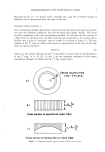
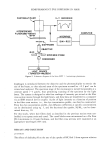
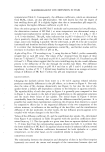
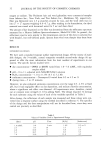
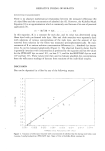
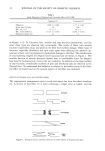
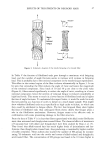
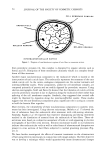
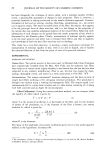
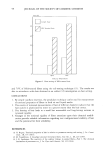
SEMIPERMANENT DYE DIFFUSION IN HAIR 3 Plotting log DT vs. 1/T should yield a straight line, and the activation energy of diffusion can be determined from the slope of the line. MICROSPECTROPHOTOMETRY (5) Dye concentration profiles obtained as a function of dyeing time can be used to calculate not only the diffusion coefficient, but also fractional dye uptake, M•/M•. The latter involves integration of the dye concentration profiles. To calculate the dye content of a fiber from an intensity scan, the fiber cross section is assumed to be circular and is divided into a series of concentric rings of width dr as shown in Figure la. The dye content of the i th ring of a fiber cross section is proportional to the area of the ring times its optical thickness: 2'rrr,dr bi, (6) where bi is the optical thickness of the i th ring which is proportional to the absorbance of the i th ring, Ai = In Io/Ii. (I o and I, are the measured intensities of the beams transmitted through the blank and the i th ring, respectively.) a) •••'• Optical volume of the ß = 2w-ridr b i r•ng b) A=•.n o Cross section of equilibrium dyed fiber c) [ l•7Ai=J•n Iø Ii Cross section of nonequilibrium dyed fiber Figure 1. Diagrams showing optical volume of fiber cross section.
Purchased for the exclusive use of nofirst nolast (unknown)
From: SCC Media Library & Resource Center (library.scconline.org)