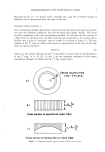
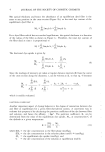
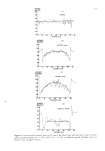
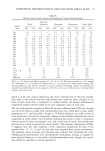
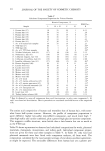
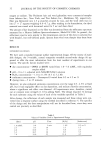
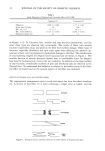
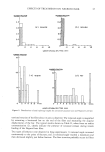
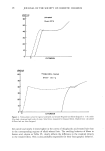
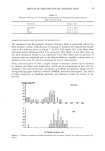
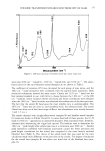
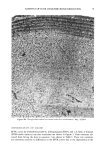
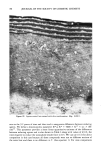
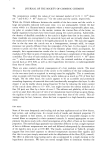
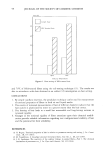
4 JOURNAL OF THE SOCIETY OF COSMETIC CHEMISTS The optical thickness and hence the absorbance of an equilibrium dyed fiber is the same at any position in the cross section (Figure lb), so the total dye content of the equilibrium dyed fiber is Moo oc • 27rridr b oc• 27rridr A. (7) i=l i=l For a dyed fiber which has not reached equilibrium, the optical thickness is a function of the radius of the fiber as shown in Figure lc. Therefore, the total dye content of the fiber dyed at time t is proportional to Mt oc • 2'n'ridr bi oc • 2'n'ridr Ai. (8) i=l i=l The fractional dye uptake is given by •-] 2'n'ridr Ai • r, Ai Mt •=1 i=l = = (9) Moo •27rridrA A• ri i=l i=l Since the readings of intensity are taken at regular distance intervals (•) from the center of the cross section along the diameter, r, can be written as if, so that eq. 9 becomes • it•Ai • iAi M t i=• •=• A• + 2A2 + . . . +nAn __ -- -- A il• A i A n (n + 1) i=l i=l 2 (lO) which is readily evaluated. PARTITION COEFFICIENT Another important aspect of dyeing behavior is the degree of interaction between dye and fiber at equilibrium for a given fiber-dye-solvent system. A convenient way to evaluate this property is by calculating the partition coefficient of the dye between fiber and solution, and hence the affinity, -Al• ø. The partition coefficient, K, can be determined from the value of the equilibrium dye uptake, Moo, at concentration C of the dyebath at a given temperature: [D]f Moo K '-• = , (11) [D] C where [D]f = the dye concentration in the fiber phase (mol/kg), [D]s = the dye concentration in the solution phase (mol/1) = (mol/kg), Moo = the equilibrium dye uptake (mol/kg), and C = the dye concentration of' the solution at equilibrium (mol/1).

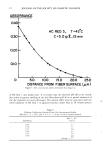
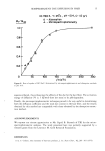
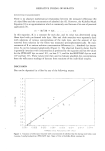
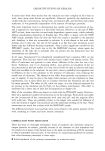
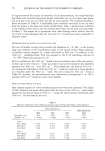
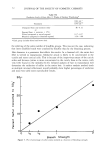
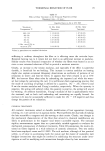
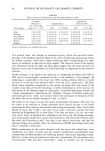
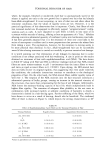
SEMIPERMANENT DYE DIFFUSION IN HAIR 5 For the semipermanent hair dye studied here, the absolute value of Ms is so small compared to the dye concentration of the solutions, that the latter value at equilibrium is virtually the same as the initial dye concentration. Once the value of the partition coefficient is known, the affinity of the dye to the fiber, for a given fiber-dye-solvent system, can be calculated: -A• ø = RTlnK = RTln-- [D]f (12) ß [D]• EXPERIMENTAL MATERIALS Virgin European gray hair (obtained from DeMeo Brothers, New York) has been used throughout this work. The hair was cleaned with a 1% sodium lauryl sulfate solution (SLS), followed by exhaustive rinsing with deionized water. After washing, the samples were blotted between paper towels and dried overnight in a vacuum desiccator over P205 ß The average fiber diameter of the hair was determined microscopically using 20 indi- vidual fibers, and the following results were obtained: maximum value = 96.7 •m minimum value = 48.7 •m median value = 68.7 •m mean value = 70.2 •m standard deviation = 11.3 •m and the average diameter with 95% confidence limit = 70.2 ñ 5.3 HC Red 3, Nt-(2-hydroxyethyl)-2-nitro-p-phenylenediamine, H% N- 0-NH2 HOCH2CH2 NO2 197 g/tool, was chosen as a representative semipermanent hair dye in this work. This dye was obtained through the courtesy of Clairol, Incorporated, and was used without further purification. ABSORPTION EXPERIMENTS The hair samples were dyed either in 50 vol. % aqueous ethanol solution or in aqueous solution under specified experimental conditions. The typical dyebath composition for aqueous ethanol dyeing was: 160 ml of 50 vol.% aqueous ethanol, 20 ml of buffer solution, 20 ml of absolute ethanol, and 0.2-1.0 g of dye, depending on the desired concentration. For aqueous solution dyeing, buffer solutions of required pH were pre- pared using either Na2HPO4 or KH2PO4. The dyebath temperature was controlled within +__ IøC using a circulating water bath. It was observed that the pH of the dyebath changes appreciably after introducing dry hair samples. The change in pH depends on both the buffer capacity of the phosphate buffer and the isoionic point of the hair fiber (pH 5.6-6.2). To minimize the pH fluctuation so that a uniform and reproducible dyebath pH could be maintained in the
Purchased for the exclusive use of nofirst nolast (unknown)
From: SCC Media Library & Resource Center (library.scconline.org)