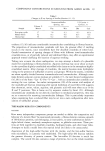
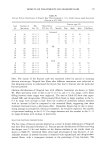
20 JOURNAL OF THE SOCIETY OF COSMETIC CHEMISTS the high-sulfur fraction. In addition, a high glycine and tyrosine (G) fraction can be isolated (22). This is thought to come from the cell membrane complex in some keratins, but occurs in greater abundance than possible from this source in others. Besides these four rough groups, an ultra-high sulfur (X) fraction has been identified (23), separable by precipitation from the high-sulfur group (24). Most fractionation studies have been carried out on whole fibers (mostly wools), so that fractions obtained represent contributions from the cortex, cuticle, and cell membrane material combined. Furthermore, there has always been some question about whether the solubilization procedure itself produces artifactive components due to chain breakage. Nevertheless, experimental studies have produced a fairly consistent set of analyses for these five components. The cuticle is included in this group because it is easily separable physically, unlike the other components, which are chemically sepa- rated. Although this may give rise to some composition overlap between the cuticle and fractionated components, the advantage of working with cuticle as though it were a component overrides this objection, at least at this stage. Table II gives mole percent analyses for each of these five components, from both human hair and wool in the L, H, and C groups, but from wool only in the X and G groups. The G group is only slightly present in hair, and the X group has so far been inadequately isolated. The hair and wool components are remarkably similar within each component group. Among the groups themselves, the X, H, and C fractions are broadly similar to each other, whereas the L and G fractions are each quite distinct. In tabulating compositions, the standard amino acid abbreviations are used, with the exception of Hcy, which is defined as the sum of half-cystine, S-carboxymethylcysteine, and cysteic acid. In what follows, the assumption is made that the amino acid composition of any human hair or wool can be approximated by a linear combination of the five components just described. To test the validity of this assumption, we examine a series of hair samples, both normal and pathological, several wools, and hair from other placental mammals, marsupials, and monotremes. Although amino acid analyses are fairly commonly done for keratins in some laboratories, the amount of reliable published data is not large. The present work should therefore be regarded as a sketch for further more careful study. The best combination of components for each keratin is found by a regression method based on minimizing the sum of squared deviations. Although this is a standard method, Gold et •l, (25) were apparently the first to propose and use it for keratin analyses, though they restricted its application to finding the best component propor- tions within a given single fractionated sample. The approach of this paper is, on the other hand, an attempt to estimate component proportions for several different keratins from a single set of components. Appendix I gives details of the method, which can be generalized to any number of components less than the number of amino acids reported in the analysis. A computer program was written in BASIC to examine all possible combinations of two or more components for goodness of fit for example, LH, LX, HC, . . . LHGC, etc. Goodness of fit, R, was defined as the RMS average of the individual deviations. Two sets of components were used: the L, H, and C analyses coming from hair samples for one set, and from wool samples for the other. Occasionally, it was found that there was some crossover, i.e., the wool set fitting hair data slightly better than the hair set.

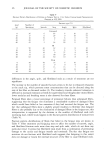
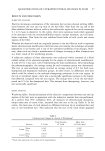
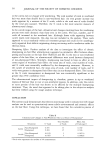
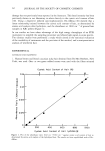
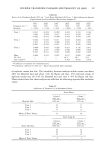
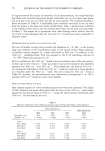
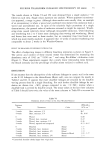
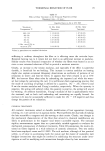
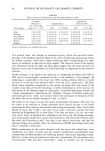
COMPONENT DISTRIBUTIONS IN KERATINS FROM AMINO ACIDS 21 Table II Amino Acid Analyses of the Major Keratin Components Low Sulfur High Sulfur Cuticle (L) (H) (C) Ultra High High Gly- Amino Sulfur (X) Tyr (G) Acid Hair Wool Hair Wool Hair Wool Wool Wool Lys 3.5 3.8 0.6 0.6 3.5 2.8 0.8 0.4 His 0.7 0.6 0.9 0.7 0.5 0.8 1.2 1.1 Arg 7.2 7.5 5.4 6.4 2.8 4.6 7.3 5.4 Hcy 7.7 6.0 27.2 19.2 19.6 16.3 29.5 6.0 Asp 9.4 8.9 2.5 3.2 3.2 3.4 0.7 3.3 Thr 5.4 4.8 10.3 10.2 4.3 4.5 10.9 3.3 Ser 9.0 8.7 11.9 12.8 15.0 14.1 12.9 11.8 Glu 16.7 15.6 8.4 7.4 9.3 8.7 8.2 0.6 Pro 3.8 3.8 12.7 12.9 9.8 11.0 13.5 5.3 Gly 5.1 7.1 6.1 6.5 9.4 8.6 4.6 27.6 Ala 7.0 7.0 2.3 2.9 5.6 5.7 2.0 1.5 Val 6.2 6.0 5.2 5.9 7.5 7.1 2.8 2.1 Ile 3.6 3.7 1.8 2.9 2.1 2.4 1.8 0.2 Leu 10.3 10.3 2.9 4.1 4.5 5.8 1.5 5.5 Tyr 2.5 3.5 0.7 2.3 1.7 2.7 1.8 15.0 Phe 1.9 2.6 1.1 2.0 1.2 1.5 0.5 10.3 Ref: 27 (a) 27 (b) (c) (d) (e) 26 (a) Average of 3 samples (26, 28, 30). (b) Average of 3 samples (26, 3l, 32). (c) Average of 3 samples (33, 34, 35). (d) Average of 3 samples (31, 36, 37). (e) Average of 2 samples (24, 32). Appendix II gives in condensed form the observed normalized mole percent analyses of the keratin fibers included in this work. Numbering of the samples or averages follows that in Table V, mostly self explanatory. Samples 7 and 8 are low-sulfur trichothiodystrophic hairs (TTD), while samples 11-15 come from patients with var- ious kinds of ichthyosis. Sample 11 is an average of three, and sample 12 an average of two different patients. Sample 26 is an average of 11 placental mammals, including wools, mohair, alpaca, human hair, seal fur and hair, and rabbit. Sample 27 averages four marsupials: two kangaroos, koala, and opossum. Sample 28 is the average of analyses of echidna and platypus hair. Only the sixteen most commonly reported amino acids are included, though all of these are not necessary for the regression analysis. For example, if five components are to be included, then at least five amino acids are required, though more reliable correlation is expected from using more. Any amino acid whose analysis is suspect could be omitted, though this was not done with these data. RESULTS To illustrate how well the linear combination of components fits observed amino acid analyses, Table III gives the observed and calculated amino acid analyses for human hair, TTD hair, hair from X-linked and lameliar ichthyosis, and human nail. Best fits
Purchased for the exclusive use of nofirst nolast (unknown)
From: SCC Media Library & Resource Center (library.scconline.org)