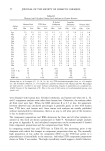
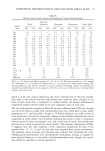
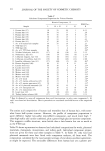
30 JOURNAL OF THE SOCIETY OF COSMETIC CHEMISTS (41) (43) (44) (45) (46) (47) (48) P. Morganti, L. Muscardin, U. Avico, and M. Cristofolini, "Abnormal Amino Acid Changes in Human Hair Associated With Rare Congenital Syndromes," in Hair Research, C. E. Orfanos, W. Montagna, and G. Stuettgen, Eds. (Springer-Verlag, Berlin, 1981), pp 442-445. (42) J. H. Bradbury, G. V. Chapman, and N. L. R. King, The chemical composition of wool. II. Analysis of the major histological components produced by ultrasonic disintegration, Aust. J. Biol. Sci., 18, 353-364 (1965). E. O. P. Thompson and I. J. O'Donnell, unpublished data in W. G. Crewther, R. D. B. Fraser, F. G. Lennox and H. Lindley, The chemistry of keratins, Adv. Protein Chem., 20, 191-346 (1965). J. M. Gillespie, M. J. Frenkel, and P. J. Reis, Changes in the matrix proteins of wool and mouse hair following the administration of depilatory compounds, Amt. J. Biol. Sci., 33, 125-136 (1980). J. H. Bradbury, The structure and chemistry of keratin fibers, Adv. Protein Chem., 27, 111-211 (1973). A. H. Simmonds, The amino acid composition of keratins. III. The amino acid composition of different qualities of wool, Aust. J. Biol. Sci., 8, 537-540 (1955). R. D. B. Fraser, T. P. MacRae, and G. E. Rogers, Keratins: Their Composition, Structure and Biosyn- thesis, (Charles C. Thomas, Springfield, Ill., 1972), p 131. W. A. Schroeder, L. M. Kay, B. Lewis, and N. Munger, The amino acid composition of certain morphologically distinct parts of white turkey feathers, and of goose feather barbs and goosedown, J. Am. Chem. Soc., 77, 3901-3908 (1955). (49) A. Parisot and J. Derminot, The amino acid composition of various morphological fractions of wool isolated during progressive acid hydrolysis, Appl. Polymer Symposium, 18, 45-53 (1971). (50) E. Menefee, Crosslinking in keratins. I. Theory for solubility on simultaneous chain scission and crosslink cleavage, J. Appl. Poly. Sci., 9, 2819-2827 (1965). (51) E. Menefee, Determination of crosslink density by end group analysis after partial degradation. I. Theory, Polymer, 22, 1214-1218 (1981).

j. Soc. Cosmet. Chem., 36, 31-37 (January/February 1985) Oxidative dyeing of keratin fibers KEITH C. BROWN, STANLEY POHL, ANNE E. KEZER, and DAVID COHEN, C/alto/Research & Development Laboratories, 2 B/ach/ey Road, Stamford, CT 06922. Received October 31, 1984. Presented at the Annual Meeting of the Society of Cosmetic Chemists, New York, December 6-7, 1984. Synopsis Dye uptake by hair and wool cloth has been measured by a reflectance technique. Using a statistical experimental design, color formation from a single pair of reactants has been used to define and quantify many of the factors that control the process. Although peroxide concentration has little effect, color intensity depends on the concentration of reactants and added surfactants and on the dyeing time. These results can, in some cases, be predicted from the solution kinetics of the coupling reaction where the rate- controlling step is formation of a reactive intermediate from hydrogen peroxide, followed by a series of faster oxidative and coupling steps to give the dye. However, there are significant differences between the dyeouts and solution chemistry reflecting the important role of the substrate on the dyeing process. INTRODUCTION Previous studies on the chemistry of oxidative dyeing of keratin fibers have concentrated largely on the reactions occurring in dye solutions (1-3). While these results appear to correlate with actual fiber dyeouts in most cases, there are significant differences reflecting both chemical and physical effects of the substrate. In addition, the oxidant used for the solution studies, potassium hexacyanoferrate, is not commonly used in dyeing practice. We now report results on dye uptake by hair and wool and on the factors that control the process when hydrogen peroxide is used as oxidant. In particular we have evaluated the amount of color deposited on hair and wool from two oxidative dye couples in use in current hair dye formulations: p-phenylenediamine (PPD)/4- amino-2-hydroxytoluene (AHT) and N, N-bis-(2-hydroxyethyl)-p-phenylenediamine (BHP)/1-naphthol (NAP). This paper describes the variation of dye uptake with factors such as dye and H202 concentration, solution pH, dyeing time and concentrations of ammonia and surfactant in the dye solution and compares the results with those predicted from the kinetics and mechanism of the solution reaction. EXPERIMENTAL All dyeing solution components were commercial materials used without further pu- riffcation. Samples of indo dyes were isolated from coupling reactions using atmospheric 31
Purchased for the exclusive use of nofirst nolast (unknown)
From: SCC Media Library & Resource Center (library.scconline.org)