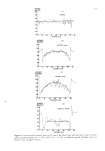
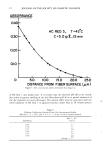
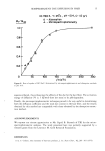
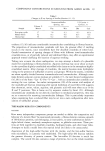
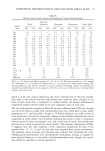
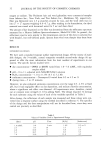
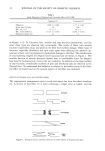
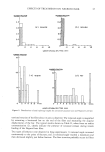
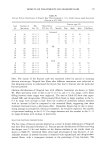
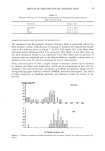
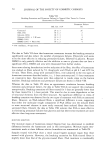
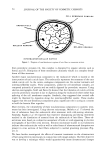
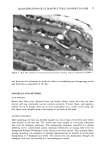
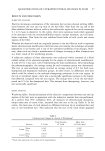
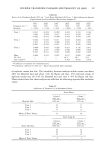
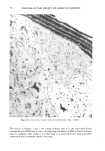
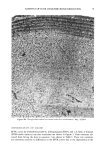
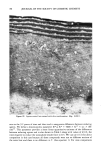
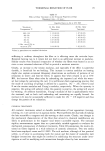
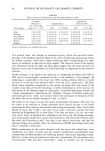
QUANTIFICATION OF ULTRASTRUCTURAL CHANGES IN HAIR 57 RESULTS AND DISCUSSION SUBJECTIVE ANALYSIS Electron microscope examination of the transverse hair sections showed striking differ- ences between the root and tip ends of the hair fiber. Hair from the tip end of the fiber exhibited discrete holes or voids in the endocuticle region of the cuticle measuring 0.1 to 0.2 p,m in diameter. In the cortex, there were numerous voids which appeared to be associated with the intermacrofibrillar matrix, nuclear remnants, and cell mem- brane complexes. Hair from the root exhibited fewer holes in both cuticle and cortex regions of the fiber. Whether the observed voids are originally present in the hair fiber as such or represent latent ultrastructural modification which becomes overt during the techniques of sample preparation is not known and is one of the unresolved problems of microscopy. How- ever, these voids are clearly a manifestation of changes occurring in fiber ultrastructure as a direct result of the weathering process. A subjective analysis of these observations was conducted which consisted of a blind ordinal rating of the photomicrographs for the degree of ultrastructural modification. A scale of 0 to 3 was used, with 0 representing the least modification. After identifying the photomicrographs, the average rating for each treatment group was determined. The root or non-weathered region received an average rating of 0.5 for both non- shampooed and shampooed treatment groups. In other words, no differences were seen which could be related to the multiple shampooing treatment in the root region. In the tip or weathered region, there was a statistically significant increase in the disrup- tion observed compared with the root region. The ratings were 2.4 for the non-sham- pooed and 2.6 for the shampooed hair. The increase from shampooing, however, was not statistically significant. IMAGE ANALYSIS Weathering Efj•cts. Statistical analysis of the objective comparisons between root and tip regions of the hair were in agreement with the subjective analysis that was performed. At a greater than 95% confidence level, all measures of ultrastructural disruption, except mean area of cortex voids, increased from the root to the tip (Table I). In the cortex, the mean area of voids showed no difference between tip or weathered hair and root or non-weathered hair. This indicated that the size of the voids which appeared Table I Ultrastructural Changes as a Result of Weathering* Total Number Mean Area Location % Voids of Voids of Voids (•m 2) IRoot 0. 365 33 0.189 Cortex LTip 1.050 76 0. 176 /Root 0.0335 5 0.00710 Cuticle [Tip 0.412 35 0.0358 * Each value represents the median of 40 measurements.

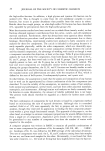
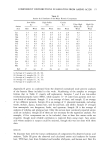
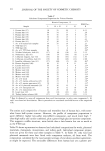
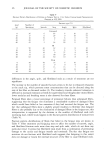
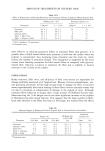
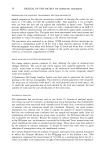
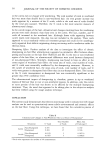
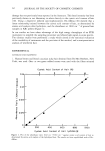
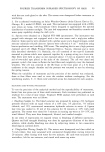
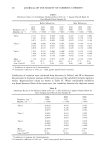
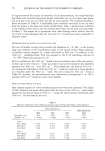
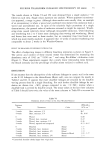
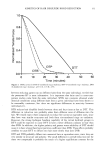
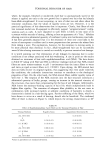
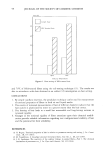
58 JOURNAL OF THE SOCIETY OF COSMETIC CHEMISTS in the cortex did not change with weathering. The total number of voids in weathered hair was more than double that in non-weathered hair. An even greater increase was made apparent by a measure of the % voids, which is the total area of voids divided by the total area scanned. Therefore, the % voids is the more sensitive measure of ultrastructural change. In the cuticle reigon of the hair, ultrastructural changes resulting from the weathering process were more dramatic than those seen in the cortex. The size, number, and % voids all increased in the weathered hair. Although linear voids appearing between cuticle layers were measured, this data was not included in the analysis. These voids appeared to occur randomly within all treatment groups and could not be unambigu- ously separated from defects originating during sectioning and/or irradiation under the electron beam. Shampooing EfJ•cts. Further analysis of the data to investigate the effect of chronic shampooing on hair fiber ultrastructure suggested an interactive effect between sham- pooing and location on the hair fiber (Tables II and III). In the root or non-weathered region of the hair fiber, no ultrastructural differences were noted between shampooed or non-shampooed fibers. Similarly, shampooing was found to have no effect in the cortex region of weathered hair fibers: the mean area of voids, total number of voids, and % voids were essentially unaffected by the shampooing treatment. However, in the cuticle of weathered hair, the mean area of voids, total number of voids, and % voids were greater in shampooed hair fibers than in non-shampooed fibers. The increase in the % voids measurement in shampooed hair was statistically significant at the greater than 95% confidence level. The ultrastructural impact of shampooing is, therefore, greater in tip or weathered regions of the hair than in root or non-weathered regions. In addition, only the cuticle or outer portion of the hair was shown to be affected by the multiple shampooing treatment. Thus, the trend that appeared to be taking place in the subjective analysis has been verified using the image analysis technique. CONCLUSION The current study demonstrates that electron microscopy used in conjunction with image analysis can be used to quantitatively assess subtle environmental and cosmetic effects on the hair fiber. Using this technique, we have found that the cumulative process of Table II Ultrastructural Changes in Non-Weathered Hair as a Result of Shampooing* Total Number Mean Area Treatment 73 Voids of Voids of Voids (•Lm 2) Cortex I Nøn-Shampøøed lShampooed Cuticle l Nøn'Shampøøed LShampooed 0.365 33 0.189 0.484 35 0.186 0.0335 5 0.00710 0.0165 4 0.00826 * Each value represents the median of 40 measurements.
Purchased for the exclusive use of nofirst nolast (unknown)
From: SCC Media Library & Resource Center (library.scconline.org)