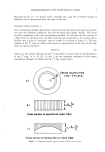
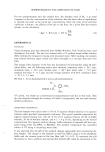
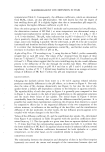
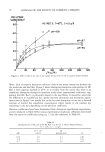
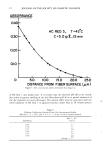
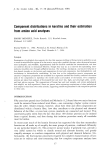
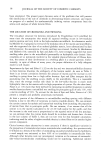
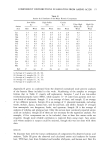
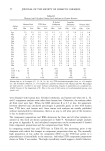
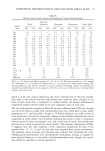
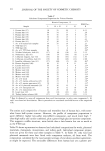
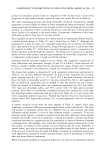
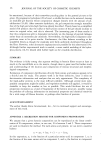
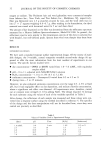
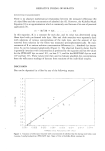
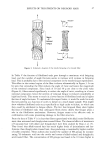
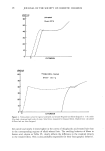
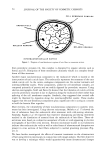
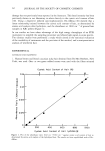
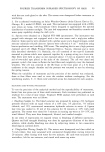
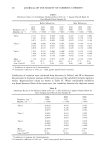
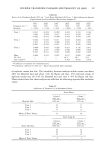
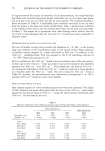
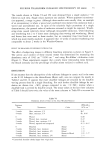
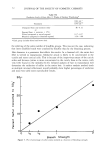
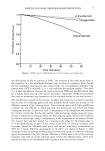
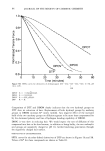
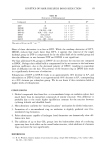
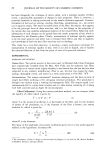
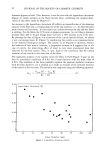
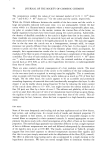
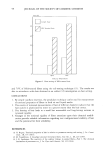
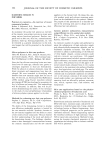
62 JOURNAL OF THE SOCIETY OF COSMETIC CHEMISTS damage has not previously been reported in the literature. This band intensity has been previously shown in our laboratory to relate directly to the cysteic acid content of hair (10). Using a dispersive infrared spectrophotometer, Bit-Alkhas (10) showed that a linear relationship existed between the cysteic acid content of hair, as determined by amino acid analysis after hydrolysis, and the absorbance at 1040 cm-• of ground hair samples in KBr pellets (Figure 1). In our studies we have taken advantage of the high energy throughput of an FTIR instrument to simplify the sampling procedure and obtain high signal-to-noise spectra. Two distinct studies were performed: a study which aimed at the statistical evaluation of the variability of treatments and the precision of the method, and a semiquantitative analysis of weathered hair. EXPERIMENTAL MATERIALS AND EQUIPMENT i. Human brown and blond caucasian scalp hair obtained from De Meo Brothers, New York, was used. One- or two-gram tabbed cresses were used with the fibers oriented 0.16 o 0.08 0.04 Cysteic Acid Content of Hair (%) 4 8 12 16 I I I r 0 200 400 600 800 I000 Cysteic Acid Content of Hair (jJmoles/g) Figure 1. Plot of the absorbance ratio 1042 cm-t/1650 cm-• against cysteic acid content of hair as determined by amino acid analysis of the hydrolysed hair. The results are from unpublished work of Bit- Alkhas.

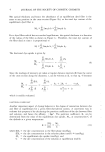
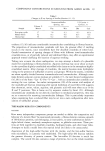
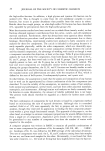
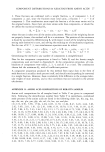
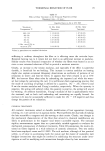
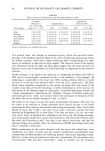
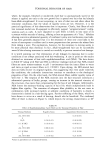
FOURIER TRANSFORM INFRARED SPECTROSCOPY OF HAIR 63 with the root ends glued to the tabs. The tresses were shampooed before treatment or weathering. ii. For accelerated weathering an Atlas Weather-Ometer (Atlas Electric Device Co., Chicago, Ill.), model 65-WRC, was used. This instrument was equipped with a 6000- watt xenon arc lamp, with borosilicate filters designed to approximate the spectral distribution of summer sunlight. The unit had temperature and humidity controlk and water spray capability during the dark cycle. iii. Spectra were obtained on a Digilab FTS-10M spectrometer. The instrument was purged with nitrogen and equipped with a hot wire source and a triglycine sulfate detector. Some spectra were obtained with a globar source and a liquid nitrogen-cooled mercury cadmium telluride detector. Spectra were collected at 4 cm-• resolution using boxcar apodization and coadding 1000 scans. The sampling device was a. high pressure diamond anvil cell (High Pressure Diamond Optics, Tuscon, Arizona) and is more fully described elsewhere (l 1). Basically, the cell consisted of two type-II diamonds mounted in pistons which were squeezed together by a spring acting on a lever arm. Hair fibers were held in place on one diamond (about 1.5 mm in diameter) with the aid of two-sided tape placed at the sides of the diamond. The cell was closed and pressure cycled a few times to flatten the hair fibers and completely cover the diamond windows. The cell was centere.d in the IR beam at the focal point of a 6 X beam condenser in the sample chamber and the pressure was returned to zero by releasing the spring tension. When the variability of treatments and the precision of the method was evaluated, three or four fibers were used to cover the window without overlapping. For the weathering studies, 9-11 fibers were stretched across the diamonds for each analysis. BLEACHING AND WAVING PROCEDURES To test the precision of the analytical method and the reproducibility of treatments, brown hair was given one of three mild treatments. Each treatment was performed in triplicate for a total of nine tresses. Triplicate FTIR analyses were performed on each tress. The treatments were as follows: i. Bleaching (Samples A). The bleach solution was prepared by mixing a 6% hydrogen peroxide solution with an equal volume of a 10% urea, 3% glycerine, 7% sodium chloride, and 12% concentrated ammonium hydroxide solution in water. A 2-gram hair tress was soaked in 10 mL of this solution for 30 minutes at 32øC with mild agitation. The tresses were rinsed for 5 mintues in running tap water at 30-35øC and towel blotted. They were then shampooed, blotted, and combed straight. In one series of experiments we exposed tresses to bleaching of different intensities. Quarter and half strength bleaching was done by appropriate dilutions of the above solution, while double bleaching was done by subjecting tresses to two consecutive bleachings as outlined above. ii. Thioglycollate Waving (Samples B). The tresses were shampooed and then rolled on 3/4-inch rollers they were saturated with commercial thioglycollate waving lotion for 20 minutes. After rinsing with water for two minutes, the curls were saturated with neutralizer, left for two minutes, and rinsed with warm tap water.
Purchased for the exclusive use of nofirst nolast (unknown)
From: SCC Media Library & Resource Center (library.scconline.org)