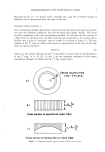
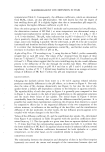
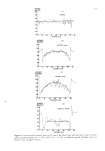
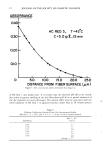
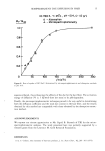
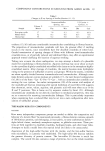
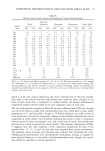
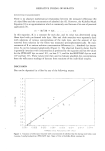
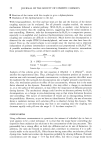
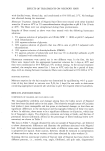
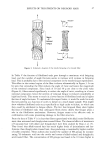
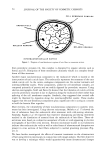
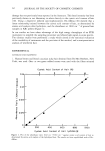
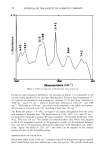
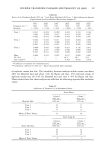
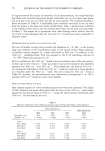
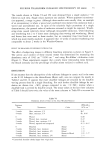
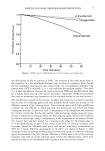
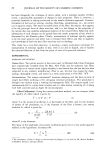
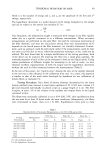
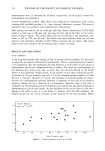
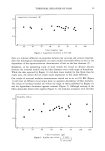
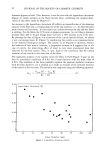
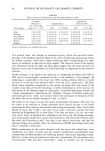
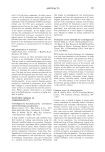
64 JOURNAL OF THE SOCIETY OF COSMETIC CHEMISTS iii. Bisu/fite Waving (Samples C). The tresses were shampooed and rinsed, then set on 3/4-inch rollers and saturated with commercial bisulfite waving lotion. The lotion was left on for 60 minutes at 32øC. The tress was rinsed, removed from the rollers, and the neutralizer applied. After 3 minutes, the hair was rinsed and dried. WEATHERING PROCEDURES i. The hair used in all the weathering studies and some of the waving and bleaching studies was thoroughly cleaned prior to use. Approximately 50 g of loosely bundled hair was extracted in a Soxhlet apparatus for 14 hours with 300 mL of anhydrous ether, and then extracted for seven hours with 300 mL of absolute ethanol. After evaporation of the solvent from hair by air drying, the hair was washed in three changes (500 mL each) of distilled water. It was then immersed in two changes of 0.001 N HC1 (500 mL each) for two hours, and finally soaked in large volumes of distilled water until the pH of the rinse water was above 5.0. The hair was air dried and conditioned at 22øC and 65% RH before use. Hair tresses were mounted in the Weather-Ometer on metal holders. Only the bottom halves of the tresses were exposed to radiation the top halves were shielded with aluminum foil. The level of irradiation was constant. The black-body temperature on the tresses was 65øC. The light was cycled at 3.7 hours of exposure and 1 hour of darkness while the relative humidity was 64% during the light cycle and 92% in the dark cycle. Samples were exposed for two- and four-week periods. if. Outdoor weathering was accomplished by mounting the tresses as in the Weather- Ometer. Tresses were exposed to the outdoor environment for 12 weeks in Rockville, Maryland, from the beginning of July through September. Some of the tresses were wetted out daily. iii. Some of the hair samples used for the weathering studies were permanently waved or bleached before exposure. The following procedures were used: The tresses were immersed for 20 minutes at room temperature in 1:1 v/v Toni © regular strength waving lotion and distilled water. The waving lotion was used at a 20:1 bath ratio, i.e., 20 mL solution (after dilution) per gram of hair. Tresses were rinsed for 30 seconds under running, tepid (30-35øC) tap water and blotted with cloth towels. Tresses were immersed for 12 minutes in a neutralizer consisting of 0.75 N hydrogen peroxide, 0.04% phenacetin, and 0.0045 M sodium stannate adjusted to pH 3.5-4.0 with phosphoric acid. A 20:1 bath ratio was used with agitation every 2-3 minutes. The tresses were rinsed as before. The bleaching method was identical to that described above except that one-gram tresses were used. RESULTS ASSIGNMENT OF ABSORPTION BANDS Typical diamond cell spectra of virgin hair and once-bleached hair are shown in Figure 2. In the bleached hair spectrum (B), a sharp band is found at 1042 cm-•, as well as a shoulder on the low frequency side of the 1231 cm -• protein band. The band at

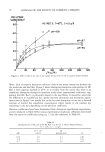
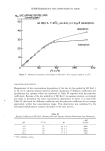
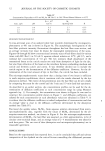
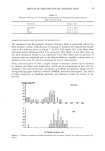
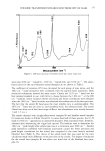
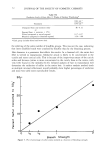
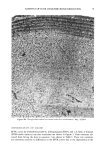
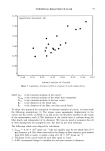
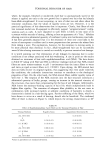
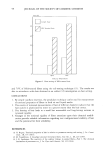
FOURIER TRANSFORM INFRARED SPECTROSCOPY OF HAIR 65 1.60 I { B •. o- Wavenumbers [cm ] Figure 2. Diamond cell spectra of virgin (A) and bleached (B) hair. 1042 cm-1 has been assigned to a symmetric S = O stretching vibration of sulfonate or sulfonic acid groups of cysteic acid residues, and its absorbance, therefore, is a measure of the - SO j content of hair (10). Spectral subtraction makes for easy elucidation of the spectra of oxidized or reacted species. A virgin hair spectrum was subtracted from both a bleached and a bisulfite- treated hair spectrum. The resulting difference spectra are shown in Figures 3 and 4.
Purchased for the exclusive use of nofirst nolast (unknown)
From: SCC Media Library & Resource Center (library.scconline.org)