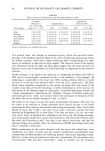
74 JOURNAL OF THE SOCIETY OF COSMETIC CHEMISTS (13) A. Simon and D. Kunath, Vibrational spectra and structure of s-alkyl thiosulfates (Bunte salts), Bet. De/•tche Chem. Ges., 94, 1980- 1986 (1961). 14) E. Tolgyesi, Weathering of hair, Cosmetics a,d Toiletties, 98, 29-33 (1983). 15) J. A. Swift and A. C. Brown, "Scanning Electron Microscope Observations of Human Hair Weath- ering," in The First Hz•ma, Hair Symposium, A. C. Brown, Ed. (Medcom Press, New York, 1974), p 332. 16) V. N. E. Robinson, A study of damaged hair, J. Soc. Cosmet. Chem,, 27, 155 (1976). (17) L. J. Wolfram and M. K. O. Lindemann, Some observations on the hair cuticle, J. Soc, Cosmet. Chem., 22, 839 (1971).

j. Soc. Cosmet. Chem., 36, 75-86 (January/February 1985) Factors affecting the kinetics of disulfide bond reduction in hair R. RANDALL WICKETT and BRUCE G. BARMAN, The Procter and Gamble Company, Miami Valley Laboratories, P.O. Box 39175, Cincinnati, OH 45247. Received October 31, 1984. Presented at the Annual Meeting of the Society of Cosmetic Chemists, New York, December 6-7, 1984. Synopsis The kinetics of hair disulfide bond reduction by dihydrolipoic acid (DHL), dithiothreitol (DTT), and 1,3 dithiopropanol (DTP) and their analogs have been investigated using a single-fiber technique. Structure- activity relationships are described, and it is shown that the overall rate of reduction may be altered by factors that affect the equilibrium constant of the reaction between the reducing agent and hair or the rate of diffusion of the reducing agent into the hair. DHL is many times faster in reducing hair than are its monothiol analogs correlating with the much higher equilibrium constant of the reaction between DHL and protein disulfide bonds. Reduction of hair with DHL leads to the formation of a moving boundary of reducing agent in the hair that can be clearly visualized by electron histochemistry. Structure activity relationships in analogs of DTT and DTP illustrate the effects of hydroxyl groups on reactivity and differences between the formation of five-membered dithiolane or six-membered dithiane rings on oxidation. INTRODUCTION A variety of hair care products from permanent waves to depilatories act by reducing hair disulfide bonds. The efficacy of these products may be affected by both the rate at which they react with hair disulfide bonds and the ease with which they penetrate into the hair structure. In a previous work on reduction kinetics in hair using a single-fiber tensile kinetics (SFTK) technique (1), dithiothreitol (DTT) and dihydrolipoic acid (DHL) were found to reduce hair much faster than did thioglycolic acid at pH 10 or below. It was postulated that this difference in kinetics is due to the much higher equilibrium con- stant between these dithiol reducing agents and hair disulfide bonds. Equilibrium constants are higher for these compounds because they form stable ring structures on oxidation (2). The equilibrium constant can affect overall reaction kinetics because the reaction leads to an increase in the diffusion constant of the reductant in the hair. This increase in diffusion constant can lead to the formation of a moving boundary of reducing agent in the hair that can be visualized by histochemical techniques. In this work we present a comparison of lipoic acid to its monothiol analog, 8-thiooc- 75
Purchased for the exclusive use of nofirst nolast (unknown)
From: SCC Media Library & Resource Center (library.scconline.org)