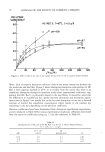
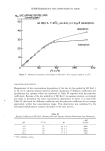
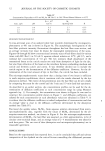
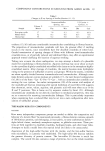
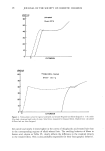
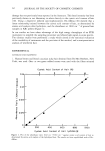
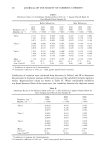
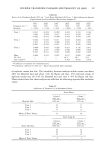
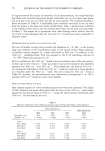
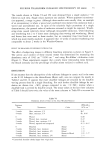
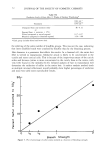
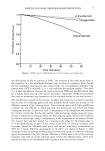
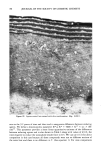
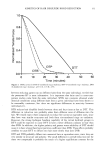
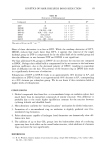
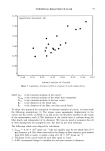
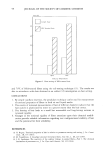
76 JOURNAL OF THE SOCIETY OF COSMETIC CHEMISTS tanoic acid, that clearly shows that it is formation of the cyclic dithiol that leads to the increase in the rate of reduction. We also present studies of reduction kinetics with homologous derivatives of dithiothreitol and dithiopropanol intended to help elucidate the relative importance of structural factors affecting diffusion into the hair. The SFTK method is ideally suited for such studies because quantitative comparisons can be made using small amounts of reducing agent. MATERIALS AND EQUIPMENT Human head hair from a single donor, who had never subjected her hair to chemical treatment, was used for all of the work described in this report. The hair was given a double lathering with Prell © Shampoo and thoroughly rinsed prior to use. Tensile measurements were made on an Instron © tensile tester interfaced to a Hewlett Packard 9825A © microcomputer. Measurements of hair diameter were made on an optical diameter gauging system made by the Diffracto © Corporation. Reducing agents that were not commercially available were synthesized in our laboratories by James Brown, PhD. THE SFTK METHOD The single-fiber kinetics method has been described in detail in a previous work. The method is based on stress relaxation caused by the breakage of disulfide bonds. Hair is extended to 102% of its original length in buffer under the pH and temperature conditions of the test and then rapidly stress relaxed using a strain cycling technique. The buffer is then replaced by a solution of the reducing agent of interest and reaction is followed by loss of tensile stress. Data may be analyzed quantitatively using either a pseudo-first-order model or a moving-boundary model of the reduction kinetics de- pending on the shape of the force-versus-time curve. The dithiol reducing agents studied in this work generally follow the moving-boundary model described by equation 1 below (1). 1. F(t) = F(0)exp(- (2/3) (KC/T)t3/2), where F(t) is the force at time t, F(0) is the force at time zero, C is the initial concentration of reducing agent, T is the root mean square of the two semi-diameters of the elliptical hair shaft, and K is the apparent rate constant. K is a combination of the rate of the reduction reaction and a factor related to the rate of diffusion of the reducing agent into the hair. RESULTS AND DISCUSSION COMPARISON OF DIHYDROLIPOIC ACID TO MONOTHIOL ACIDS Figure 1 shows SFTK curves for reactions of the sodium salts of DHL (dihydrolipoic acid), 8-thiooctanoic acid, and thioglycolic acid with different sections of the same hair at pH 9.0 using 0.1 M thiol (0.05 M DHL). Note that the rate of force reduction with DHL is much faster than with either 8-thiooctanoic acid or thioglycolic acid. The only difference in structure between DHL and 8-thiooctanoic acid is the presence of

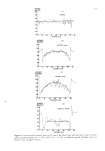
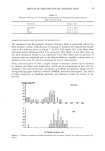
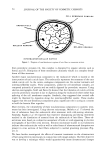
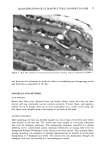
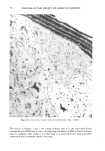
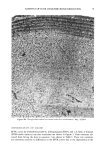
KINETICS OF HAIR DISULFIDE BOND REDUCTION 77 1.0- 0.8- 0.6-- 0.4-- 0.2-- 0.0 h•oglycolate Dihydrolipoate ! I I I I i 0 10 20 30 40 50 60 Time (minutes) Figure 1. SFTK curves for dihydrolipoate, 8-thiooctanoate, and thioglycolate. the thiol group on the six position of DHL. The presence of this thiol group leads to the formation of a five-membered dithiane ring structure on oxidation. Even though the five-membered ring may be more strained than the six-membered dithiolane ring formed when DTT is oxidized (2,3), it still stabilizes the oxidized product. This leads to a higher equilibrium constant for reaction between DHL and disulfide bonds than for disulfide bond reaction with typical monothiol compounds. (Differences between five- and six-membered ring formation will be discussed further in the next section.) The equilibrium constant of the reaction can affect the overall reaction kinetics because the reaction of a reducing agent with hair disulfide bonds causes an increase in the diffusion constant of the reducing agent. Thus reducing agents with high equilibrium constants are very efficient in enhancing their own penetration and reduce hair along a sharp reaction front. In previous work (1) the presence of this sharp front was indicated by a kinetic model that fits the data and by light microscopy studies using dye pene- tration or reduction of iodinated fibers (4). The reducing agent itself can be visualized by electron microscopy using a modification of the histochemical technique of Swift (5). Control hair and hair treated for 5 minutes with either 0.5 M thioglycolate or 0.15 M dihydrolipoate at pH 9.3 was rinsed, fixed with 1% osmium tetroxide, thin sectioned, placed on 200-mesh gold grids, and stained with silver methenamine at 40øC for 3 hours. Electron micrographs at 16,200X are shown in Figure 2. This technique results in staining of SH groups and shows the extent to which the reducing agent has penetrated the hair. Lipoate diffusion is clearly seen to be of the moving- boundary type with all of the reducing agent behind the diffusion front, while thio- glycolate is seen to be distributed with a gradient from the outside inwards.
Purchased for the exclusive use of nofirst nolast (unknown)
From: SCC Media Library & Resource Center (library.scconline.org)