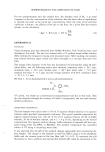
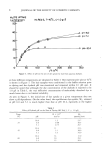
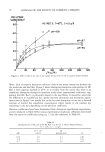
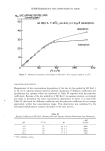
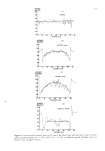
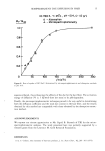
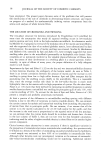
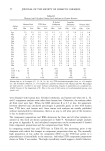
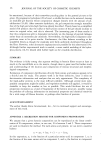
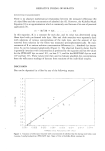
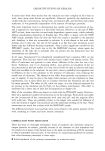
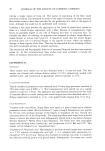
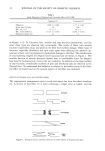
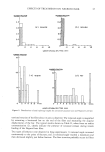
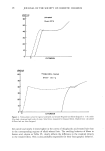
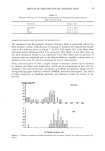
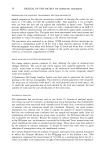
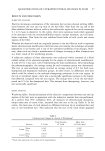
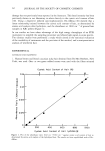
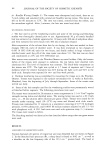
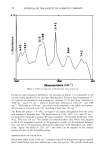
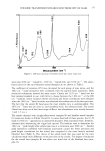
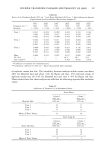
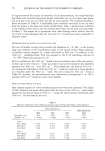
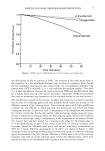
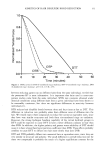
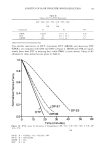
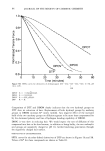
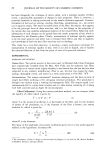
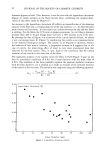
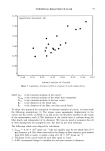
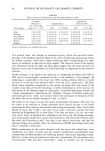
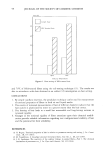
84 JOURNAL OF THE SOCIETY OF COSMETIC CHEMISTS DPOV x,x '-.,.,DPOC DTP ...... I I I I I 0 10 20 30 40 50 Time (minutes) Figure 5B. SFTK curves for derivatives of dithiopropanol (HS-CH 2-- CH- CH 2- 10.0, 22øC. OR DPOT R = -- CH 2 QCO2H. DPOC R = CH2CO2H. DPOV R = (CH2)5CO2H. DTP R = H. DPOT 60 SH). 0.5 M, pH Comparison of DTT and DBOM clearly indicates that the two hydroxyl groups on DTT slow its reduction of hair. Replacement of both hydroxyl groups by methoxy groups in DBOM increases K* nearly twofold. Any negative effect of the increased bulk of the two methoxy groups on diffusion appears to be more than compensated for by the decreased polarity and loss of hydrogen bonding capability of DBOM. DBOC is very slow in reducing hair. We would expect the rate of diffusion of this compound into hair to be slow because, in addition to being bulky, the two carboxylic acid groups are negatively charged at pH 10, further hindering penetration through the negatively charged hair surface. DERIVATIVES OF DITHIOPROPANOL SFTK curves for six ether-linked derivatives of DTP are shown in Figures 5A and 5B. Values of K* for these compounds are shown in Table III.

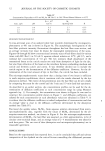
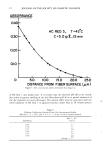
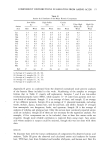
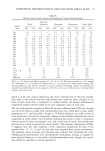
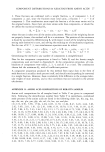
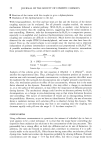
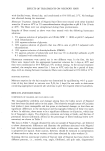
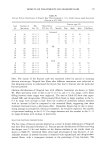
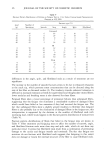
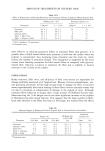
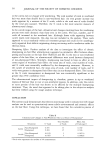
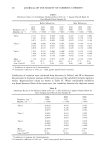
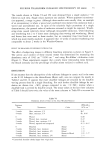
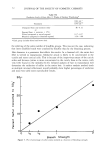
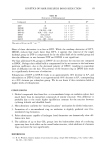
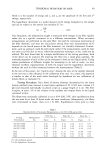
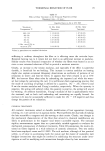
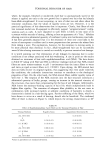
KINETICS OF HAIR DISULFIDE BOND REDUCTION 85 Table III Derivatives of Dithiopropanol Compound R K K* DTP H 3.3 x 10 -5 5.1 DPOM CH 3 3.1 X 10 -5 4.9 DTP-E 1 CH2CH 2 - OH 2.3 X 10- 5 4.0 DTP-E3 (CH2-CH2-O)34 9.4 X 10 -6 2.2 DPOV (CH2)5CO24 1.2 X 10 ¸ 2.6 DPOC CH 2 -- CO2 H 8.5 X 10- 6 2.1 DPOT CH2-- Q -CO2 H 3.3 X 10 -6 1.1 The units ofK arecmM-•sec-•5 None of these derivatives is as fast as DTP. While the methoxy derivative of DTT, DBOM, reduces hair much faster than DTT, it appears that removal of the single hydroxyl group in DTP is compensated for by the added bulk of the methyl group and that the difference in rate between DTP and DPOM is not significant. The four additional CH2 groups in DPOV do not decrease the reaction rate compared to DPOC. Perhaps their added bulk is compensated for by an increase in the hair/water partition coefficient, due to the decreased polarity of DPOV, resulting in equivalent rates of diffusion into the hair. The presence of the benzene ring in DPOT does result in a significantly slower rate of reduction. Ethoxylation of DTP to DTP-E1 leads to an approximately 20% decrease in K*, and ethoxylation to DTP-E3 leads to an approximately 60% decrease in K*, corresponding to a 20% decrease per ethoxylate group. We do not know if this correlation holds at higher levels of ethoxylation. CONCLUSIONS 1. Dithiol compounds that form five- or six-membered rings on oxidation reduce hair much faster than do monothiol compounds of similar structure. This difference is probably due to the much higher equilibrium constant for the reaction between cyclizing dithiols and disulfide bonds. 2. Histochemistry confirms the "moving-boundary" mechanism for dithiol reductants. 3. Formation of a six-membered ring on oxidation is slightly preferred over five- membered ring formation. 4. Polar substituents capable of hydrogen bond formation can dramatically slow dif- fusion into hair. 5. The addition of up to four CH 2 groups into the hydrocarbon chain of a reducing agent may have little effect on the overall reduction rate, while addition of a benzene ring can lower the rate significantly. REFERENCES (1) R. R. Wickett, Kinetic studies of hair reduction using a single fiber technique, J. Soc. Cosmet. Chem., 34, 301-316 (1983).
Purchased for the exclusive use of nofirst nolast (unknown)
From: SCC Media Library & Resource Center (library.scconline.org)