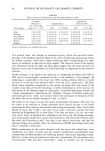
86 JOURNAL OF THE SOCIETY OF COSMETIC CHEMISTS (2) W. W. Cleland, Dithiothreitol: A new protective reagent of SH groups, Biochemistry, 3, 480-482 (1960). (3) U. Schmidt, P. Grafen, and H. W. Goedde, Chemistry and biochemistry of lipoic acid, Angew. Chem. Internat., Edit/Vol. 4, 846--856 (1965). (4) K. W. Herrmann, Hair keratin reduction and swelling in mercaptan solutions. Trans. Faraday Soc., 59, 1663 (1963). (5) J. A. Swift, Electron histochemistry of cystine containing proteins in thin transverse sections of human hair, J. Royal Microsc. Soc., 88, 449-460 (1968).

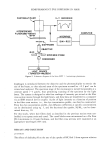
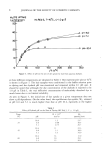
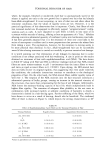
j. Soc. Cosmet. Chon., 36, 87-99 (January/February 1985) Torsional behavior of human hair LESZEK J. WOLFRAM and LINDA ALBRECHT, Clairol Research Laboratories, 2 Blachley Road, Stamford, CT 06922. Received October 31, 1984. Presented at the Annual Meeting of the Society of Cosmetic Chemists, New York, December 6-7, 1984. Synopsis The unique tensile properties of keratin fibers in water led Speakman to develop the technique of fiber calibration which has become one of the mainstays of hair testing methodology. We have followed a similar approach in studying the torsional rigidity of hair. A simple modification allows for the torsion pendulum technique to be used both in air and in liquids. The results of torsional measurements on fibers of different diameters suggest that the hair cuticle, while tough and resilient in the dry state, undergoes water plasticization to a much greater extent than the hair cortex. The change in the torsional moduli of fibers exposed to chemical modification can be related to the configurational stability in water and be of sonhe utility in predicting the setting behavior of hair. INTRODUCTION Bogaty (1) was the first to point to the relevance and importance of torsional defor- mations both in impartation and in maintenance of hair styles. By setting or waving of hair, helical coil configurations are formed and the performance of these can be related to the engineering spring theory in respect to the effects of fiber diameter, coil radius, and torsional stiffness. The latter is highly moisture sensitive, a behavior that can be accounted for by the two-phase model for keratin structure developed by Feugh- elman (2). In this model, the hair fiber is viewed as a composite made up of two phases: the water unpenetrable and axially oriented filaments embedded in a water absorbing, cystine-crosslinked matrix. In the dry hair, the mechanical properties of both phases are similar. The fiber acts as a homogeneous, isotropic material, the tensile or torsional deformations being resisted by the total structure. On exposure of hair to increasing levels of humidity, the absorbed water progressively softens the matrix, thus lowering its mechanical modulus while the filament phase remains relatively unchanged and highly resistant. The water brings to the fore the latent anisotropy of keratin fibers. In the tensile mode of deformation, the filaments are the primary load-bearing elements of the fiber as the swollen and highly weakened matrix contributes little to the overall resistance. The reverse occurs in torsion. In this deformation mode, the water-pene- trated and soft matrix phase takes up virtually all shear stress imposed on the fiber, with the stiff filaments merely tilting as the matrix deforms. Since the early work of Speakman (3), the measurements of tensile properties of keratin fibers have been utilized in studies of their behavior in a diversity of media, in mon- itoring the course of cosmetic modification of hair by various reagents, and in evaluation of fiber damage. The calibration approach (work or force index in the wet state) which 87
Purchased for the exclusive use of nofirst nolast (unknown)
From: SCC Media Library & Resource Center (library.scconline.org)