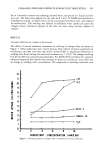
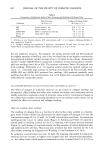
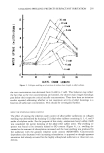
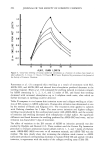
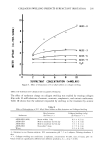
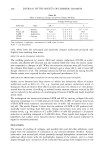
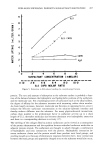
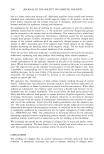
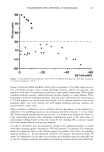
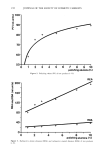
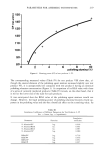
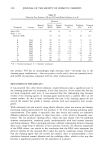
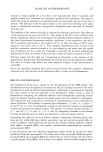
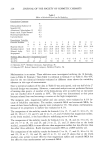
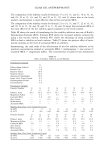
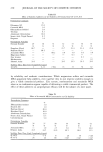
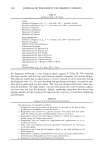
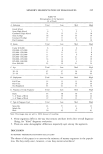
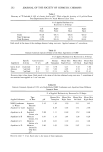
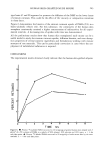
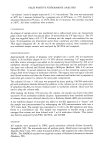
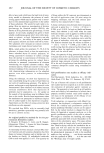
220 JOURNAL OF THE SOCIETY OF COSMETIC CHEMISTS Table IV Values for Test Products VII and VIII and Market Products A to K Toothpaste Abrasion Abrasive Dentin Enamel Scratching Polishing Cleaning Country Type* (RDA) (REA) (SV) (PV) (CP) Silica (VII) Silica + 1% Alumina (VIII) 60 15 - 15 3 80 55 26 -7 36 211 A USA N 65 15 - 10 9 33 B FRG N 30 13 - 20 5 35 C FRG N 78 11 - 6 7 40 D FRG N 89 18 - 32 4 53 E USA S 199 32 - 76 - ! ! 70 F USA N 78 46 - !!4 - 15 79 G FRG S 154 122 - 115 - 20 96 H USA N 9! !7 - ! 8 10! I USA S 98 17 - 52 2 !90 K USA N !20 !96 - 7 ! 3 ! 267 * N = Normal toothpaste. S = Smokers' toothpaste. test product VIII has an astonishingly high cleaning value--obviously due to the cleaning agent combination--this test product can be said to have an extremely favor- able profile of properties compared with the other market products. DISCUSSION OF THE RESULTS It was assumed that, after dentin abrasion, enamel abrasion plays a significant part in the cleaning properties of a toothpaste, if not a key function. As the reason why this has not been recognized until now, it was assumed that this relationship only becomes evident if the cleaning agents or cleaning agent systems have a uniform effect on the enamel surface. As this is most conclusively the case if the cleaning agents do not scratch the enamel but polish it instead, systems with such properties were investi- gated. With extremely low and scarcely rising dentin abrasion, there was serious and sharply increasing enamel abrasiveness for test products I-VI with increasing polishing agent concentrations. This makes it especially clear that dentin and enamel are extremely different substrates with respect to their wear rates--a fact which is frequently over- looked. The test products' cleaning effect, which also rises steeply with the polishing alumina concentration, correlated purely mathematically with both enamel abrasion and dentin abrasion. This in principle prevents a definite relationship between cleaning effect and a single form of abrasion. If one considers, however, the absolute magnitude of the RDA values, one arrives at the conclusion that the REA value represents the decisive variable for the cleaning effect under the specific conditions chosen. Provided that the cleaning agent does not scratch the enamel, there is understandably a close correlation between enamel abrasion and the polishing effect, which in this way also becomes a significant parameter for the assessment of a product.

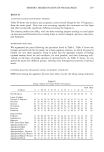
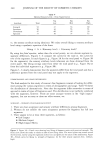
PARAMETERS FOR ASSESSING TOOTHPASTES 221 The measurement results for test product VIII demonstrate that these parameters allow the production of marketable toothpastes, which with respect to all properties closely approximate dental requirements. Test product VIII's excellent cleaning power is also apparent from clinical tests. The advantage of this product becomes particularly evident when compared with the other market products. The current results present a modified picture of the ideal cleaning agent systems com- pared with conventional concepts by focusing attention on a specific form of enamel abrasion. This new concept resolves the conflict which is undesirable from a dental point of view, viz., that a high cleaning effect is only possible at the cost of high dentin abrasion. A further consequence is that one will have to search for other comparable polishing agent systems in an extensive series of tests in a wider and possibly even different field to those studied so far. REFERENCES (1) Statement of the FDI/WG4 task group I on dentifrice abrasivity, FDI-Congress, Hamburg, September 1980. (2) R. R. Lobene, P.M. Soparkar, and M. B. Newman, Plaque removing effectiveness of brushing with dentifrice or water, J. Dent. Res., 62, 199 (1983). (3) H. Stean and G. C. Forward, Measurement of plaque growth following toothbrushing, Community Dent. Oral Epidemiol., 8, 420-423 (1980). (4) R. W. Phillips and V. Huysen, Dentifrices and the tooth surface, American PerJ•mer and Essential Oil Review, 50, 33-41 (1948). (5) M. L. Swartz and R. W. Phillips, Comparison of bacterial accumulations on rough and smooth enamel surfaces, J. Periodontol., 28, 304-307 (1957). (6) M. L. Swartz and R. W. Phillips, Cleansing, polishing and abrasion technics (in vitro), Ann. Rev. N.Y. Acad. Sci., 153, 120-136 (1968). (7) D. Singer and H.-D. Mierau, Plaquebildung und Oberfl•ichenstruktur des Zahnschmelzes, Dtsch. zahniz'rztl. Z., 33, 527-528 (1978). (8) H.-D. Mierau, Beziehungen zwischen Plaquebildung, Rauhigkeit der Zahnoberfl•iche und Selbstreinigung, Dtsch. zahniirztl. Z., 39, 691-698 (1984). (9) R. S. Manly, A structureless recurrent deposit on teeth, J. Dent. Res., 22, 479-481 (1943). (10) J. Head, Modern Dentistry, (W. B. Saunders Company, Philadelphia, 1977), pp 60-64. (11) R. R. Lobene, Clinical studies of the cleaning functions of dentifrices, J. Am. Dent. Ass., 105, 798-802 (1982). (12) M. Pader, Dentifrices: Perspectives, Cosmetics & Toiletries, 97, 40-59 (May 1982). (13) J. B. Wilkinson, Efficacy of dentifrices--formulation and evaluation, Cosmetics & Toiletries, 97, 45-48 (October 1982). (14) O. K. Dolles, H. M. Eriksen, and P. Gjermo, Tooth stain during 2 years' use of chlorhexidine- and fluoride-containing dentifrices, Sc•nd. J. Dent. Res., 87, 268-274 (1979). (15) G. J. Leonard, J. J. Witt, and R. A. Underwood, The enhancement of chlorhexidine stain in dogs, J. Dent. Res., 591, Abstr. 27 (1980). (16) A. Gaffar, H. P. Niles, and C. B. Davis, Evaluation of an oligomer or an oligomer plus cetyl pyri- dinium chloride against plaque, stain, calculus, and gingivitis,J. Dent. Res., 60, 1432-1439 (1981). (17) J. E. Ellingsen, G. R/311a, H. Eriksen, and H. Nordb/3, Dental stain by chlorhexidine, a possible mechanisrn, J. Dent. Res., 61, Abstr. 174 (1982). (18) J. L. McDonald, B. R. Schemehorn, and G. K. Stookey, The influence of dietary factors upon dental staining in the rat, f/. Dent. Res., 61, Abstr. 30 (1982). (19) W. D. Miller, Experiments and observations on the wearing of tooth tissue variously designated as erosion, abrasion, chemical abrasion, denudation etc., Dent. Cosmos, 49, 1-23, 109-124, 225-247 (1907). (20) A. Sagnes and P. Gjermo, Prevalence of oral soft and hard tissue lesions related to mechanical tooth cleaning procedures, Community Dent. Oral Epidemiol., 4, 77-80 (1976).
Purchased for the exclusive use of nofirst nolast (unknown)
From: SCC Media Library & Resource Center (library.scconline.org)