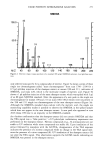
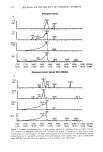
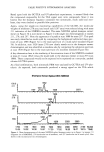
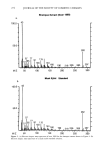
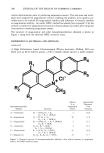
j. Soc. Cosmet. Chem., 37, 267-277 (July/August 1986) Nitromusks: False positives in the analysis for nitrosamines MARK R. SINE, The Procter & Gamble Company, Fabric, Hardsurface, and Beauty Care Technology Division, Miami Valley Laboratories, Box 39175, Cincinnati, Ohio 45247. Received March 24, 1986. Synopsis Nitrosamine analyses using a gas chromatograph (GC) interfaced to a thermal energy analyzer (TEA) showed "nitrosamine-like" signals for extracts of shampoo, conditioner, and antiperspirant/deodorant products. In several instances these "nitrosamine-like" responses could not be distinguished from the re- tention time of N-nitroso-N-methyl dodecylamine (NMDDA) however, the levels appeared unrealistically high (ppm instead of ppb) and the reproducibility was poor. Re-examination of these samples by gas chromatography/mass spectrometry (GC/MS) disproved the presence of NMDDA and identified the com- pound producing the GC/TEA signal (i.e., the false positive) as a nitromusk compound, musk xylol, present in the product fragrances. Other "nitrosamine-like" GC/TEA signals have also been linked to other nitromusk perfume raw materials (PRM) including moskene and musk ketone. Nitromusks are perfume components in numerous cosmetic products and can interfere with the GC/TEA analysis of nitrosamines. Confirmatory experiments such as GC/MS, wet chemical procedures, or UV-photolysis should be run in conjunction with any GC/TEA determination of nitrosamines. An example of a false positive in a shampoo extract is presented. INTRODUCTION N-nitrosamines have received widespread publicity as a group of potentially carcino- genic compounds. Their presence has been reported in a wide range of materials in- cluding cosmetics (1) and shampoos (1) and can be linked to the presence of potential nitrosamine precursors including amines (particularly secondary amines (2,3)), amine oxides (2), and quaternary ammonium salts (2,3) often used in cosmetic products. Since minimization of nitrosamine levels is of high interest to the cosmetic industry, a reliable and sensitive analytical technique is necessary to monitor their presence. One particular technique which has been widely used in the industry for measuring volatile nitrosamines is the GC/TEA system. In the GC/TEA system, compounds which elute from the GC column are passed into the TEA where they are thermally degraded. N-nitrosamines, which have the general structure RtR2N-N = O, decompose, releasing the nitrosyl radical ('NO) and various organic materials (4). The degraded materials are carried by an oxygen-free carrier gas (helium) through a cryogenic trap and/or filter which traps the organics but allows the ß NO to pass into an ozone reaction chamber. Ozone combines with 'NO to form electri- 267

268 JOURNAL OF THE SOCIETY OF COSMETIC CHEMISTS cally excited NO• which chemiluminesces in the 600-800 nm range and is observed by passing the radiation through a band pass filter to a photomultiplier tube. Conse- quently, any compound which yields 'NO upon pyrolysis will potentially produce a response on the TEA. This response has been observed for materials other than N-nitro- samines including O-nitroso (O-NO), C-nitroso (C-NO), O-nitro (O-NO2), and C- nitro (C-NO 2) compounds (5-7). We have observed strong TEA responses from extracts of a shampoo (discussed in the Results and Discussion section) as well as other shampoos, conditioners, and antiper- spirant/deodorant products not discussed herein. Using a packed column GC/TEA system, the retention time of the TEA-responding material could not be distinguished from that of NMDDA. Unlike the NMDDA, however, the response was not reproduc- ible and the calculated concentration was unrealistically high (ppm levels instead of ppb) based on the absence of NMDDA precursor raw materials in the products. Upon re-examination of the same extracts by GC/MS, it was found that the compound pro- ducing the TEA response was not a nitrosamine but rather the nitromusk, musk xylol, present in the product perfumes. Other "nitrosamine-like" GC/TEA signals have also been linked to different nitromusk PRM including moskene and musk ketone. Because of the false positives (i.e., nitromusks) potentially present in many cosmetic products, we believe confirmatory experiments such as the use of UV photolysis (8), wet chemical procedures (8) and/or GC/MS (2) are necessary and should be required to confirm the presence/absence of nitrosamines when using the GC/TEA. An example of a false posi- tive in a shampoo extract is presented. EXPERIMENTAL APPARATUS GC/TEA. The GC/TEA system consisted of a Hewlett-Packard (Palo Alto, CA) Model 5710A gas chromatograph interfaced to a Thermo Electron Corporation (Waltham, MA) Model 543 Thermal Energy Analyzer. The GC/TEA system used a 3% silicone UCW-98 on 80/100 mesh Chromosorb WHP (¬" x 6') packed column. The column was maintained isothermally at 200øC nitrogen was used as the carrier gas at 20 ml/ min. One-microliter sample injections were made into a 200øC injector. The TEA was operated at a furnace temperature of 500øC, and a cold trap temperature of - 100øC. GC/MS. The GC/MS system was a Finnigan (San Jose, CA) Model 4610 gas chromato- graph/mass spectrometer equipped with the Super INCOS data system. Initially, samples were separated on a J&W Scientific (Rancho Cordova, CA) DB-1 capillary column (30 m, 0.25 micron film, 0.25 mm i.d.) maintained isothermally at 50øC for 1 minute followed by an initial program rate of 20øC/min. to 90øC (held for 2 minutes), then 8øC/min. to 325øC (held for 8 minutes). Samples (0.5-4 microliters) were injected at 250øC in the splitless mode. Helium was used as the carrier gas at a linear velocity of 30 cm/sec. The capillary column was interfaced directly into the source of the mass spec- trometer. The interface was maintained at 280øC. Ionization was achieved by electron impact at 70 eV. An improved GC/MS method was also used which employed a J&W Scientific (Rancho Cordova, CA) DX-4 capillary column (30 m, 0.25 micron film, 0.32 mm i.d.) and the
Purchased for the exclusive use of nofirst nolast (unknown)
From: SCC Media Library & Resource Center (library.scconline.org)