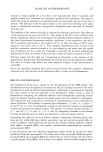
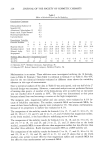
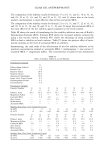
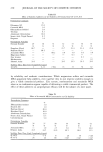
FALSE POSITIVE NITROSAMINE ANALYSES 269 "on-column" mode of sample injection (0.2- 0.5 microliters). The oven was maintained at 40øC for 2 minutes followed by a program rate of 20øC/min. to 75øC (held for 2 minutes) followed by 8øC/min. to 250øC (held for 19 minutes). The interface was held at 240øC. All other conditions were as above. UV-PHOTOLYSIS An aliquot of sample extract was transferred into a teflon-lined screw cap, borosilicate glass culture tube which was placed about 10 inches from the UV light source. The UV light was supplied from a GE 275 W suniamp and the sample was irradiated for one hour. N-nitrosamines are photolyzed under these conditions and their corresponding TEA signal disappears (8). At the end of the photolysis period, both irradiated and non-irradiated sample extracts were analyzed by GC/TEA and compared. SAMPLE PREPARATION Approximately 20 grams of shampoo were weighed into a tared 250 ml separatory funnel. A 20 milliliter aliquot of a 0.1 N HC1 solution containing 1.67 mg/g ascorbic acid (free nitrite scavenger) was added to the separatory funnel followed by 100 ml of methylene chloride. A liquid/liquid extraction was performed and the methylene chlo- ride layer was collected and filtered through a Millipore (Bedford, MA) 0.45 micron Nylon 66 filter. A second extraction was carried out on the remaining aqueous layer using a fresh 50 ml aliquot of methylene chloride. The organic layer was again collected and filtered as above and then the flitrates were combined and loaded onto a preparative scale silica gel column (to remove the more polar components). The column (19 mm X 100 mm) was prepared by slurry packing 100/200 mesh silica gel with methylene chloride followed by addition at the column top of a ten gram layer of anhydrous Na2SO 4 (to remove residual water) in methylene chloride. Glass wool was used to plug the column ends. After loading the flitrate (150 ml) onto the column, the sample was eluted with three successive 50 ml methylene chloride aliquots. Approximately three hundred milliliters of column eluent were collected directly into a Kadurna-Danish (KD) preconcentrator. A one milliliter aliquot of isooctane was added to the KD apparatus as a "keeper" and the sample was preconcentrated by submerging the KD preconcentrator tube into a 70øC water bath. The sample was evaporated to 10 ml in the KD apparatus and trans- ferred to a scintillation vial. The sample was evaporated to dryness using a gentle nitrogen flow stream and then diluted with 5 ml of methylene chloride. This extract was directly analyzed by GC/FID, GC/TEA, and GC/MS. REAGENTS All samples were prepared in HPLC grade methylene chloride (Fisher Scientific, Springfield, N J). The nitromusks were all perfume grade. Musk ketone was supplied by Naarden (New York, NY), while Givauden (Clifton, NJ) supplied the other nitromusk PRM's. The NMDDA standard was supplied courtesy of Hazleton Laboratories America (Madison, WI).

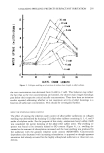
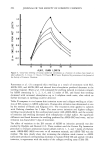
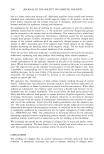
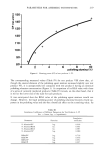
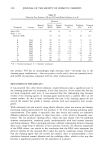
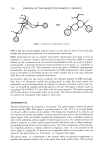
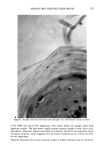
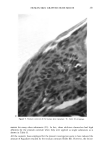
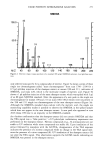
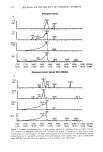
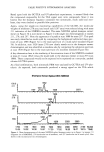
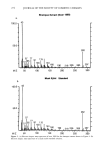
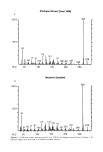
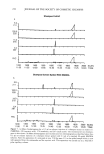
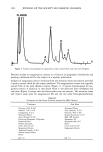
270 JOURNAL OF THE SOCIETY OF COSMETIC CHEMISTS RESULTS AND DISCUSSION An initial screening of a shampoo a for volatile nitrosamines revealed a relatively large response on the GC/TEA at the retention time characteristic of NMDDA. Based upon external standard calculations, the apparent NMDDA concentration was approximately 12 ppm. This level was unexpectedly high since literature values for volatile nitrosa- mines in shampoos are at the 10-200 ppb range (2), and since the product contained none of the likely NMDDA precursors. GC/MS analysis of the shampoo extract for NMDDA utilizing a non-polar 30m DB-1 capillary column revealed the reconstructed ion chromatogram (RIC) shown in Figure 1. The chromatogram is complex and largely dominated by an overloaded component appearing at scan 1881. This peak was identified as myristic acid (extracted from the shampoo) along with some coeluting minor components which will be discussed later. A GC/MS analysis of NMDDA was also performed and its mass spectrum is shown in Figure 2. The NMDDA spectrum contains two primary fragment ions at masses 211 and 198, with a relative intensity ratio of 3/1, respectively. Additionally, the NMDDA standard coeluted with the myristic acid on the DB-1 column. Utilizing the single-ion monitoring capability of the GC/MS, it is possible to observe Shampoo Extract 100.0 - RIC '' ' ' I ' ' ' oel I ' I I I ' il I ' ' ' ' I ' ' ' I I ' ' ' I ' ' ' '1 500 1000 1500 2000 2500 3000 3500 4000 SCAN 4:35 9:10 13:45 18:20 22:55 27:30 32:05 36:40 TIME Figure 1. Reconstructed ion chromatogram of a shampoo extract on a 30 m DB-1 capillary column by electron impact ionization. a Shampoo ingredients: water, ammonium lauryl sulfate, sodium lauryl sulfate, fragrance, myristic acid, SD alcohol 40, glycol distearate, cocamide DEA, disodium phosphate, EDTA, sodium hydroxide, am- monium chloride, methylchloroisothiazolinone, methylisothiazolinone, D&C Green No. 8, and FD&C Blue No. 1.
Purchased for the exclusive use of nofirst nolast (unknown)
From: SCC Media Library & Resource Center (library.scconline.org)