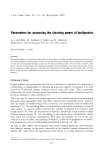
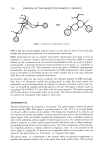
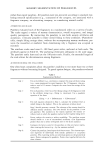
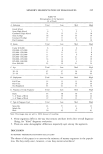
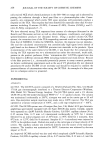
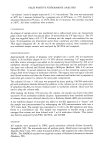
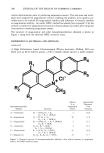
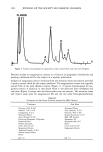
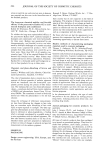
280 JOURNAL OF THE SOCIETY OF COSMETIC CHEMISTS control determination prior to producing sanguinaria extract. The oral rinse and tooth- paste were analyzed for sanguinarine content, enabling the products to be quality con- trolled and to be studied for sanguinarine stability and influences of formula variables on sanguinarine stability. An earlier HPLC method has already been reported (7) by the authors to analyze for sanguinarine retention in human plaque and saliva after using oral care products containing sanguinaria extract. The structure of sanguinarine and other benzophenanthridine alkaloids is shown in Figure 1 along with the observed HPLC retention times. EXPERIMENTAL MATERIALS AND METHODS APPARATUS A High Performance Liquid Chromatograph (Waters Associates, Milford, MA) was fitted with an M-45 delivery system, a UK 6 variable volume injector, a radial compres- R 1 R2 R 3 N +Cl' CH 3 94 R 5 Relative Approximate % in Retention Benzophenanthridine Sanguinaria Time Alkaloid Structure Extract (minutes) A--Chelirubine R• •- OCH3 R 2 q- R3, 4 10.4 R 4 q- R 5 = OCH20 B--Sanguinarine R• = H R 2 + R3, 50 12.0 R 4 + R 5 = OCH20 C--Sanguirubine R• = OCH3 R2 + R 3 = OCH20 4 13.7 R4, R5 = OCH 3 D--Chelilutine R•, R2, R 3 = OCH3 2 15.4 R 4 + R 5 = OCH20 E--Chelerythrine R• = H R 2, R 3 = OCH3 25 16.6 R4 + R 5 = OCH20 F--Sanguilutine R•, R2, R 3, R4, R 5 = OCH 3 15 17.7 Figure 1. Chemical structure of benzophenanthridine alkaloids, their relative amounts in sanguinaria extract, and HPLC retention times.

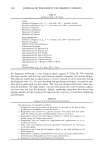
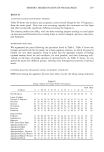
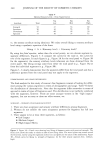
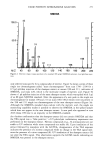
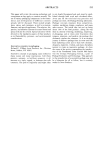
SANGUINARINE ANALYSIS BY HPLC 281 sion module, a Model 440 detector with a 280-nm filter, and a Hewlett Packard Model 3390 reporting integrator. A 5-CN 10-• Radial-Pak column (5-mm I.D. X 100-mm) (Waters Associates) was used for the separation of the alkaloids with a mobile phase containing 84:16 (v/v) methanol:water with 5 X 10⁻³M triethylamine and phosphoric acid, pH 5.6. The separation was carried out at a pumped flow rate of 0.5 ml/minute. The sanguinarine was monitored at 280 nm. STANDARD SOLUTIONS Pure sanguinarine was obtained as bright orange-red needles from sanguinaria extract by an aqueous alcoholic extraction process and crystallization from methanol, and pu- rity was determined by elemental analysis, melting point, and thin layer chromatog- raphy (TLC). Theory--C, 65.31: H, 3.84: O, 17.40: N, 3.81: C1, 9.64. Actual-- C, 64.97: H, 3.97: O, 17.03: N, 3.81: C1, 9.60. Melting point 279-281øC: reported (8) 273øC. TLC single orange spot methylene chloride:hexane:methanol (85:10: 5). The material gave the expected NMR. A standard solution of pure sanguinarine chloride was made in methanol. (Standard solutions of other benzophenanthridine alkaloids comprising sanguinaria extract were similarly made from the purified alkaloids.) Two drops of phosphoric acid were added per 250 ml methanol to acidify the system. Oral rinse and dried rhizomes required a standard solution of 20 mg pure sanguinarine/250 ml methanol. Toothpaste and san- guinaria extract required a standard solution of 20 mg pure sanguinarine/500 ml meth- anol. SAMPLE PREPARATION Dried rhizomes. The dried rhizomes of Sanguinaria canadensis (bloodroot) were ground to a 60-mesh size. A 35-cc syringe was fitted with a 3-in length of 3/8 tygon tubing and control clamp. Some glass wool was placed in the bottom of the syringe and packed down. Approximately V2 of untreated sea sand (Mallinckrodt) was poured on top of the glass wool and 1.00 g of ground bloodroot was quantitatively transferred on top. Fif- teen ml of methanol acidified with 0.5% citric acid was added and allowed to stand for 1V2 hours. The control clamp was released and the methanol allowed to drip into a 50-ml edenmeyer flask. When the liquid level in the syringe became low, it was topped up with the methanol until 50 ml was collected in the flask. The 50 ml of extract was quantitatively transferred to a 500-ml volumetric flask and diluted to volume with methanol. An aliquot was injected into the HPLC and the percent of sanguinarine in the rhizomes calculated. Sanguinaria extract. Sixty mg of sanguinaria extract obtained from the extraction of bloodroot rhizomes were quantitatively transferred to a 500-ml volumetric flask and diluted to volume with methanol followed by four drops of phosphoric acid. An aliquot was injected into the HPLC instrument and the percent of sanguinarine with respect to the other alkaloids calculated based on the molar extinction coefficient (= 39,300) of sanguinarine. In this way the other alkaloids were expressed as sanguinarine equiva- lents. Toothpaste. The contents of a single tube of toothpaste were emptied into a beaker and stirred to ensure a uniform sample. Three g of the toothpaste were weighed into a 50-cc
Purchased for the exclusive use of nofirst nolast (unknown)
From: SCC Media Library & Resource Center (library.scconline.org)