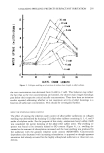
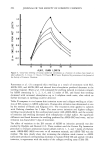
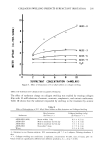
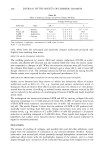
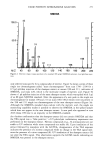
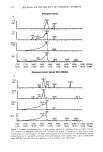
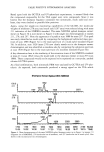
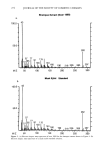
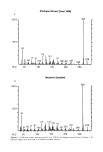
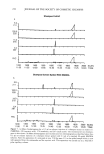
FALSE POSITIVE NITROSAMINE ANALYSES 277 persisted after UV-photolysis. In addition, the musk xylol retention time could not be distinguished from that of the NMDDA standard. In order to improve the quality of the GC/MS (and potentially GC/TEA) analysis for nitrosamines in the presence of nitromusks and myristic acid, a better separation scheme was developed. This method utilized a 30m DX-4 polar capillary column and on-column injection to greatly improve the separation of these materials. Figure 7a shows a series of single ion chromatograms at masses 211 (NMDDA), 228 (myristic acid), 278 (moskene), and 297 (musk xylol) for a 0.2 ptl on-column injection of the neat shampoo extract. Figure 7b shows the same single ion chromatograms for the same amount of extract spiked with 0.3 ptl of the 88 ppm NMDDA standard. Note the absence of a peak at mass 211 in the neat shampoo extract and its appearance (scan 1510) in the spiked sample. Also note that the NMDDA is well separated from the nitromusks and from the myristic acid. This separation technique could be adapted for the GC/TEA systems which would eliminate this false positive problem when using the GC/TEA. We would like to stress, however, that confirmatory experiments are still necessary when using the GC/TEA. CONCLUSION The TEA is an excellent detector for determination of nitrosamines providing its limita- tions are understood. Because of the high specificity of the TEA, it is often used blindly and the required confirmatory experiments such as GC/MS, UV-photolysis, or wet chemical procedures are neglected. Special attention should be given to the determination of nitrosamines in any fragranced product due ro the widespread use of nitromusks in perfumes which may produce false positive results when using the TEA. ACKNOWLEDGEMENTS We would like to acknowledge Thermedics, Inc. (Woburn, MA) and Hazleton Labora- tories America (Madison, WI) for the GC/TEA analyses. REFERENCES (1) T. Y. Fan, E. U. Goff, L. Song, D. H. Fine, G. P. Arsenault, and K. Bieman, N-nitrosodiethanol- amine in cosmetics, lotions, and shampoos, Food Cosmet. Toxicol., 15, 423-430 (1977). (2) S. S. Hecht, J. B. Morrison, and J. A. Wenninger, N-nitroso-N-methyldodecylamine and N-ni- troso-N-merhylretradecylamine in hair-care products, Fd. Chem. Toxicol., 20, 165-169 (1982). (3) M.D. Erickson, D. B. Lakings, A.D. Drinkaine, and J. L. Spigarelli, Determination of N-nitroso- dierhanolamine (NDELA) in cosmetic ingredients, J. Soc. Cosmet. Chem., 36, 223-230 (1985). (4) D. H. Fine and D. P. Rounbehler, Trace analysis of volatile N-nitroso compounds by combined gas chromatography and thermal energy analysis, J. Chromatog., 109, 271-279 (1975). (5) D. H. Fine, F. Rufeh, and B. Gunther, A group specific procedure for the analysis of both volatile and non-volatile N-nitroso compounds in picogram amounts, Anal. Lett., 6, 731-733 (1973). (6) T. Y. Fan, I. Krull, M. Wolf, R. Ross, and D. H. Fine, "Comprehensive Analytical Procedures for the Determination of Volatile and Non-Volatile, Polar and Non-Polar N-Nitroso Compounds," Pro- ceedings of the 5th IARC Meeting on the Formation and Analysis of N-Nitroso Compounds, Durham, NH, (1977). (7) T. Y. Fan, R. Vita, and D. H. Fine, C-nitro compounds: A new class of nitrosating agents, Toxicol. Lett., 2, 5-10 (1978). (8) I. S. Krull, E. U. Goff, G. G. Hoffman, and D. H. Fine, Confirmatory methods for the thermal energy determination of N-nitroso compounds at trace levels, Anal. Chem., 51, 1706-1709 (1979).

j. Soc. Cosmet. Chem., 37, 279-286 (July/August 1986) HPLC analysis of sanguinarine in oral health care products E. M. THORNE, R. T. BOULWARE, R. J. HARKRADER, and G. L. SOUTHARD, Vipont Laboratories, Fort Collins, CO 80524. Received March 14, 1986. Presented in part at the International Association of Dental Research, Sixty-Second General Session, Dallas, Texas, March 15-18, 1984. Synopsis Sanguinarine is a component of an alkaloid extract obtained from the plant Sanguinaria canadensis. This extract is used in a commercial toothpaste and oral rinse exhibiting anti-plaque effectiveness. Using high performance liquid chromatography, rapid methods were developed whereby methanolic sanguinarine so- lutions of the plant rhizomes, sanguinaria extract, oral rinse and toothpaste were quantitatively analyzed. The method employed a Waters HPLC and a 5-CN 10-• Radial-Pak column with a mobile phase of 84:16 (v/v) methanol:water containing 5 x 10⁻³M triethylamine and phosphoric acid, pH 5.6, at a flow rate of 0.5 ml/minute. A Model 440 detector with a 280-nm filter was used with a Hewlett Packard Model 440 recorder. The detection limit for sanguinarine was 0.25 •g/ml. The method was demonstrated to be useful as a quality control technique and as a means for monitoring sanguinarine levels in stability samples. For example, an acidic pH range was found to be required for sanguinarine stability in oral rinse. INTRODUCTION Sanguinarine is a component of an alkaloid extract obtained from the plant Sanguinaria canadensis. The extract is used as a component in a commercial toothpaste and oral rinse exhibiting anti-plaque effectiveness. The effectiveness of the extract is attributable to sanguinarine, which is present in the extract as the chloride salt. Sanguinaria extract has been used in a variety of medications for over 100 years in the United States and other countries (1). The extract is principally a mixture of benzo- phenanthridine alkaloids, the chief constituent alkaloid being sanguinarine (approxi- mately 33% by weight). Sanguinarine is highly fluorescent under long-wave ultraviolet light which makes it relatively easy to monitor and analyze. Various methods have been reported for the analysis of this extract. An early method reported in 1913 detailed problems resulting from the use of any volumetric processes (2) and was tedious and time consuming. Later methods used paper chromatography (3-5) and electrophoresis, but these methods gave unreliable results. In 1977 a thin layer chromatography method was developed (6), but the method lacks the precision and accuracy for routine quality control analysis. A high performance liquid chromatography (HPLC) method was developed to quantita- tively analyze for sanguinarine in the plant rhizomes, sanguinaria extract, and oral care products. The rhizomes were analyzed for sanguinarine content, enabling a quality 279
Purchased for the exclusive use of nofirst nolast (unknown)
From: SCC Media Library & Resource Center (library.scconline.org)