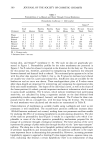
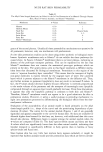
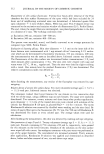
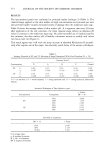
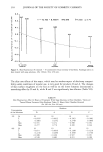
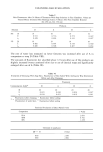
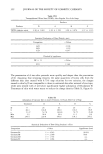
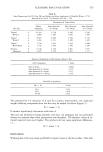
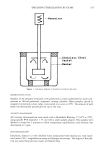
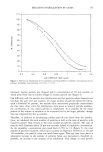
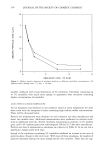
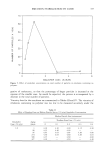
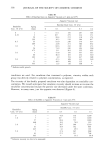
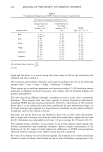
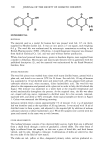
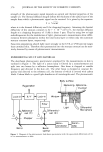
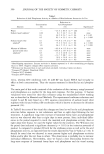
332 JOURNAL OF THE SOCIETY OF COSMETIC CHEMISTS Table I General Formula for Non-Ionic o/w Emulsion (Example: 1.0% Emulsifier) A. Light Mineral Oil 10.0 g Surfactants Volpo 3 0.41 g Volpo 10 0.59 g B. Preserved Water (a-phase [i]) 39.0 g C. Polymers 0-1.5 % [ii] D. Preserved Water (b-phase [iii]) 50.0 g 100.0 g [i] a-phase is the amount of preserved water used to make master emulsion. [ii] % of polymer is based on the total amount of aqueous phase. [iii] b-phase is the amount of preserved water added to master emulsion. It contains all added polymers. at the same temperature was added to the mixture in a 2000-ml beaker. The beaker was fitted inside a stainless steel jacket to prevent drastic heat loss during emulsification as shown in Figure 1. The top of the beaker was covered with paraffin film to avoid evaporation. After emulsification at 2000 rpm for 20 minutes, the master emulsion was added at a constant rate into a 400-ml beaker, which contained the b-phase (water plus dissolved polymers, if present). The finished emulsion was then mixed with a rotating paddle at 100 rpm for 10 minutes. P^•tT•CLE S•ZE ^N^L¾S•S Particle size distribution was determined by the HIAC PC-320, equipped with a CMH-60 High Concentration sensor. The HIAC sensors operate on the light blockage principle. Particles in diluted emulsion flow through a channel past a window whose area 'A' is known accurately. A collimated light beam shines through the fluid at right angles to the direction of flow, passes through the window, and falls on a photodiode. The preamplifier output is maintained at 10 V when no particle is in the window. When a particle of projected area 'a' passes across the window, it partially blocks the light beam, the reduction being a/A. The amplitude of the pulse produced by the particle is E, given by Eq. 1, E = a/A X 10 V (Eq.1) In terms of equivalent spherical diameter, i.e., the diameter of a sphere whose projected area is the same as the particle, E becomes E = •r d2/4A x 10 V (Eq. 2) The voltage pulse corresponding to the appropriate particle diameter is fed into an electronic counter. All pulses above the threshold value selected by the user are counted. The number of oversize particles is obtained and a particle size distribution by number can be determined from readings taken at different threshold values. The following procedure for the dilution steps was adopted: 0.1 ml of emulsion was diluted with 9.9 ml filtered distilled water presaturated with mineral oil. Then 0.2 ml of the aliquot was further diluted with 199.8 ml presaturated, filtered, distilled water. The particles were immediately counted.

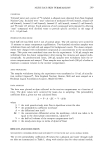
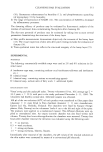
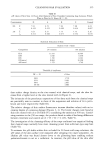
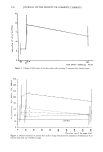
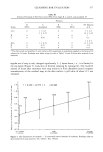
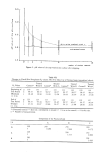
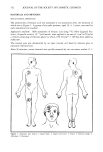
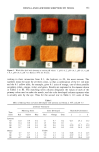
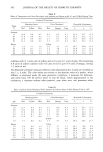
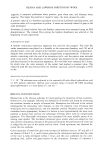
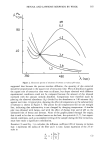
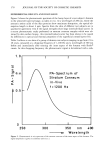
EMULSION STABILIZATION BY GUMS 333 --Homomixer --Stainless gteel Jacket ---Beaker Figure 1. Schematic diagram of emulsion manufacturing setup. SEDIMENTATION STUDY Samples of the prepared emulsions were permitted to stand undisturbed at room tem- perature in 100-ml graduated, stoppered, mixing cylinders. Other samples, placed in stoppered cylindrical culture tubes, were stored in an oven at 45øC. The amount of each phase was determined periodically for up to one year. VISCOSITY MEASUREMENT All viscosity determinations were made with a Brookfield Rheolog 2.5 LVT at 25øC, using spindle #18 (diameter 1.75 cm) with a small sample adapter. The samples were allowed to stand for 5 minutes to allow temperature equilibration, and viscosity was determined at 3 rpm. PHOTOMICROGRAPHY Emulsions, diluted 1:2 with distilled water presaturated with mineral oil, were exam- ined under 150 X magnification using an Olympus microscope. The degree of floccula- tion was noted from pictures made on Polaroid film.
Purchased for the exclusive use of nofirst nolast (unknown)
From: SCC Media Library & Resource Center (library.scconline.org)