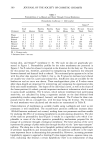
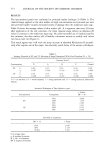
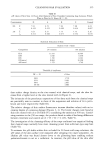
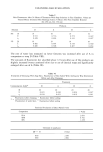
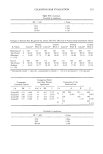
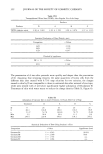
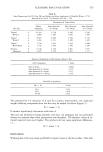
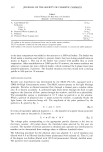
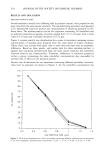
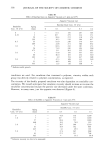
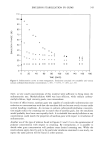
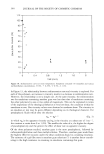
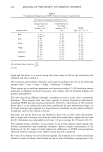
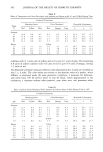
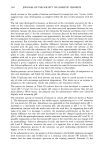
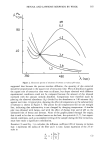
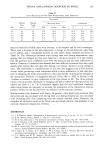
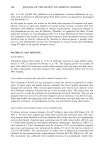
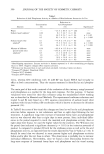
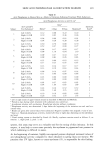
338 JOURNAL OF THE SOCIETY OF COSMETIC CHEMISTS Table III Effect of Xanthan Gum on Apparent Viscosity at 3 rpm and 25øC Apparent Viscosity (cp) Xanthan Gum Conc. (% w/w) Emulsifier Aging Conc. (% w/w) (days) 0 0.1 0.2 0.3 0.4 0 1 -- 67.1 170 297 303 0.25 3 -- 107 275 314 371 59 -- 99.4 272 318 374 399 -- 36.3 212 504 817 0.5 55 -- 93.0 248 374 417 409 -- 22.8 271 584 872 1.0 7 -- 82.6 243 381 474 56 -- 74.9 240 394 500 472 -- 15.1 201 522 832 3.0 7 -- 47.8 176 457 613 60 -- 40.0 165 452 610 462 -- 4.9 154 647 698 5.0 7 -- 47.3 168 333 549 53 -- 48.5 168 332 * 455 -- 11.5 116 368 * * Indicates mold growth. conditions we used. For emulsions that contained a polymer, viscosity within each group was directly related to polymer concentration, as expected. The viscosity of the freshly prepared emulsions was also dependent on emulsifier con- centration. We would anticipate that emulsion viscosity should increase as we raise the emulsifier concentration because the particle size decreased under the same conditions. However, in many cases, just the opposite was observed (Figure 6). Table IV Effect of NaCMC on Apparent Viscosity at 3 rpm and 25øC Apparent Viscosity (cp) NaCMC Conc. (% w/w) Emulsifier Aging Conc. (% w/w) (days) 0 0.5 1.0 1.5 0 1 -- 44.4 336 1290 1.0 7 -- 107 775 1290 57 -- 99.4 755 1280 448 -- 19.3 76.9 152 3.0 7 -- 38.7 300 1210 61 -- 19.4 192 865 445 -- 4.1 49.5 165 5.0 7 -- 37.4 265 968 61 -- 27.1 151 768 445 -- * 34.4 99.0 * Indicates viscosity too low to be measured.

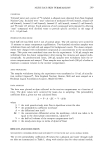
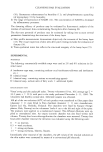
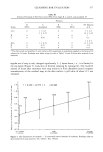
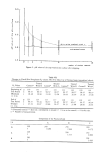
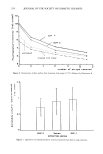
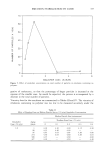
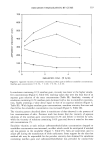
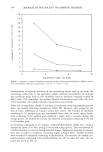
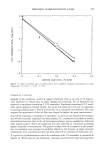
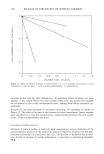
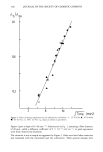
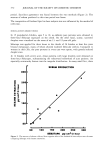
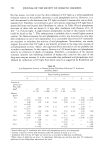
EMULSION STABILIZATION BY GUMS 339 7OO 6DO - 500 - ß 00 - 300 - 200 - 100 - 0 2 4 6 EMULSIFIER CONC. (• W/W) Figure 6. Apparent viscosity of emulsions containing xanthan gum at different emulsifier concentrations. Xanthan gum concentration: [] 0.1%, + 0.2%, O 0.3%, /• 0.4%. In emulsions containing 0.1% xanthan gum, viscosity was lower at the higher emulsi- fier concentrations (Figure 6, Table lll), reaching values that were less than that of an aqueous gum solution of the same concentration (Table Ill). Similarly, viscosity of emulsions containing 0.2% xanthan gum decreased with a rise in emulsifier concentra- tion, finally attaining a value about equal to that of an aqueous solution (Figure 6, Table III). With higher xanthan gum concentrations, emulsion viscosity first rose and then fell as the emulsifier concentration was increased (Figure 6, Table Ill). The viscosity pattern described above is reminiscent of that observed in the presence of low concentrations of salts. Previous work has shown that the viscosity of aqueous solutions of low xanthan gum concentrations (0.2% and below) is lowered by salts, while the viscosity of solutions containing 0.4% gum and above is raised at the same salt concentrations (7). Emulsion viscosity at each sodium carboxymethylcellulose concentration dropped as emulsifier concentration was increased, an effect which would be anticipated if residual salt was present in the emulsifier (Figure 7, Table IV). Salts are sometimes used to adjust pH during the manufacture of oleth surfactants. Some support for the idea that residual salt may be responsible for the peculiar viscosity data obtained for emulsions containing xanthan gum and carboxymethylcellulose was provided by conductivity
Purchased for the exclusive use of nofirst nolast (unknown)
From: SCC Media Library & Resource Center (library.scconline.org)