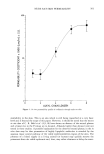
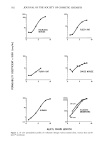
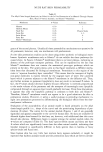
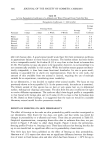
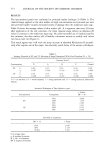
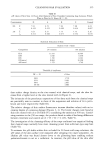
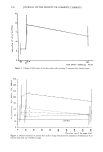
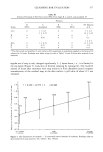
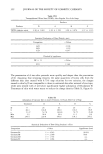
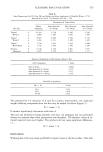
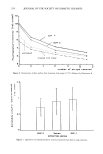
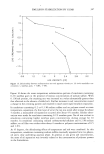
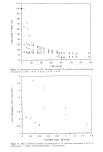
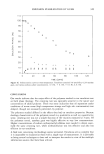
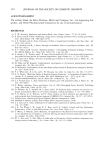
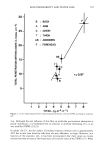
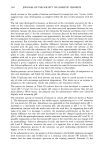
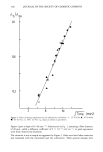
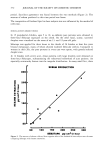
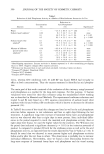
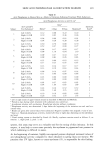
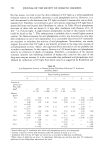
356 JOURNAL OF THE SOCIETY OF COSMETIC CHEMISTS the influence of the corneocytes size is on percutaneous absorption, is a question we have undertaken to answer. Each anatomic site has its own particular characteristics, which might combine to dif- ferent extents to create the differences observed in the experimental values of TEWL and penetration. While it is generally agreed that either of these parameters can be considered as a reflection of the functional state and integrity of the cutaneous barrier, our results have demonstrated that they are directly linked (r = 0.97). It is, however, of note that without the point associated with the forehead, the correla- tion coefficient for a linear relationship is 0.73. As a consequence, examination of other molecules of varying physicochemical properties and additional anatomic sites should be examined before overgeneralizing. ACKNOWLEDGEMENT The authors would like to thank Jim McMaster for his excellent technical assistance. REFERENCES (1) (2) (3) (4) (5) (6) (7) (8) (9) (lO) (11) (12) (13) (14) (15) R. J. Scheuplein and I. H. Blank, Permeability of the skin. Physicological Rewews, 54(4), 702-747 (1971). I. H. Blank, J. Moloney, A. G. Eroslie, I. Simon, and C. H. Apt, The diffusion of water across the stratum corneum as a function of its water content, J. Invest. Dermatol., 82, 188-194 (1984). F. N. Marzulli, Barrier to skin penetration, J. Invest. Dermatol., 39, 387-393 (1962). F. D. Malkinson, Studies on percutaneous absorption of •4C labelled steroids by use of the gas-flow cell, J. Invest. Dermatol., 31, 19-28 (1958). D. E. Wurster, and S. F. Kramer, Investigation of some factors influencing percutaneous absorption, J. Pharm. Sci., 50, 288-293 (1961). W. F. Fritsch and R. B. Stoughton, The effect of temperature and humidity on the penetration of •4C acetyl salicylic acid in excised human skin, J. Invest. Dermatol., 41, 307-311 (1963). R. J. Scheuplein, "The Skin as a Barrier," in The Physiology and Pathophysiology of the Skin (Jarret, London, 1978), Vol. 5, p 1669. J. G. Smith, R. W. Fischer, and I. H. Blank, The epidermal barrier: A comparison between scrotal and abdominal skin.,J. Invest. Dermatol., 36, 337-341 (1961). J. C. Guillaume, J. de Rigal, J. L. Leveque, P. Galle, R. Touraine, and L. Dubertret, Etude com- parde de la perte insensible d'eau et de la pdn•tration cutan•e des corticoYdes, Dermatologica, 162, 380-390 (1981). E. Lamaud, B. Lambrey, W. Schalla, and H. Schaefer, Correlation between transepidermal water loss and penetration of drugs, J. Invest. Dermatol., 82, 556 (1984). D. R. Wilson and H. I. Maibach, "A Review of Transepidermal Water Loss: Physical Aspects and Measurements as Related to Infants and Adults," in NeonatalSkin, H. I. Maibach and E. K. Boisits, Eds. (Marcel Dekker, New York, 1982), p 83. H. I. Maibach, R. Bronaugh, R. Guy, E. Turr, D. R. Wilson, S. Jacques, D. Chaing, "Non-Inva- sive Techniques for Determining Skin Function," in Cutaneous Toxicity, V.A. Drill and P. Lazar Eds. (Raven Press, New York, 1984). J. S. Surinchak, J. A. Malinowski, D. R. Wilson, and H. 1. Maibach, Skin wound healing deter- mined by water loss, J. Surgical Res., 38, 258-262 (1985). R. J. Feldmann and H. I. Maibach, Regional variations in p½'r,':'•ta,,•eous penetration of 14C cortisol in man, J. Invest. Dermatol., 48, 181-183 (1967). H. I. Maibach, R. J. Feldmann, T. Milby, and W. Serat, Regional variations in percutaneous pene- tration in man. Arch. Environ. Health 23, 208-211 (1971).

SKIN PERMEABILITY AND WATER LOSS 357 (16) R. L. Bronaugh, R. F. Stewart, E. R. Congdon, and A. L. Giles, Methods for in vitro percutaneous absorption studies. I: Comparison with in vivo results, Toxicol. Appl. Pharmacol., 62, 474-480 (1982). (17) J. W. Bridges, M. R. French, R. L. Smith, and R. T. Williams, The fate of benzoic acid in various species, Blochem. J., 118, 47-51 (1970). (18) R.J. Feldmann and H. I. Maibach, Absorption of some organic compounds through the skin in man,J. Invest. Dermatol., 54, 399-404 (1970). (19) A. Rougier, D. Dupuis, C. Lotte, R. Roguet, and H. Schaefer, In vivo correlation between stratum comeurn reservoir function and percutaneous absorption, J. Invest. Dermatol., 81, 275-278 (1983). (20) D. Dupuis, A. Rougier, R. Roguet, C. Lotte, and G. Kalopissis, In vivo relationship between horny layer reservoir effect and percutaneous absorption in human and rat, J. Invest. Dermatol., 82, 353-356 (1984). (2 l) K. Grice, M. Sattar, M. Sharratt, and H. Baker, Skin temperature and transepidermal water loss, J. Invest. Dermatol., 57, 108- 110 (1971). (22) K. A. Holbrook and G. F. Odland, Regional differences in the thickness (cell layers) of the human stratum corneum: An ultrastructural analysis, J. Invest. Dermatol., 62, 415-222 (1974). (23) M. A. Pathiak and T. B. Fitzpatrick, "The Role of Natural Photoprotective Agents in Human Skin," in Sunlight and Man, T. B. Fitzpatrick, Ed. (University of Tokyo Press, 1974), pp 725-750. (24) G. E. Burch, and N. P. de Pasquale, Hot Climates, Man and His Heart (Thomas, Springfield, Illinois, 1962). (25) A.M. Kligman, The use ofsebum, BritishJ. Dermatol., 75, 307-319 (1983). (26) G. Plewig and R. R. Marples, Regional differences of cell sizes in human stratum comeurn. Part I., J. Invest. Dermatol., 54, 13-18 (1970). (27) R. Marks, S. Nicholls, and C. S. King, Studies on isolated corneocytes, Int. J. Cosmet. Sci, 3, 251-254 (1981). NOTE: Reprint requests to A. Rougier.
Purchased for the exclusive use of nofirst nolast (unknown)
From: SCC Media Library & Resource Center (library.scconline.org)