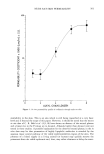
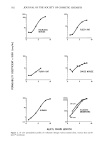
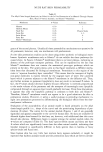
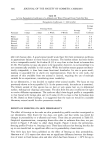
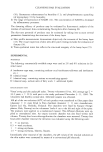
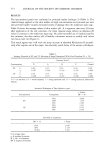
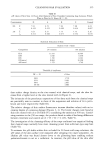
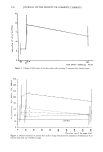
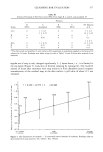
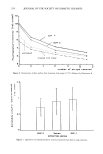
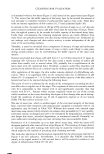
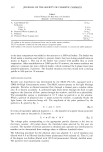
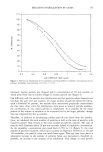
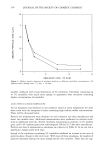
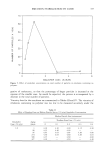
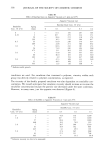
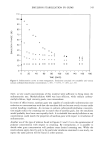
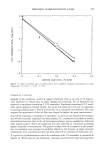
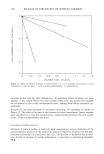
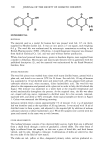
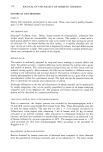
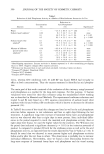
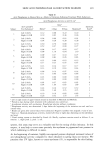
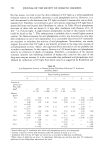
j. Soc. Cosmet. Chem., 37, 359-367 (September/October 1986) The absorption of lawsone and henna by bleached wool felt K. C. JAMES, S. P. SPANOUDI, and T. D. TURNER, Welsh School of Pharmacy, University of Wales Institute of Science and Technology, P.O. Box 13, Cardiff, CF1 3XF, United Kingdom. Received January 24, 1986. Synopsis Bleached wool felt was chosen as a substitute for human hair to avoid complications due to natural pig- ment. Pieces were dyed by immersion in lawsone or henna suspension, and their colors assessed using a Lovibond tintometer and a Hunterlab colorimeter. With lawsone, immersion for 30 minutes was sufficient to dye the wool. The hue and intensity of the color developed did not change significantly when the pH was varied between 3 and 5, in contrast to the electronic spectra of lawsone solutions, in which absorbance decreased progressively with decreasing pH. Below pH 6 the color of the wool varied little with pH and was predominantly red, but above pH 6 the intensity decreased and the yellow component became pre- dominant. At pH 4.5 the intensity of the red component increased with dyeing temperature between 15 and 50øC, and became progressively more predominant. The color developed with henna increased with temperature, and also with time, probably because time was required to extract coloring matter from the plant tissue. In contrast to lawsone, henna gave a color which was predominantly yellow and had a greater blue component over the whole pH range. Both factors were attributed to the chlorophyll content. Sub- stantivity was tested by extracting felts with water and measuring the absorbance of the extract after timed intervals. The extraction rate was unaffected by dyeing time, pH, or temperature. Examination of the extracted wool pieces suggested that a slow reaction occurs on the wool, either producing new compounds which are more substantive than lawsone to wool or changing the mode of attachment, and thereby in- creasing the strength of the interaction. INTRODUCTION The henna plant (Lawsonia inermis L.) contains a red-orange component which is sub- stantive to keratin. Henna has been used as a hair dye since the dawn of history, and is still commonly employed as a conditioner and coloring agent in cosmetic preparations for the hair. The leaves are reduced to a fine powder and mixed with hot water, to form a paste, which is applied to the hair while still hot. Lawsone, 2-hydroxy-1,4-naphtho- quinone (I) is the principal active constituent. No other coloring material has been identified, although the whole leaf is known to behave differently towards the hair from lawsone alone (1). Forestier (1) followed the absorption of lawsone and henna by mea- suring the increase in weight of the hair after treatment. The object of this communica- tion is similar, but examines absorption in terms of the color developed. It was there- fore necessary to use bleached lambs' wool as substrate, rather than human hair, because it has the advantage of being white, with no complicating pigments. 359

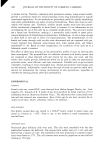
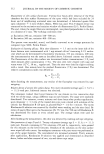
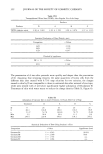
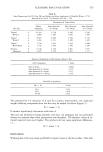
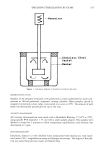
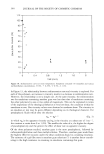
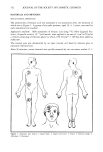
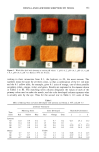
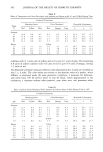
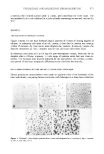
360 JOURNAL OF THE SOCIETY OF COSMETIC CHEMISTS O O OH • OH S-R 0 0) 0 EXPERIMENTAL MATERIALS The material used as a model for human hair was pressed wool felt, 0.5 cm thick, supplied by Hinders-Leslies Ltd. It was cut into pieces 2.5 cm square, each weighing 0.6 g. The wool felt was authenticated by microscopic examination according to the British Pharmacopoeia (1980). 2-Hydroxy-1,4-naphthoquinone (lawsone) was obtained from Aldrich Chemical Co. Ltd. and was used without further purification. Whole dried and powered henna leaves, grown in Southern Algeria, were supplied from a market in Ghardaia. Microscopic and macroscopic features were in agreement with the published description (2), and the material was authenticated by the Royal Botanical Gardens, Kew. DYEING PROCEDURE The wool felt pieces were washed three times with warm distilled water, pressed with a glass rod, and dried in an oven at 50øC for 24 hours. For each felt, 20 mg of lawsone was suspended in 10 ml distilled water and mixed well. pH was adjusted with sodium carbonate solution and, when necessary, dilute hydrochloric acid. The wool felt was placed in the suspension and pressed with a glass rod in order to help the felt absorb the liquid. The mixture was immersed in a water bath at the required temperature and stirred mechanically throughout the process. At the required time, the felt was taken out, rinsed with tap water, immersed in distilled water for a few seconds, removed, squeezed well, and dried at 50øC overnight. Some typical samples are shown in Figure 1. Colors were measured the following morning. Lawsonia inermis leaves contain approximately 1% of lawsone (3,4). 2 g of powdered leaf was therefore used as the equivalent of 20 mg lawsone. It was mixed with 10 ml of distilled water to form a paste, and adjusted to the required pH by addition of sodium carbonate solution or dilute hydrochloric acid. Wool felt samples were covered with the paste and treated in the same way as with lawsone. COLOR MEASUREMENTS The Lovibond tintometer consists of two identical light sources. Light from one is reflected from a chalk block through a series of graduated, colored slides. The other beam of light is reflected from the sample, in this case a piece of dried felt, and both beams viewed, side by side, through a telescope. Combinations of slides are selected so that the two sides of the field of view match. The slides are red, yellow or blue, designated primary colors, and are graduated ac-
Purchased for the exclusive use of nofirst nolast (unknown)
From: SCC Media Library & Resource Center (library.scconline.org)