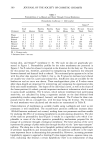
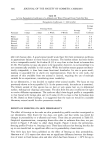
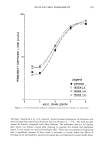
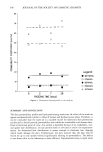
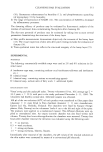
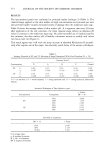
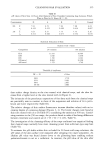
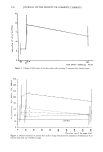
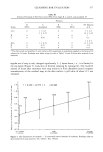
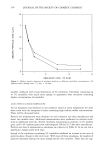
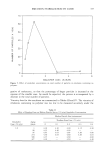
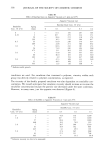
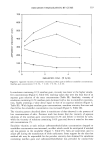
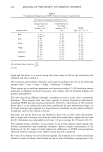
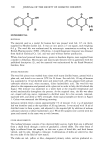
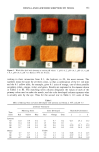
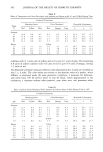
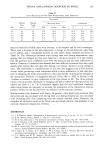
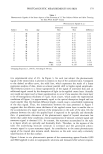
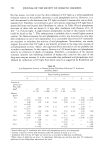
HENNA AND LAWSONE SORPTION BY WOOL 367 Table IV Colors Remaining on Felts Dyed With Lawsone, After Extraction Tintometer Dyeing Dyeing Matching Series Colorimeter Time Temp pH (min.) (øC) Red Yellow Blue L a b 4.5 30 30 8.6 10.0 2.0 36.4 19.6 18.0 4.5 30 50 8.9 10.0 2.5 34.8 19.6 17.7 4.5 60 30 8.1 10.1 2.0 35.5 19.3 17.7 3.0 30 30 8.4 9.4 2.2 36.8 21.0 18.5 7.0 30 30 1.7 1.6 0 65.8 5.9 17.1 detected from felts freshly dyed with lawsone, in all samples and by both techniques. These were a decrease in the red component, a change in the predominant color from red to yellow, and a considerable increase in color depth. Some examples are shown in Table IV. The differences increased with dyeing time and dyeing temperature, sug- gesting that the changes in color were based on a chemical reaction. It is also evident that the products have a different color from the reactants and are more substantive to keratin. Forestier (1) observed that lawsone was more difficult to remove from hair eight months after dyeing than two days after dyeing, but did not comment on any change in color. His observation is complementary to our own and suggests that a slow reaction occurs, either producing a new compound which is more substantive to hair than law- sone or changing the mode of attachment to hair and thereby increasing the strength of the interaction. Forestier (1) suggested fixation of free -SH or -NH 2 in keratin to the 3-carbon in lawsone, to give complexes of the type shown in (II). The three primary colors of extracted felts decreased on changing the pH at which the dyeing process was carried out from 4.5 to 7.0. It therefore appears that the acid conditions employed when using henna are necessary to increase the proportion of the substantive reaction product formed on the hair but have no influence on the reactant, lawsone. Similar results were obtained with henna. In general, color depth was increased after extraction and also increased with dyeing time and dyeing temperature, but decreased with increasing pH, thus complying with the scheme outlined above. However, the complete set of results could not be fitted into any simple pattern, due probably to the intricate chemical composition of henna. REFERENCES (1) J.P. Forestier, Henn& Absorption de la lawsone par le cheveu, Int. J. Cos. Sci., 4, 153-174 (1982). (2) E. M. Holmes, Henna, Pharm. J., 112, 437-439 (1924). (3) H. E. Cox, Hair dyes. I. The chemistry and analysis of henna, Analyst, 63, 397-404 (1938). (4) M. S. Karawya, S. M. Abdel Wahhab, and A. Y. Zaki, A study of the lawsone content of henna, Lloydia, 32, 76-78 (1969). (5) M. R. Verma and J. Rai, Spectrophotometric and chromotographic studies of henna leaf and powder extracts, Indian Standards Institute Bulletin, 20, 495-497 (1968). (6) I. Singh, R. T. Ogata, R. E. Moore, C. W. J. Chang, and P. J. Schener, Electronic spectra of substituted naphthoquinones, Tetrahedron, 24, 6053-6073 (1968). (7) J. A. Medley and M. W. Andrews, The effect of surface barrier on uptake rates of dye into wool fibres, Textile Research Journal, 29, 398-403 (1959).

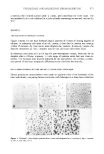
j. Soc. Cosmet. Chem., 37, 369-374 (September/October 1986) $ebutape' A device for visualizing and measuring human sebaceous secretion ALBERT M. KLIGMAN, DAVID L. MILLER, and KENNETH J. McGINLEY University of Pennsylvania School of Medicine, Department of Dermatology, Philadelphia, PA 19104 (A.M.K., K.J.M), and CuDerm Corporation, P.O. Box 801413, Dallas, TX 75380 (D.L.M.). Received March 31, 1986 Synopsis Current methods of determining sebum production do not enable visualization of the droplets produced by individual follicles. Sebutape furnishes a means of obtaining sebum pore patterns. The tape is a hydro- phobic adhesive film with innumerable tiny cavities which trap sebum as it issues from each follicular orifice. The pore pattern provides a permanent record of size and distribution of sebum droplets which can be quantified speedily by computerized image analysis. Additionally, the tape can be extracted with hexane for analysis of lipid components by thin layer chroma- tography and for determination of sebum output gravimetrically. Pore patterns vary in various parts of the body, with age, sex, and disease. Sebutape is convenient for estimating the effect of topical and oral drugs which influence the physiology of the sebaceous glands. INTRODUCTION The measurement of sebum production in humans most often depends on a gravimetric method in which the sebum is trapped in an absorbing matrix (for example, cigarette paper), from which it is subsequently extracted and analyzed (1). Sebum output can also be estimated optically by the way droplets collected on ground glass alter the transmis- sion of light (2). The lipometer is a recently introduced, commercially available device which simplifies and standardizes the optical assessment (3, 4). These techniques permit estimation of the total quantity of sebum produced per unit area for a given time period. The production of droplets from individual follicles cannot be monitored. In this paper we describe a sebum-sensitive adhesive film (Sebutape ©) which not only allows measurement of sebum production but also displays the output from individual follicles, as well as revealing overall droplet patterns. 369
Purchased for the exclusive use of nofirst nolast (unknown)
From: SCC Media Library & Resource Center (library.scconline.org)