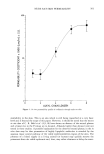
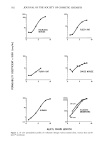
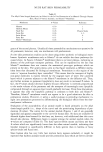
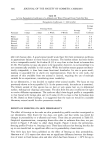
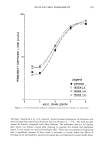
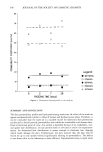
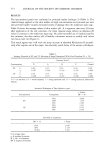
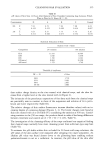
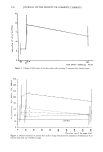
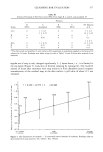
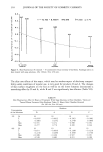
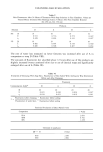
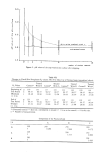
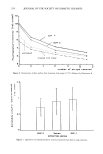
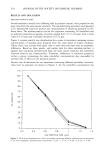
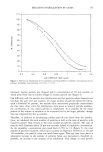
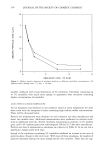
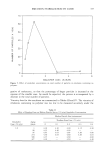
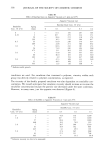
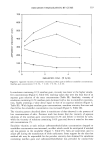
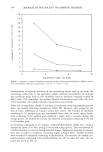
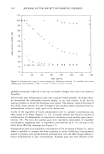
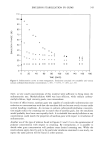
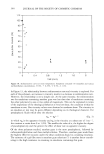
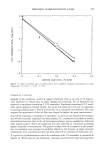
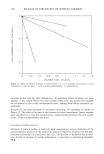
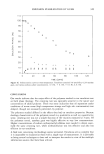
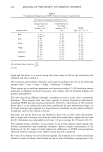
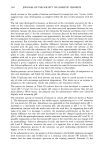
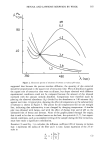
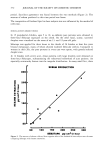
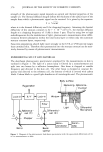
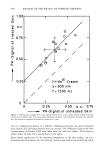
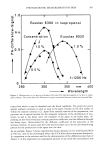
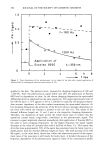
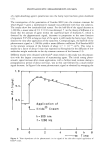
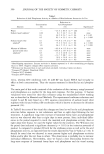
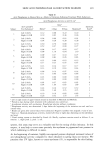
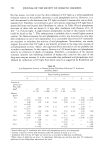
384 JOURNAL OF THE SOCIETY OF COSMETIC CHEMISTS individual 1,200 Hz signals of six test subjects is plotted over time. A measurement performed after a postapplication period of 24 h showed the sunscreen signal to be plainly visible. The half-life was estimated to be about 15 h. The 180 Hz signal showed a very similar temporal behavior, so that with the Ilrido © cream the transport of the sunscreen from the vehicle to the horny layer seems to be the rate-determining process for the penetration of the agent into the skin. For the weak signal increase observed during the first hour after application, two opposing processes might be responsible: (i) the penetration of the sunscreen into the stratum corneum and (ii) the redistribution of the preparation from the sulci over the skin surface. While the first process is respon- sible for the decrease of the photoacoustic signal, the latter yields an increase as the amount of agent which is reached by the light and contributes to its absorption is increased. Recently Blank eta/. observed in vitro a similar increase of the absorption ability of a sunscreen during the first two hours after topical application to excised stratum corneum and interpreted this effect as being caused by a redistribution of the agent (12). The authors were able to demonstrate in vivo the corresponding delay in erythemal response of the skin to ultraviolet irradiation. CONCLUSION This study shows that photoacoustic spectroscopy can be used to observe in vivo the penetration of topically applied drugs into the skin if their ability to absorb radiant energy is sufficiently strong with respect to that of stratum corneum. At chopping frequencies in the audio frequency range, the method mainly yields information about the absorption of light on and within the horny layer. To obtain data about the viable epidermis would require much lower chopping frequencies. The stability of the agent against irradiation is of utmost importance as the photoacoustic in vivo measurements are performed at relatively high light intensities in order to achieve a satisfactory signal-to-noise ratio. Experimental results are presented which show the different pene- tration behavior of two sunscreening agents incorporated in different vehicles. As ex- pected, the penetration of the agent dissolved in alcohol occurred faster than that of the agent incorporated in a cream. ACKNOWLEDGEMENTS Financial support by the Deutsche Forschungsgemeinschaft, Bonn-Bad Godesberg, FRG, and the Paul G. Unna-Stiftung, Diisseldorf, FRG, is gratefully acknowledged. REFERENCES (1) R. C. Wester and H. I. Maibach, "In Vivo Methods for Percutaneous Absorption Measurements," in Percutaneous Absorption, R. L. Bronaugh and H. I. Maibach, Eds. (Marcel Dekker, New York, 1985), pp 245-249. (2) A. Rosencwaig, Photoacoustic Spectroscopy (J. Wiley, New York, 1980). (3) T. A. Moore, "Photoacoustic Spectroscopy and Related Techniques Applied to Biological Materials," in Photothem. Photobid. Rev. 7, K. C. Smith, Ed. (Plenum Press, New York, 1983), pp 187-222. (4) A. Rosencwaig, Potential clinical applications of photoacoustics, C/in. Chem., 28, 1878-1881 (1982). (5) I. Simon, A. G. Emslie, C. M. Apt, I. H. Blank, and R. R. Anderson, "Determination of In Vivo

PHOTOACOUSTIC MEASUREMENTS ON SKIN 385 (6) (7) (8) (9) (lO) (11) (12) (13) (14) Water Concentration Profile in Human Stratum Corneum by a Photoacoustic Method," in Bioengineer- ing and the Skin, R. Marks and P. A. Payne, Eds. (MTP Press, Lancaster, UK, 1981), pp 187-195. S. D. Campbell, S. S. Yee, and M. A. Afromowitz, Applications of photoacoustic spectroscopy to problems in dermatology research, IEEE Transactions on Biomedical Engineerzng, BME-26, 220-227 (1979). K. Giese and K. K/51mel, A photoacoustic hydration study of human stratum corneum, J. Physique, Colloque C6, 373-378 (1983). P. Poulet and J. Chambron, Conception and realization of a photoacoustic detector for in situ spec- troscopy,J. Photoacoustics, 1, 329-346 (1983). J.J. O'Neill, Effect of film irregularities on sunscreen efficacy, J, Pharmaceutical Sciences, 73, 888-891 (1984), and 74, 232 (1985). K. K/51mel, A. Nicolaus, and K. Giese, Photoacoustic determination of the water uptake by the upper horny layer of non-eczematous skin in atopic dermatitis, Bioeng, Skin, 1, 125-131 (1985). K. Giese, A. Nicolaus, and K. K/51mel, In vivo application of photoacoustic spectroscopy to stratum corneum studies, Med, Bid. Eng. Cornput., 23, Suppl. 1, 378-379 (1985). I. H. Blank, J. H. Cohen, R. R. Anderson, K. F. Jaenicke, and J. A. Parrish, Observations on the mechanism of protective action of sunscreens, J. Invest. Dermato/,, 78, 381-385 (1982). K. Giese, A. Nicolaus, B. Sennhenn, and K. K/51mel, Photoacoustic in vivo study of the penetration of sunscreen into human skin, Can. J, Phys., 1986, in press. R. J. Scheuplein, Mechanism of percutaneous absorption, J. Invest. Dermatol., 48, 79-88 (1967).
Purchased for the exclusive use of nofirst nolast (unknown)
From: SCC Media Library & Resource Center (library.scconline.org)