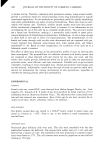
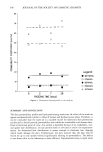
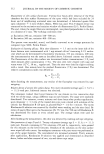
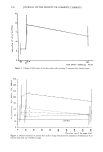
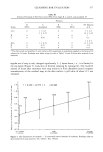
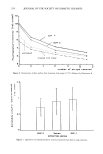
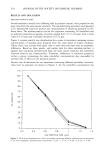
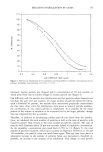
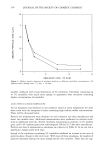
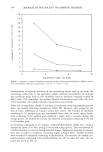
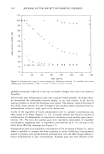
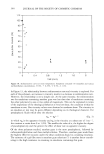
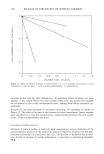
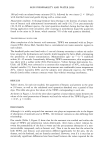
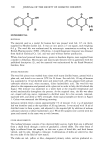
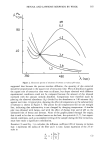
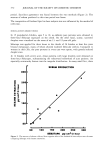
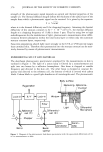
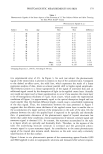
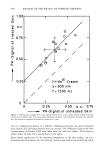
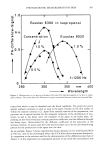
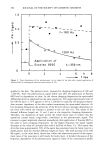
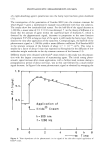
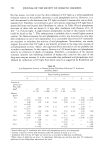
382 JOURNAL OF THE SOCIETY OF COSMETIC CHEMISTS 1.0 I I I ß I ß f = 180 Hz ß ""' ""' i - -• o • I - r r t Eusotex 8020 ),=350 nm h Time Figure 5. Time dependence of the photoacoustic in vivo signal of the skin after topical application of Eusolex 8020 in isopropanol solution (concentration 0.1%). applied to the skin. The plotted curves, measured at chopping frequencies of 180 and 1,200 Hz, show the photoacoustic signal before and after the application of Eusolex 8020 and its dependence on time. At the chosen chopping frequencies the open-ended differential detector employed has the same sensitivity. The larger experimental error of the 180 Hz data (_-4- 15% against _ 4% at 1,200 Hz) is caused by the frequency-depen- dent acoustic impedance of the skin surface terminating the open-ended detector. At low chopping frequencies the sensitivity of the detector shows a stronger dependence on the force with which the forearm is pressed to the cell rim (13). The values of the thermal diffusion length are 12 and 4 Ibm at the respective chopping frequencies. Therefore, the absorption of light within the whole horny layer or within only the superficial corneal layers, respectively, contributes to the photoacoustic signal. The increase in signal amplitude observed immediately after application of Eusolex 8020 is the same at both chopping frequencies. At the higher frequency the signal rapidly decreases to the value of untreated skin with a half-life of about 3 h. This means that after this time approximately 50% of the agent has penetrated into the horny layer to a depth greater than the thermal diffusion length of 4 tzm. The weak decrease of the 180 Hz signal, on the other hand, shows that within the observation period of the experi- ment most of the sunscreen is still inside the horny layer. A detailed discussion of the frequency dependence of the photoacoustic signal in terms of the concentration profile

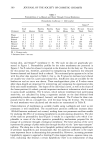
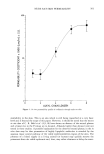
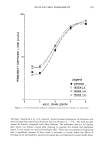
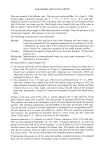
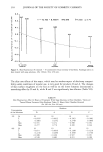
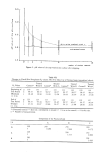
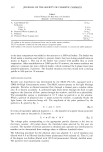
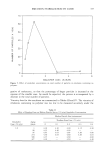
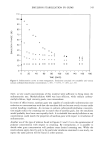
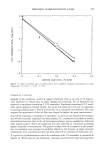
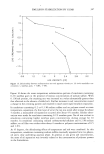
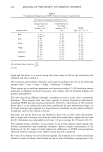
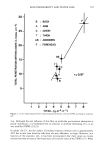
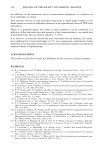
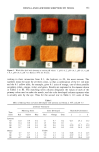
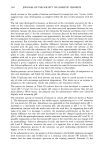
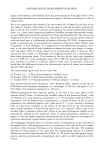
PHOTOACOUSTIC MEASUREMENTS ON SKIN 383 of a light-absorbing agent's penetration into the horny layer has been given elsewhere (ii). The investigation of the penetration of Eusolex 8020 into the stratum corneum for which Figure 5 gives a representative example was performed with four test subjects. The results show low interindividual scatter. For the half-life of the signal decrease at 1,200 Hz, a mean value of 2.9 - 0.9 h was obtained. F •m the theory of diffusion it is found that the amount of agent within the superficial layer of thickness e, which is detected by the photoacoustic signal, decreases in proportion to the error function of argument e/2X/Dt as long as most of the agent is still inside the horny layer. Here t denotes the time after application of the sunscreen. Correspondingly, the half-life of the photoacoustic signal at 1,200 Hz yields a mean diffusion coefficient D of Eusolex 8020 in the stratum corneum of the forearm of about 1.7 x 10 -• cm2/s. This value is smaller by a factor of about 6 than that reported by Scheuplein for the diffusion of low molecular weight molecules in the dry stratum corneum of the forearm (14). Different results were obtained with Ilrido © cream which in this study was the prepara- tion with the largest concentration of sunscreening agent. The initial strong photo- acoustic signal increase after cream application, with a further weak increase during a postapplication period of about one hour, was in this case followed by a much slower signal decrease. In Figure 6 the mean photoacoustic signal as obtained by averaging the 1.0 Oo go 0.5 I I I I Appticotion of I[rido Creorn 300 n rn 1200 Hz 0 2 /, 6 h 8 -,- Time Figure 6. Time dependence of the photoacoustic in vivo signal of the skin after topical application of Ilrido © cream.
Purchased for the exclusive use of nofirst nolast (unknown)
From: SCC Media Library & Resource Center (library.scconline.org)