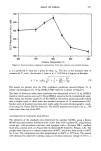
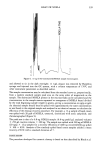
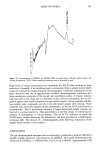
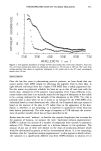
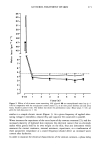
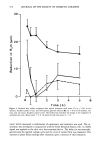
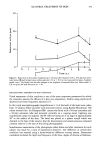
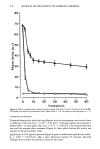
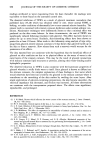
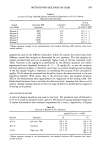
ASSAY OF NDELA ,, 343 Figure 8. Chromatogram of NDELA (as NDELA-TMS) recovered from 100-ppb spiked lotion. GC column temperature: 130øC. Other operating conditions were as described in text. High levels of reactor by-products can overwhelm the ELCD when working at high sensitivity. Generally, if an interfering peak is encountered from a sample matrix which cannot be resolved by simply changing chromatographic conditions, preparation of the other derivative and use of appropriately modified chromatographic conditions will allow satisfactory resolution of the sample and interference peaks. A ceramic reaction tube was used in this study and is a relatively sturdy, low-cost component the use of a gold or quartz tube would be expected to give similar results. Certain pyridine-soluble, non-volatile polar compounds are left in the derivatized sample after cleanup. These materials may eventually degrade column performance, so the use of GC precolumns is recommended. This is particularly necessary if larger derivatized sample volumes are injected to increase sensitivity. Mass spectrometry is the best means of confirming the presence of nitrosamines in critical analyses. The use of UV radiation to cleave the N-NO bond, thereby destroying the nitrosamine, has been described as a confirmatory technique (48). The absence of a chromatographic peak following irradiation of the sample lends credence to the analysis. CONCLUSIONS The gas chromatograph equipped with an electrolytic conductivity detector (ELCD) is capable of high sensitivity and selectivity for NDELA. This work demonstrated the sensitivity for NDELA, as NDELA-OAc, was 0.25 ng in MeOH. Approximately 81%

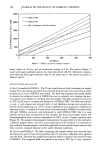
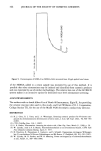
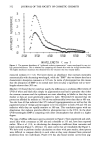
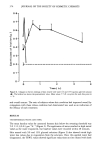
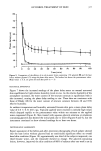
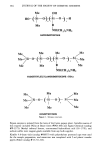
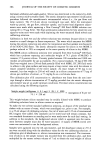
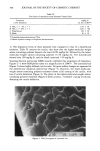
344 JOURNAL OF THE SOCIETY OF COSMETIC CHEMISTS Figure 9. Chromatogram of NDELA (as NDELA-OAc) recovered from 20-ppb spiked hand cream. of the NDELA added to a cream sample was recovered by use of this method. It is possible that other nitrosamines may be isolated and identified from cosmetic products and raw materials by use of similar methodology. The relative low cost of the GC/ELCD system makes it an attractive option for dedicated trace level nitrosamine screening. ACKNOWLEDGMENTS The authors wish to thank Albert Cox of North 40 Instruments, Elgin IL, for providing the ceramic reaction tube used in this study, and Carl Williams of O.I. Corporation, College Station TX, for the use of the Model 4420 electrolytic conductivity detector. REFERENCES (1) H. J. Chou, R. L. Yates, and J. A. Wenninger, Screening cosmetic products for N-nitroso com- pounds by chemiluminescent determination of nitric oxide, J. Assoc. Off. Anal. Chem., 70, 960-963 (1987). (2) CTFA Tech/RegNotes, 1(3), 1 (1987). (3) L. R. Ember, Nitrosamines: Assessing the relative risk, Chem. Eng. News, March 31, 1980, p. 20. (4) W. Lijinsky, cited in F. E. Bently, Nitrosodiethanolamine as an environmental hazard, CTFA Task Force Chemistry Committee Meeting, April 27, 1977. (5) H. Druckrey, R. Preussmann, S. Ivankovic, and S. Schmahl, Organotrope carcinogene Wirkungen bei 65 verschiedenen N-Nitroso-Verbindungen and Bd-Ratten, Z. Krebsforsch, 69, 103-201 (1967). (6) W. Lijinsky, M.D. Reuber, and W. B. Manning, Potent carcinogenicity of nitrosodiethanolamine in rats, Nature, 11, 589-590 (1980).
Purchased for the exclusive use of nofirst nolast (unknown)
From: SCC Media Library & Resource Center (library.scconline.org)