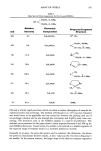
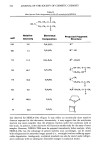
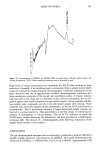
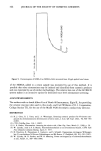
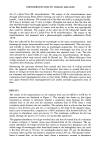
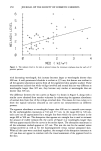
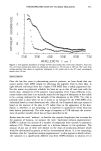
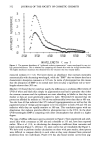
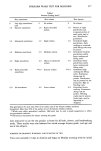
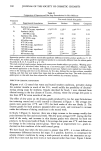
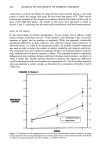
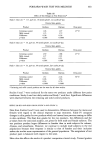
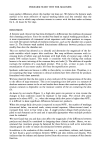
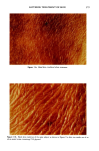
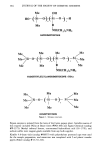
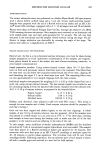
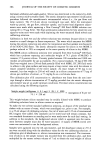
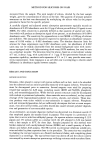
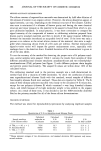
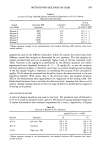
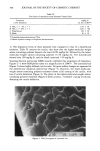
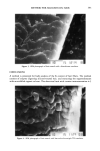
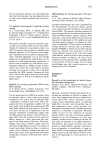
390 JOURNAL OF THE SOCIETY OF COSMETIC CHEMISTS Table IV First Series of Aminofunctional Siloxane*-Treated Hair Treatment mg/kg Si (. 25% Emulsion) by AA (+ SD)** A TSA, x = 96, y = 2 1170 + 50 B TSA, x = 298, y = 2 4220 + 100 C Dimethicone 190 + 20 D Blank 30 + 30 * Trimethylsilylamodimethicone (TSA). ** Means represent averages of duplicate determinations. 1). The deposition levels of these polymers were compared to that of a dimethicone emulsion. Table IV contains the results, that show that the higher-molecular-weight amine-containing polymer deposits the most (4220 mg/kg Si), followed by the lower- molecular-weight amine-containing polymer (1170 mg/kg Si). The dimethicone showed only 190 mg/kg Si, and the blank contained 30 mg/kg Si. Scanning electron microscopy (SEM) visually confirmed this progression of deposition. Figures 2- 5 show SEM photos taken at a magnification of 2000 x. The untreated hair (Figure 2) shows highly defined cuticle scales. No gross surface changes are apparent for the dimethicone emulsion-treated hair (Figure 3). However, the lower-molecular- weight amine-containing polymer treatment shows a full coating of the cuticle, with loss of cuticle definition (Figure 4). The photo of the higher-molecular-weight amine- containing polymer treatment (Figure 5) shows a heavy, "wrinkled" coating of silicone, obscuring the cuticle definition. Figure 2. SEM photograph of untreated hair.

METHOD FOR SILICONES ON HAIR 391 /- Figure 3. SEM photograph of hair treated with a dimethicone emulsion. CONCLUSIONS A method is presented for bulk analysis of the Si content of hair fibers. The method consists of enzyme digesting silicone-treated hair, and extracting the organosiloxanes with an acidified organic solvent. The detection limit with current instrumentation is 3 Figure 4. SEM photograph of hair treated with low-molecular-weight TSA emulsion.
Purchased for the exclusive use of nofirst nolast (unknown)
From: SCC Media Library & Resource Center (library.scconline.org)