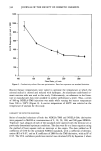
386 JOURNAL OF THE SOCIETY OF COSMETIC CHEMISTS Instrument calibration and sample analysis. Silicon was determined in the extracts by AAS, using a nitrous oxide-acetylene flame. The atomic absorption spectrometer initialization procedure followed the manufacturer's recommended values (i.e., for gas flows and lamp current). The 251.6-nm silicon wavelength was used. After the instrument warm-up period, the gas flow, nebulizer uptake, and burner head alignment adjust- ments were made while aspirating a Dow Corning © 200 fluid-MIBK solution con- taining 60 to 70 •xg Si/ml. The final optimization adjustments for best sensitivity and signal-to-noise ratio were made while aspirating the water-saturated blank solvent and calibrating solutions. Calibration in both wet and dry solvent solutions was necessary because silicon is very sensitive to small changes in flame temperature. The water which saturates the MIBK during the solvent extraction step alters the temperature and fuel-oxidant stoichiometry of the N20-C2H2 flame. The atomic absorption response for silicon in wet MIBK is perhaps reduced to 70% as compared to the same quantity of silicon in dry MIBK. Dry MIBK silicon calibration solutions were prepared from Dow Corning © 200 fluid, which has a polymer repeating unit molecular weight of 74. ! g/unit of Me2SiO. It contains 37.9 percent silicon. Viscosity grades between 100 centistokes and 1000 cen- tistokes are permissible for use as standards. For a typical standard, 50 mg of DC 200 fluid was weighed into a 250-ml flask partially filled with MIBK. DC 200 fluid tends to adhere to dry glass surfaces and may require a long contact time with the solvent to ensure complete solubility of the entire sample. An exact weight of 50 mg is not essential, but that weight in 250 ml will result in a silicon concentration of 75 }zg of silicon per milliliter of solvent, or 75 mg/kg Si on a wt/volume basis. The calibration plot of Si concentration vs. absorbance was linear from the zero inter- cept through a silicon concentration of 75 mg/kg provided that the atomic absorption spectrometer was set up under optimum conditions. The exact silicon concentration was calculated using the following equation: Sample weight (milligrams + 0.1 mg) x 28.1 x 1000 74.1 x 250ml = micrograms of Si per ml This weight/volume silicon standard may be serially diluted with MIBK to produce calibrating solutions lower in silicon content as required. To make the wet solvent standard calibration solutions, an aliquot of the standard was shaken with an excess of water, which was centrifuged out, prior to use. For example, to a 25-ml aliquot of calibrating solution, five ml of water and 0.25 ml of concentrated HCI reagent were added. Dry standards can be stored and will remain constant, but wet standards deteriorate on standing and so were made anew for each day's testing. In addition to the standards, the background solvent which is aspirated into the instru- ment between samples must also be water-saturated. A supply of MIBK stored over water was maintained to use for background solvent. Samples were aspirated into the AA spectrometer, and the absorbance values at 251.6 nm were recorded along with the absorbance values for the wet calibrating solutions. A calibration plot of absorbance vs. silicon concentration was constructed. The concentra- tion of silicon in the sample extracts was recorded from the calibration plot, and then multiplied by the extract solvent volume of 7 ml to obtain the total weight of silicon

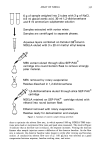
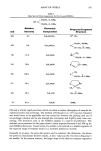
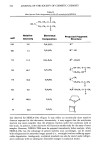
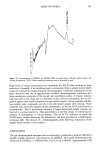
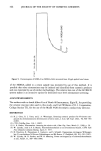
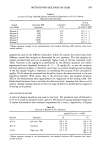
METHOD FOR SILICONES ON HAIR 387 recovered from the sample. The total weight of silicon, divided by the hair sample weight, gave the concentration of silicon on the hair. The quantity of siloxane polymer treatment on the hair was determined by multiplying the silicon value by the proper gravimetric factor for the specific polymer. A carefully aligned and adjusted atomic absorption spectrometer typically records an absorbance of 0.050 absorbance units for 10 •xg of silicon per milliliter (10 ppm) in wet MIBK. For AAS, sensitivity is generally defined as that quantity of analyte per milli- liter which will produce an absorption signal of one percent, or an absorbance of 0.0044 absorbance units. The sensitivity for organosilicon in wet MIBK is 0.88 •xg of silicone per milliliter. The instrument should be expected to reproduce an absorbance measure- ment of 0.050 within _+ 0.002 absorbance units. The absolute detection limit for silicone for these experiments was 0.002 absorbance units. An absorbance of 0.002 units may not be readily discernible from the normal background noise with instru- ments equipped only with light-emitting diode array (LED) readouts, but may be seen on a stripchart recorder. The detection limit for silicon, based on a total solvent volume of 7 ml, is about 3 •xg, with a precision of -+ 3 }xg. If the spectrometer features scale expansion capability, moderate scale expansion of 2 X or 3 X may provide some sensi- tivity improvement. Scale expansion is an aid when one is attempting to discern small differences in absorbance signals between samples. RESULTS AND DISCUSSION METHOD SELECTION Siloxanes, when placed in contact with porous surfaces such as hair, tend to be adsorbed into the substrate and can only be partially extracted with organic solvents. Treated hair must be decomposed prior to extraction. Several reagents were tried for preparing treated hair samples for AAS assay, including caustic (KOH and NaOH), phosphoric acid, and tetramethylguanidine. While the hair protein structure could be decomposed with sodium or potassium hydroxides, those materials were not selected, as they caused cleavage of the organosiloxane polymer into cyclics, silanols, and silicates. Those reac- tion products were either volatile or non-extractable in organic solvents. Phosphoric acid and tetramethylguanidine did not sufficiently decompose the hair at room temper- ature, even after several weeks, and when heated also caused siloxane polymer degrada- tion and generation of non-extractable species. As an alternative, an enzyme digestion method was discovered in a literature search (2) that employed papain (an enzyme found in papaya). This enzyme is a proteolytic en- zyme that is active with free sulfhydryl groups. An aqueous solution containing 0.13% papain and 2% sodium sulfite as a catalyst (with the pH adjusted to 6.8) was heated with a hair sample at 65øC for three days. Samples prepared by this method were further extracted with methylisobutyl ketone (MIBK) and a small quantity of hydro- chloric acid before AAS analysis. The HCI served to precipitate otherwise soluble pro- teins and aided in phase separation later in the procedure. The extraction was completed by shaking the vial and contents on a Burrell mechanical shaker, and completing phase separation in a centrifuge. The top (solvent) layer was drawn off and the silicon content was assayed by atomic absorption spectroscopy utilizing a nitrous oxide-acetylene flame.
Purchased for the exclusive use of nofirst nolast (unknown)
From: SCC Media Library & Resource Center (library.scconline.org)