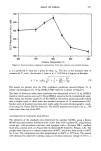
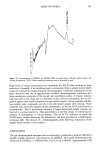
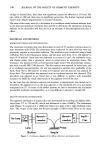
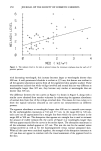
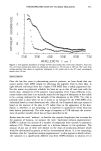
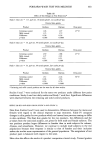
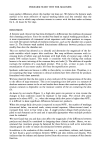
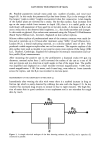
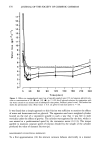
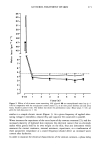
PHOTOPROTECTION BY HUMAN MELANIN 349 slit of a Jobin-Yvon HL monochromator. The output of the monochromator went through order-sorting filters before entering one end of a bifurcated fused silica fiber bundle, 3 mm in diameter. The joined end of the fiber was held in a plexiglass holder, 50.0 mm in diameter and 15 mm in height. Plexiglass was used so that the skin site that the fiber bundle was brought against could be visually checked. The bifurcated end of the fiber bundle was brought in contact with the skin, as in this way reproducible data could be obtained. The output of the other leg of the bifurcated bundle was brought to the input slit of a Jobin-Yvon H-10 monochromator. The output of the monochromator was measured with a photomultiplier amplifier combination (Oriel 7070). Data was collected by first setting the wavelength on the input monochromator, then scanning the output monochromator until the output was maximized. This was neces- sary initially to ensure that there were no wavelength mismatches. The output of the current amplifier was recorded manually. The next wavelength was then set on the input monochromator, and the whole procedure was repeated every 5 nm. The slits were selected for a band width of 2 nm. By using two monochromators, the fluores- cence signals which were excited could be filtered out. The diffuse reflectance from vitiligo-involved, as well as adjacently located normal skin, was determined from seven volunteers after obtaining informed consent. Subtracting the spectrum obtained from normal skin from that of vitiligo-involved skin, the apparent absorbance of the chromophore that exists in normal skin but is absent in vitiligo-involved skin was obtained. The same operation was performed with six volunteers who had been exposed to either artificial UVB or solar radiation and as a consequence had hyperpigmented areas on their backs. Diffuse reflectance spectra were once again obtained from hyperpigmented and nearby normally pigmented areas of skin. RESULTS The results of the measurements on the melanin level and the MED to UVB for 47 psoriatic patients are displayed in Figure 2. The straight line drawn on this figure represents an attempt to determine whether a correlation exists between the visible melanin level in the skin and the minimum erythema dose of UVB. Only a weak correlation exists between the two variables. The melanin level is a factor that has been found to vary between zero and ten it corresponds to the slope of the apparent absor- bance curve of normal skin, compared to a 100% amelanotic skin between 620 and 720 nm given in absorbance units per micron (7). The correlation coefficient for the line drawn through the points is 0.3 and is not statistically significant. The apparent absorbance of vitiligo-involved skin and that of normal skin of a volunteer is shown in Figure 3. Similar curves were obtained from all the volunteers. The ap- parent absorbance of vitiligo-involved skin shows no characteristic absorption over the visible range of wavelengths other than broad bands at the hemoglobin lines the curve is flat from 350 nm to 720 nm. At wavelengths shorter than 335 nm the absorbance increasese rather quickly and reaches a maximum around 285 nm. The apparent absor- bance of normal skin, on the other hand, shows a monotonic increase in absorbance

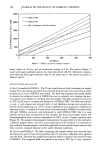
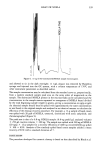
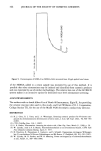
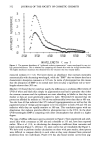
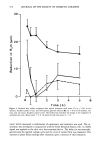
350 JOURNAL OF THE SOCIETY OF COSMETIC CHEMISTS z 3 + . +++ • ++ + ++ 0 1 2 3 4 MED ( kJ/rn 2) Figure 2. The melanin level in the skin is plotted versus the minimum erythema dose for each of 47 psoriatic patients. with decreasing wavelength this increase becomes larger at wavelengths shorter than 400 nm. A well-pronounced shoulder is evident at 335 nm this feature was evident in all the apparent absorption spectra from all the pigmented skin samples studied. These measurements indicate that while vitiligo-involved and normal skin are very different at wavelengths longer than 305 nm, they become very similar at wavelengths that are shorter than 305 nm. The difference between the two curves on Figure 3 is shown in Figure 4, along with a similar curve obtained from another volunteer by subtracting the apparent absorbance of normal skin from that of the vitiligo-involved skin. The reason for two curves is to show the typical variation obtained as one carries out measurements on different persons. The apparent absorbance at wavelengths longer than 400 nm is a smooth curve except for the oxyhemoglobin resonances at 542 and 577 nm. In the range 620 to 720 nm, each curve can be approximated by a straight line from which the curve deviates in the range 400 to 500 nm. The absorption that appears as a straight line is used to estimate the amount of visible melanin (8) the curves of Figure 4 at wavelengths longer than 400 nm appear exactly like the curves in the earlier report. The absorption maximum in all the volunteers studied appears at 335 nm. This was the case for the normal versus vitiligo-involved as well as for the hyperpigmented versus normal unexposed skin. When all the cases were considered together, the strength of the absorption resonance at 335 nm does not appear to correlate with the visual assessment of the pigment level in the skin.
Purchased for the exclusive use of nofirst nolast (unknown)
From: SCC Media Library & Resource Center (library.scconline.org)