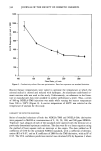
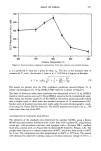
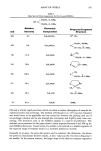
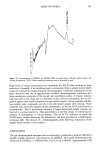
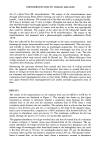
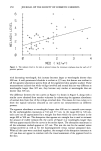
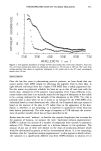
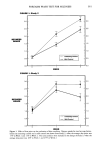
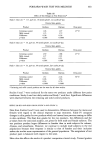
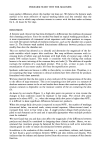
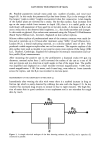
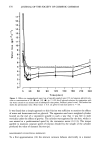
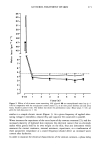
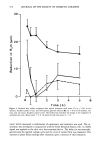
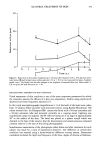
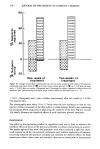
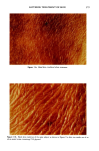
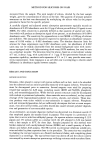
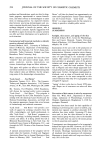
PHOTOPROTECTION BY HUMAN MELANIN 351 s % 25g 35g 45g 550 850 75g WAVELENiZTH ( nm ) Figure 3. The apparent absorbance of vitiligo-involved and normal skin of the same volunteer. Note that the curve from normal skin shows two absorption resonances at 335 nm and at 285 nm. The curve from vitiligo-involved skin shows no significant absorption in the visible and in the UV until wavelengths shorter than 320 nm. DISCUSSION Over the last few years in phototesting psoriatic patients, we have found that one cannot predict their MED simply by observing the pigment level in their skin. A light-skinned individual often has a higher UVB MED than a darkly pigmented one. For this reason our phototest schedule has been set up so that all tests start with the lowest dose, irrespective of the patient's visual pigment level. Upon reflection it be- comes evident that there is no scientific reason for the degree of absorption in the visible to be a strong indicator for the strength of the absorption in the UVB. Yet, this is precisely what is done when we try to arrive at an estimate for the UVB MED of an individual based on visual observation only. After all, the Fitzpatrick skin type system is based on the reaction of the skin to UV rather than on the appearance of the skin. Figure 2, therefore, is not surprising, as it expresses in quantitative terms what has been known qualitatively. The wide range of responses to UVB indicates the involve- ment of another variable which has not been identified so far. Rather than the word "melanin" to describe the complex biopolymer that accounts for the pigment of humans, we propose the term "epidermal melanin pigmentation" (EMP) to indicate the mixture of a number of compounds from tyrosine to polymeric melanin (10). These compounds exist in a delicate balance in the epidermis. The amount of any one of these will depend on the chain of production-demand which would be determined by genetic as well as environmental factors. It is not surprising, therefore, that the "epidermal melanin pigmentation" in skin appears to absorb ultravi- olet radiation in a significantly different way from DOPA-melanin in solution (1) or

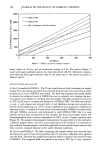
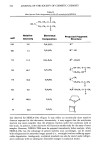
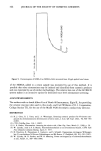
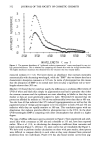
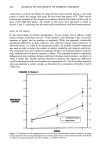
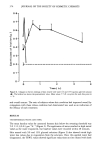
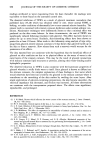
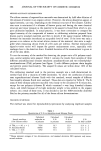
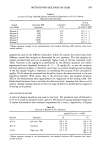
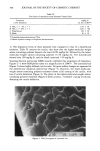
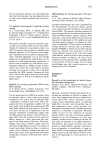
352 JOURNAL OF THE SOCIETY OF COSMETIC CHEMISTS o 250 + + + + + + + + + + + + * + ++ % . % %, 351ZI 451ZI 551ZI 651ZI 75g WAVELENGTH ( nm) 1•o p•d½•t$/•olu•t½½r$. •h•$ •$ obt•½d by comp•r• the •orm•l $14• •th the •t•I•o-•ol•½(l The higher absorbance maximum was obtained from the volunteer that was visually darker. extracted melanin (11-12). The latter shows an absorbance that increases essentially monotonically with decreasing wavelength, while the "EMP" that we observe here has a characteristic absorption resonance at 335 nm. In terms of photoprotection this means that the absorption of EMP in its normal state does not play a significant role at wave- lengths shorter than 305 nm. Mischer (13) found that he could not justify the differences in erythema effectiveness of UVB of white and black skin simply on pigmentation and had to postulate that either the stratum corneum and the epidermis are more absorbing in blacks or that they are thicker or they are more genetically adapted to light. Westerhof (5) reported that the protection afforded by melanin at 310 nm was substantially lower than that at 405 nm. Van der Leun (6) has indicated that UV induced hyperpigmentation as well as that the pigmented areas of vitiligo patients appear to be less sensitive to both 254 and 336 nm radiation while they are equally sensitive to 300 nm. This conclusion agrees with our observation that melanin provides effective photoprotection in the UVA. In the short UVB wavelengths EMP is competing with other chromophores that absorb to a higher degree. The type of diffuse reflectance spectra presented in Figure 2 from pigmented and amel- anotic skin with a resonance at 285 nm and a shoulder at 335 nm, have been reported earlier. Wan et al. (14), in calculating the absorption coefficient from caucasian and black epidermis (Figure 5, reference 13), show curves that are remarkably like Figure 2. We have tried to perform similar calculations on these with poor results these spectra were difficult to compare directly to each other as they were obtained from extracted epidermis from two individuals. Poulet (15) has also found similar curves from pig-
Purchased for the exclusive use of nofirst nolast (unknown)
From: SCC Media Library & Resource Center (library.scconline.org)