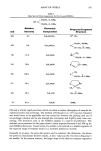
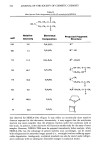
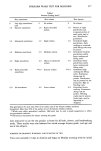
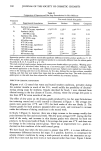
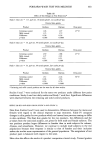
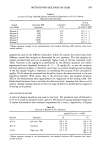
FOREARM WASH TEST FOR MILDNESS 357 Table I Forearm Grading Scale* Skin smoothness Skin redness Skin dryness Very high smoothness/ 0 No redness 0 No dryness slick Extreme smoothness 1.0 Barely detectable 1.0 redness o 1.o 2.0 Substantial smoothness 2.0 Slight redness 3.0 Moderate smoothness 3.0 Moderate redness 4.0 Slight smoothness 4.0 Heavy or substantial redness 5.0 Barely detectable ** 5.0 Extreme redness * * 5.0 smoothness 6.0 No smoothness 6.0 Severe redness Patches of slight powderiness and occasional patches of small scales may be seen. Distribution generalized. 2.0 Generalized slight powderiness. Early cracking or occasional small lifting scales may be present. 3.0 Generalized moderate powderiness and/or heavy cracking and lifting scales. 4.0 Generalized heavy powderiness and/or heavy cracking and lifting scales. Generalized high cracking and lifting scales. Eczematous change may be present. Powderiness may be present but not prominent. May see bleeding crack. 6.0 Generalized severe cracking. Eczematous change may be present. Bleeding cracks may be present. Scales large, may be beginning to disappear. Non-generalized: No more than 50% of the surface area of the forearm exhibits attribute. Generalized: More than 50% of the surface area of the forearm exhibits attribute. * Whole units reflect generalized condition. Half units may be used in grade assignments to reflect non-generalized condition. ** Discontinue treatment(s) for subject reaching this grade. were instructed to use the test product at home for all bath, shower, and handwashing needs. These studies were also balanced for initial average dryness grade, and age and sex of the subjects. SCHEDULE OF GRADINGS, WASHINGS, AND DURATION OF TEST Tests were normally 12 days in duration and began on Monday morning with the initial

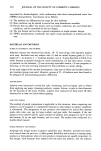
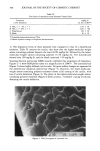
358 JOURNAL OF THE SOCIETY OF COSMETIC CHEMISTS grading, selection, and assignment of subjects, immediately followed by the first wash. Wash sessions (described below) continued morning and afternoon, with the first after- use grading on Friday afternoon (three hours after the ninth wash session and just before the tenth). Sessions then continued twice a day until noon the next Friday (after the 23rd wash session) when the final grading took place. Grading was always scheduled at least three hours after the preceding wash session to assure that the forearms were dry when examined by the grader or tested for transepidermal water loss. This also provides time for any residual perfume on the skin to dissipate, so that the blinding of the grader would not be compromised. WASH PROCEDURES The wash protocol was derived from habit information and by timing the various steps as a group of one hundred consumers washed their forearms. Therefore, the wash pro- tocol is believed to reflect more realistic conditions of product exposure. For example, most people utilize a wash cloth and bathe either once or twice each day. In these observations, the lather-on-towel procedure by consumers averaged six seconds and the wash of the forearm averaged ten seconds. All washings were performed at the test facility either by a technician or by the subjects themselves under supervision of a monitor to assure uniform washing and correct product usage. The water used in all applications (wet, wash, rinse) was controlled at 6-8 grain hardness and kept at 90-100øF. The procedure was as follows: Wet the left forearm liberally with the running water wet a non-woven paper towel (Masslinn Towel, Chicopee Mills, New Brunswick, N.J.) wet the bar rub bar on towel in a six-second lather workup rub lathered towel on the volar surface of the forearm with moderate pressure, going from wrist to elbow joint and back in about one second, for a total of ten seconds discard towel and allow lather to remain on the skin for an addi- tional ninety seconds rinse thoroughly for fifteen seconds pat forearm dry with a paper towel. The process was then repeated with the right forearm. Under certain environmental conditions (discussed below), the wash procedure involved four washes per day: two at the morning visit and two in the afternoon. At each visit, there was a five minute "rest period" after the first wash, and the entire washing proce- dure was repeated. EVALUATION OF SKIN CONDITION During the grading sessions, the same trained examiner evaluated both forearms of each subject with the aid of a Luxo Illuminated Magnifying Lamp (Model KFM-1A) which provided 2.75 X magnification and which had a shadow-free circular fluorescent light source (General Electric Cool White, 22 watt 8" Circline). Grades were assigned for redness (visual assessment), dryness (visual assessment), and smoothness (tactile assess- ment), using a seven-point scale (see Table I) with lower grades indicating better skin condition. Any subject exhibiting excessive skin dryness or redness (i.e., a grade of 5 or higher for either parameter) anytime during the study was not allowed to continue with treatment. To avoid bias in such cases, the maximum observed grade was retained in the data set and included in the final analyses. At the final grading session, the subjects also evaluated the skin of each of their own
Purchased for the exclusive use of nofirst nolast (unknown)
From: SCC Media Library & Resource Center (library.scconline.org)