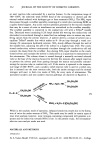
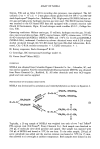
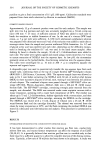
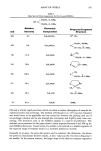
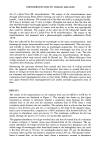
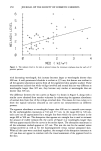
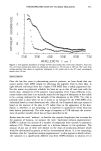
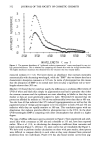
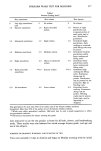
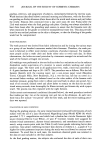
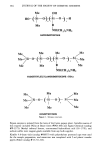
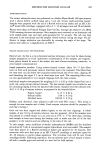
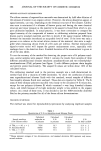
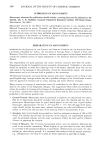
388 JOURNAL OF THE SOCIETY OF COSMETIC CHEMISTS METHOD ACCURACY DETERMINATION The silicon content of organosilicon materials was determined by AAS after dilution of the siloxane of interest in an organic solvent. However, the silicon absorption signal, or signal intensity, can vary, depending on the chemical structure of the siloxane. Calibra- tion error is minimized if a siloxane of known purity and having the same chemical structure and vapor pressure as the material to be assayed is found from which to pre- pare calibration standards. In actual practice, it was more convenient to compare the signal intensity of the compounds of interest to calibrating solutions prepared from known purity standard materials and then to decide if the signal response differences between the materials introduced an acceptable level of error. If the error was only a percent or so relative to the actual silicon content of the material, that error is negli- gible when measuring silicon levels of a few parts per million. Normal instrumental signal-to-noise ratios will impart far greater measurement error, especially with readings close to the detection limit. Standard deviation of the measurement is given in all of the data tables. To test the accuracy of the method for detecting the proper ratio of Si polymer emul- sion, several samples were assayed. Table I contains the results from samples of three different aminofunctional siloxane emulsions: amodimethicone and two trimethylsilyl- amodimethicone (TSA) polymers [see Figure 1] with different polymer chain lengths and percent amine functionality. The assayed Si values are within about 10% of the calculated values. The calibrating standard used in the previous example was a well-characterized di- methyl fluid with a viscosity of 1000 centistokes. To check the correlation of various neat organofunctional siloxane fluids with this standard, several samples of different functionality siloxane fluids were analyzed. Those data are reported in Table II. The Si assay of these siloxane polymers matched very closely to the calculated % Si values also, except for one polymer (siloxane E) which contained a very long dimethyl siloxane chain, and which because of its high molecular weight is less soluble in the organic solvent. As a result of these tests, it was decided to use the 1000-centistoke dimethyl fluid as the primary standard for all of the future silicon determinations. PRECISION OF METHOD The method was tested for reproducibility (precision) by analyzing duplicate samples Table I Quantitation of % Si in Aminofunctional Siloxane Fluids Calculated Calculated Calculated Sample emulsion molecular wt % Si % Si in % Si (35% silicone solids) of polymer in polymer emulsion by AAS (+ SD)* A TSA, x = 96, y = 2 7624 36.7 12.9 12.4 _ .2 B Amodimethicone 38038 36.8 12.9 12.1 --- .2 C TSA, x = 45.8 3939 35.5 12.8 11.5 --- .2 y= 2.2 * Means represent averages of two determinations, and standard deviations (SD) represent only instru- mental variation.

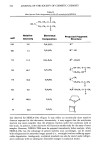
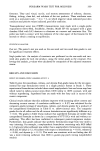
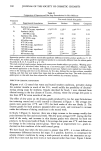
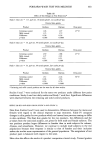
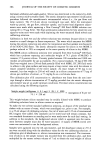
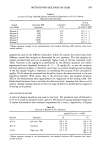
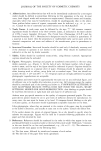
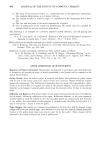
METHOD FOR SILICONES ON HAIR 389 Table II Accuracy of Using Dimethyl Siloxane Standards for Quantitation of % Si in Various Organofunctional Siloxanes %Sias Sample Calculated MW Calculated determined (neat fluids) of polymer % Si by AAS ( ___ SD)* Siloxane A 8005 35.0 35.6 + .3 Siloxane B 7980 35.1 36.2 + .3 Siloxane C 7698 36.4 36.3 + .3 Siloxane D 8059 34.7 33.4 -4_-_ .3 Siloxane E 30480 41.3 35.3 + .3 Siloxane F 7630 36.7 36.8 -4_-_ .3 * Means represent averages of two determinations, and standard deviations (SD) represent only instru- mental variation. prepared by each of two different researchers. Table III contains the results from three different treated hair samples as determined by two operators. The hair samples in- cluded untreated hair and two increasingly higher levels of silicone treatment (with TSA). Variation in the mg/kg Si as determined by the different operators was within experimental error (standard deviation of +/- 30 mg/kg Si), as was the variation between replicate samples. It should be noted that an accurate weighing and recording of the hair sample weight is important in controlling the accuracy of the calculated Si mg/kg. The Si values for untreated hair should be close to the detection limit or the test should be repeated. With values close to the detection limit, the standard deviation (SD) of the measurement often approximates the magnitude of the reading itself. The blank should measure close to or below the detection limit, meaning that there is no Si present. Sample readings that are in this low range of detection should also be suspected of having no Si present. APPLICATIONS OF METHOD A series of siloxane emulsions was used to treat hair. The emulsions were all diluted to 0.25 wt % solids in deionized water, and two TSA fluids of varying polymer length and % amino functionality were evaluated (represented by x and y, respectively, in Figure Table III Precision of Method by Two Operators mg/kg Si by A.A. (+ SD)* Tress # Treatment (1) (2) K13-3 Low conc. TSA 150 + 30 140 --- 30 170 --- 30 150 + 30 K13-U Untreated 70 +- 30 60 --- 30 70 -+ 30 30 + 30 K14-2 High conc. TSA 370 + 30 380 + 30 380 + 30 * Means represent averages of two determinations, and standard deviations (SD) represent only instru- mental variation.
Purchased for the exclusive use of nofirst nolast (unknown)
From: SCC Media Library & Resource Center (library.scconline.org)